


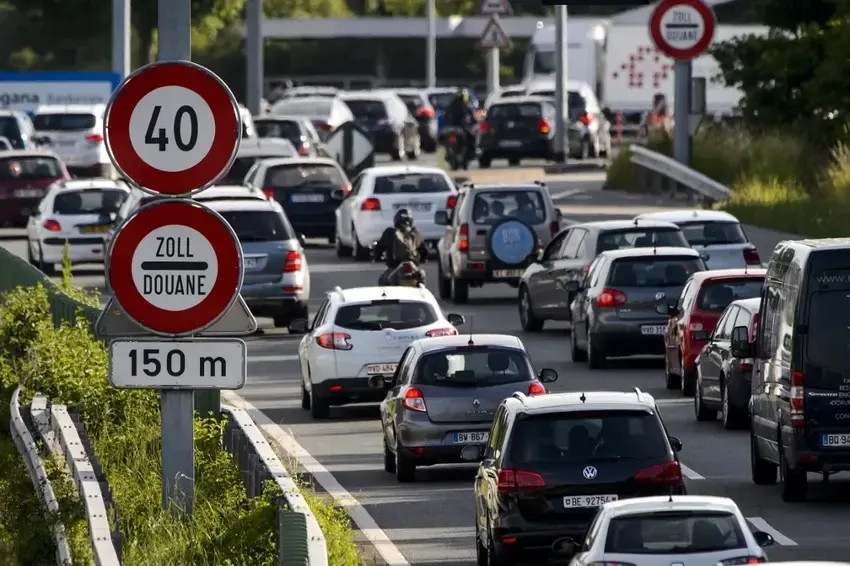
In five years, the number of employees who commute daily from neighbour countries to Switzerland has grown by 20 percent, new statistics show.
Data for the first three months of 2025 indicates that by the end of March, just over 400,000 G-permit holders worked in the country, according to a report released on May 6th by the Federal Statistical Office.
That is 62,000 more than in the same time period in 2020.
Who are they and where do they work?
More than half of the cross-border workforce — 57.8 percent — are from France, and work primarily in Geneva, but also in Vaud. (Some are also employed in two other border cantons — Neuchâtel and Jura).
In all, 114,700 foreign cross-border workers were active in Geneva at the end of March.
A separate dataset, published by Geneva’s Cantonal Statistical Office and released in January 2025, shows that the canton counted 24,835 new French new cross-border commuters at the end of last year— a figure never seen since the canton started to collect such statistics in 1989.
The vast majority of Geneva-bound workforce commute from the two French regions closest to the canton — Haute Savoie and Ain — and work primarily in sectors such as restaurants, healthcare, retail, and construction.
READ ALSO: How much more do France-based cross-border workers earn in Switzerland?
Advertisement
What about other nationalities?
The next largest group of cross-border commuters (22.7 percent) are Italians, who work mostly in Ticino, with smaller numbers employed in Valais and Graubünden as well — the three cantons which share a border with Italy.
Next (proportion-wise) are Germans — 16.3 percent, who commute to Basel, and other cantons of northern Switzerland adjacent to Germany.


