

On Sunday, the Swiss could ease restrictions on their arms exports in a referendum that pits economic interests and security imperatives against the principles of Swiss neutrality and humanitarian responsibility.
In light of a deteriorating geopolitical landscape, Parliament has relaxed the Federal Act on War Materiel to facilitate exports to 36 partner countries—provided that such exports do not confer any military advantage to those nations in a specific conflict, in line with the Swiss model of neutrality.
This list includes European nations, as well as Argentina, Australia, Canada, the United States, Japan, and New Zealand.
An alliance comprising the Socialists, the Greens, and various NGOs opposes the reform, fearing it could facilitate exports to lawless states or countries at war, thereby undermining Switzerland’s credibility. The alliance has successfully triggered a referendum, with polls suggesting a tight outcome.
Supported by the right and the political centre, the reform would also allow the government to waive conditions otherwise applicable to non-partner states in the event of “exceptional circumstances.”
Furthermore, it would loosen the rules governing the onward transfer of Swiss-made military equipment by purchasing nations to third-party states.
Proponents argue that the reform is essential to maintaining the competitiveness of the Swiss arms industry and ensuring its integration into international supply chains.
‘Times of crisis’
According to estimates from the Stockholm International Peace Research Institute (SIPRI), Switzerland ranked 20th among arms-exporting nations for the 2021–2025 period.
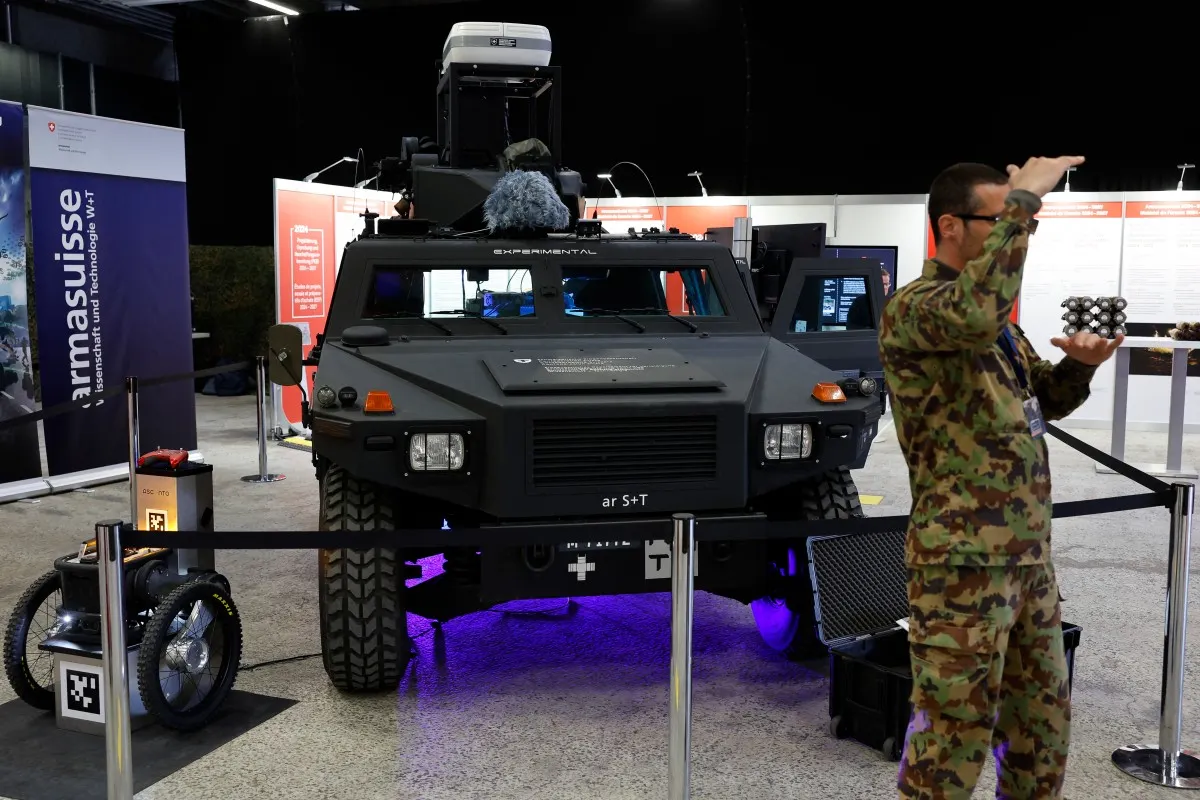
Following two consecutive years of decline, Swiss exports of war materiel surged by 43 percent, reaching 948.2 million francs. This increase is primarily due to shipments of ammunition, armored vehicles, and spare parts to Germany.
However, the sector accounts for only 0.21 percent of total Swiss merchandise exports, more than 86 percent of which go to European countries.
For Swiss President Guy Parmelin, the stakes go beyond mere economic benefits.
“In times of crisis, the arms industry primarily addresses the needs of its own country,” he explained at a press conference.
“If Switzerland wants to be assured of supplies when the need arises, it must itself offer military equipment and remain integrated into international value chains,” he added.
Around 20 NGOs, including Amnesty International Switzerland, have denounced what they call “a dismantling of the key safeguards governing Swiss arms exports.”
“Swiss weapons could more easily end up in the hands of actors likely to use them against civilian populations”—such as “in Gaza or Sudan”—warned Patrick Walder, an arms control expert at Amnesty.
Opponents also point out that the reform would make Switzerland the only country in Europe to abolish non-re-export declarations.
Ukraine
They further criticise the proposal for failing to include any measures to support Ukraine, despite requests from several European countries since the Russian invasion in 2022.
According to the Federal Department of Economic Affairs, the law of neutrality prohibits Swiss exports of war materiel to Ukraine.
“Since Switzerland enforces an embargo on military equipment against Russia, it cannot supply such equipment to Ukraine either,” the department explains.
Indirect transfers to Ukraine would also remain subject to restrictions. If Switzerland deems there is a high risk that weapons exported to one of its 36 partner countries could subsequently be transferred to Kyiv, it may require a non-re-export declaration.
“What was initially a ‘Lex Ukraine’—that’s how it was presented—has turned into a ‘Lex Arms Lobby,’ designed to send weapons in all directions—just not to Ukraine,” Lisa Mazzone, president of the Green Party, told AFP.
Opponents also view the reform as a threat to Swiss neutrality.
The Federal Department of Economic Affairs maintains that such exports to partner states must comply with… neutrality: “only exports (…) that confer no military advantage (…) could be authorised.”
“In the event of a confirmed violation, measures may be considered—ranging from the withdrawal of diplomatic support for the destination country to a total ban on the export of war materiel to the country in question,” he explained to AFP.


