


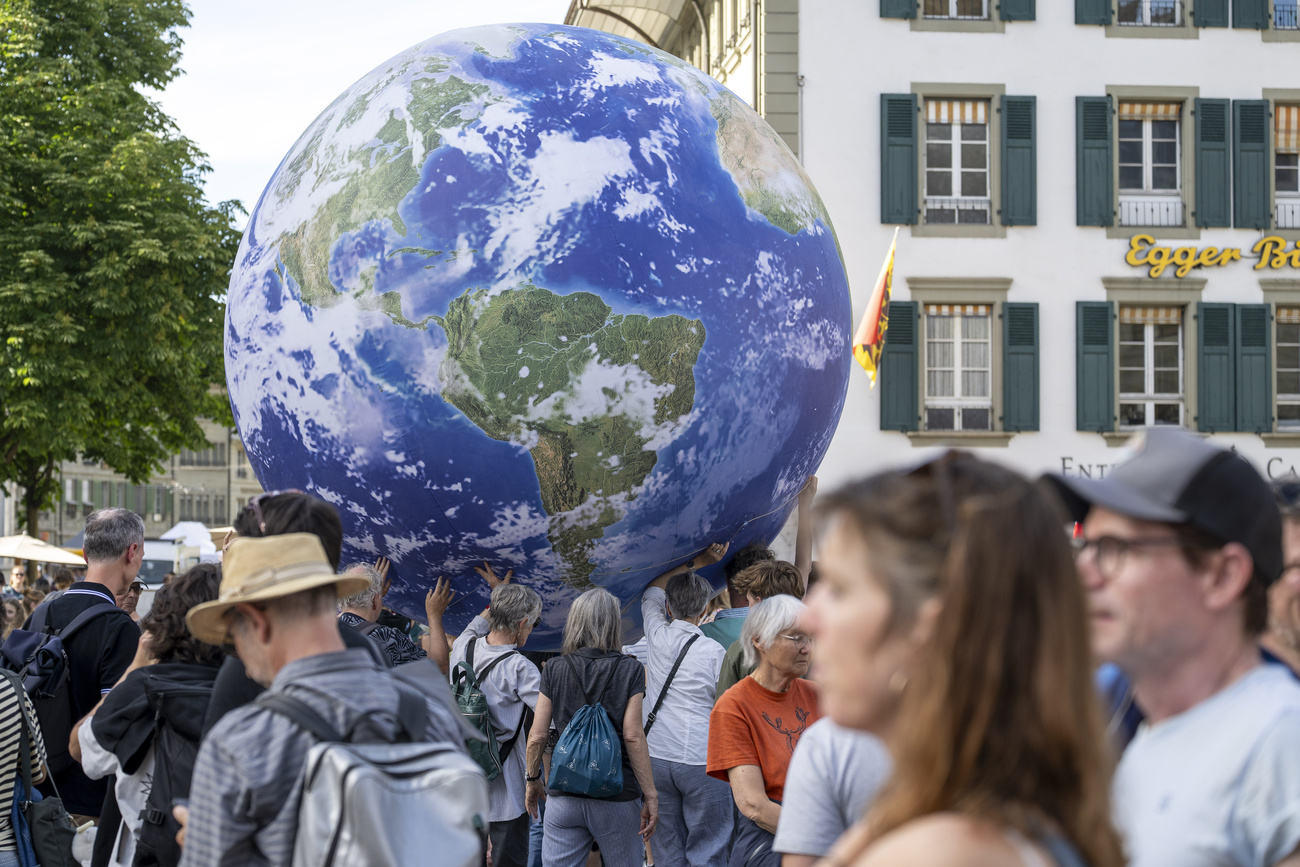
In May, the Climate Strike association organised a demonstration in Bern against the Swiss People’s Party initiative, chanting the slogan ‘Limit CO2, not people’.
Keystone / Peter Schneider
Swiss voters’ rejection of the “No to ten million” immigration initiative on Sunday has been widely interpreted abroad as a choice for stability and openness. Many media outlets around the world highlight the risks that a population cap would have posed to Switzerland’s relations with the European Union.

While the campaign had already captured the attention of the international press, the rejection of the initiative has also prompted a strong reaction from foreign media.
Many headlines highlight the unprecedented nature of the proposal by the right-wing Swiss People’s Party, which aimed to cap Switzerland’s population at ten million by 2050 by drastically restricting immigration. It’s currently 9.1 million.
“On Sunday June 14, Switzerland did not become the first country in the world to set a population cap,” notes the French daily Le MondeExternal link.
The GuardianExternal link in the UK also points out that while many countries restrict immigration, none has ever attempted to set a population cap via a referendum, which gave this vote unprecedented international significance.
More
More
Six takeaways from Switzerland’s population cap vote
A vote at the heart of the European debate
Most foreign media analyse the vote in the context of relations with the European Union. Le Monde refers to the “real relief” that the initiative’s failure represents for the federal government, which had opposed the proposal. “Had it been accepted, the government might have found itself, in a few years’, obliged to denounce a whole series of bilateral agreements linking Switzerland to the EU, with which relations are often complicated,” said the French newspaper.
The tone is similar in the Financial TimesExternal link, which says that this outcome “removes an immediate threat to the agreements between Switzerland and the EU”. The FT believes that the result of the vote should facilitate the implementation of the new package of agreements between Bern and Brussels. The project aimed at modernising relations between Switzerland and the EU will be the next major political issue in Switzerland. It will be debated in parliament in autumn, then put to a public vote, likely in 2028.
El MundoExternal link also notes that the vote had “a significant European dimension”. The Spanish daily argues that calling the free movement of people into question would have weakened relations with the EU. “The European Union remains, by far, Switzerland’s main trading partner, and a break would have created economic uncertainty and uncertainty for businesses,” it said.
Priority for the economy and stability
The German press focuses on the economic consequences that acceptance of the proposal might have had. “The Swiss people’s no to the introduction of a strict cap on the population allows the country’s economy to breathe a sigh of relief,” writes the Frankfurter Allgemeine ZeitungExternal link (FAZ). The daily highlights that Switzerland’s economic fabric is heavily reliant on skilled foreign workers and that businesses feared staff shortages as well as a loss of attractiveness.
The newspaper also highlights the risk of a gradual erosion of Switzerland’s access to its main export market. As a last resort, the initiative provided for the government to terminate the agreement on the free movement of people with the EU. “Due to the so-called guillotine clause, a number of other important bilateral agreements with the EU, which are highly advantageous for exporting companies, would have become obsolete,” the FAZ wrote.
ARDExternal link also emphasises the consequences of a possible termination of the free movement agreement. “This would have had considerable consequences for the close relations that Switzerland, a non-EU member state, maintains with its main trading partner,” according to the media outlet.
In the Arab world, the newspaper Asharq Al-AwsatExternal link sums up the prevailing view: Swiss voters prioritised economic stability and ties with the European Union. The vote is sometimes compared to a “Brexit moment”, such were its potential implications for foreign relations.
>> Our article on how the Swiss Abroad voted:
More
More
Swiss Abroad overwhelmingly reject capping Swiss population
Immigration: a persistent unease
Several foreign media outlets place the vote within the context of the global debate on immigration. The Portuguese daily Expresso External linkobserves that migration remains a sensitive issue in Europe, against a backdrop of an ageing population and rising anti-foreigner sentiment. It highlights the distinctive nature of the Swiss debate: “While in other European countries this sentiment focuses on migrants from the developing world, the majority of foreigners in Switzerland are Europeans”.
In Italy, the Corriere della Sera External linkhighlights the demographic context in which Sunday’s vote took place: “In recent years, Switzerland has experienced rapid population growth; 32% of residents are of foreign origin, a percentage exceeded only by Luxembourg and Australia among OSCE countries. The population has risen from 7.2 million in 2003 – when the free movement agreement with the EU came into force – to 9.1 million today.”
The debate is also being analysed in Russia, notably by the Russian business daily Vedomosti, which draws on expert opinion. For Vladimir Schweitzer, a researcher at the Institute of Europe at the Russian Academy of Sciences, the idea of limiting the population reflects the concerns of a section of Swiss society committed to preserving the cultural environment and a sense of security. He notes that certain fears linked to immigration are fuelled by the international context and armed conflicts in the regions from which migrants originate.
For her part, researcher Olga Trofimova emphasises that anti-migrant sentiment is also based on social and economic factors, notably competition in the labour market. She says it extends to several migrant groups, “not only migrants from Africa and the Middle East, but also Ukrainians”.
Edited by Samuel Jaberg. Translated from French by AI/ts
How we translate with AI
We use automatic translation tools, such as DeepL and Google Translate, for some content.
Each translated article is carefully reviewed by a journalist for accuracy. Using translation tools gives us the time for more in-depth articles.
Learn more here about how we work with AI.


