


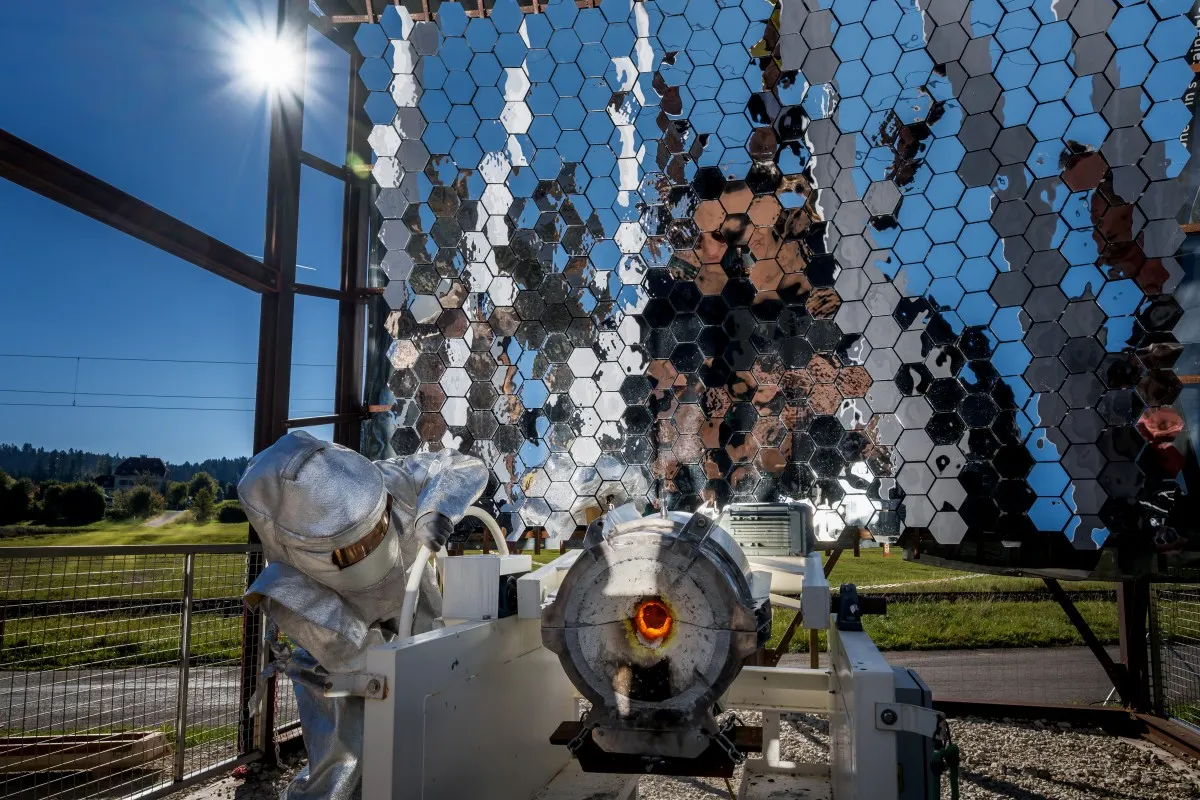
A Swiss company inaugurated two solar furnaces on Friday in a watchmaking city, aimed at melting down and recycling the key industry’s steel offcuts by using green energy.
The Jura mountains form Switzerland’s northwestern border with France, with the Swiss side home to multiple watchmaking companies and medical instrument manufacturers that use high-quality steel.
The goal is to take their production waste and melt it down into ingots using concentrated solar rays — then recirculate it to companies throughout the border region via a short supply chain.
“I’ve been dreaming of this moment for 10 years,” said Raphael Broye, the chief executive of Panatere, which specialises in transforming and recycling metal raw materials.
La Chaux-de-Fonds is the cradle of Swiss watchmaking.
Panatere will continue testing with local companies before opening a factory in 2028, either on site or in the Wallis mountains in southwestern Switzerland.
The company hopes to be able to produce recycled steel using solar energy on an unprecedented scale of 1,000 tonnes a year — thanks to furnaces where the temperature can approach 2,000 degrees Celsius.
The site inaugurated on Friday is therefore “only a step”, said Broye, who nonetheless intends to demonstrate that this solar technology is not just a concept but a process that can be used in industry.
Advertisement
Prices soaring
Some 148 scientists and professionals worked on the first prototype.
It consists of a 140-square-metre heliostat covered with movable mirrors, and a dish with a 10-metre diameter that focuses the Sun’s rays onto a crucible, where the metals are melted.
In creating these prototypes, the company had to learn how to cope with the wind moving the mirrors, Saharan dust that occasionally reaches the Swiss skies, and temperatures that can drop to minus 20C in winter and exceed 30C in summer.
“Nowadays, there is a real economic model to develop,” Broye told reporters.
“With the price levels and the scarcity of metals, we are able to find a position to make these projects profitable… even with Swiss wages,” he explained, while handling shavings of copper, the price of which is skyrocketing.
“This restores the prestige of short supply chains,” he said, with high prices leading watchmakers and manufacturers to realise that with their production waste, they have “a treasure trove round the back of their factories”.


