


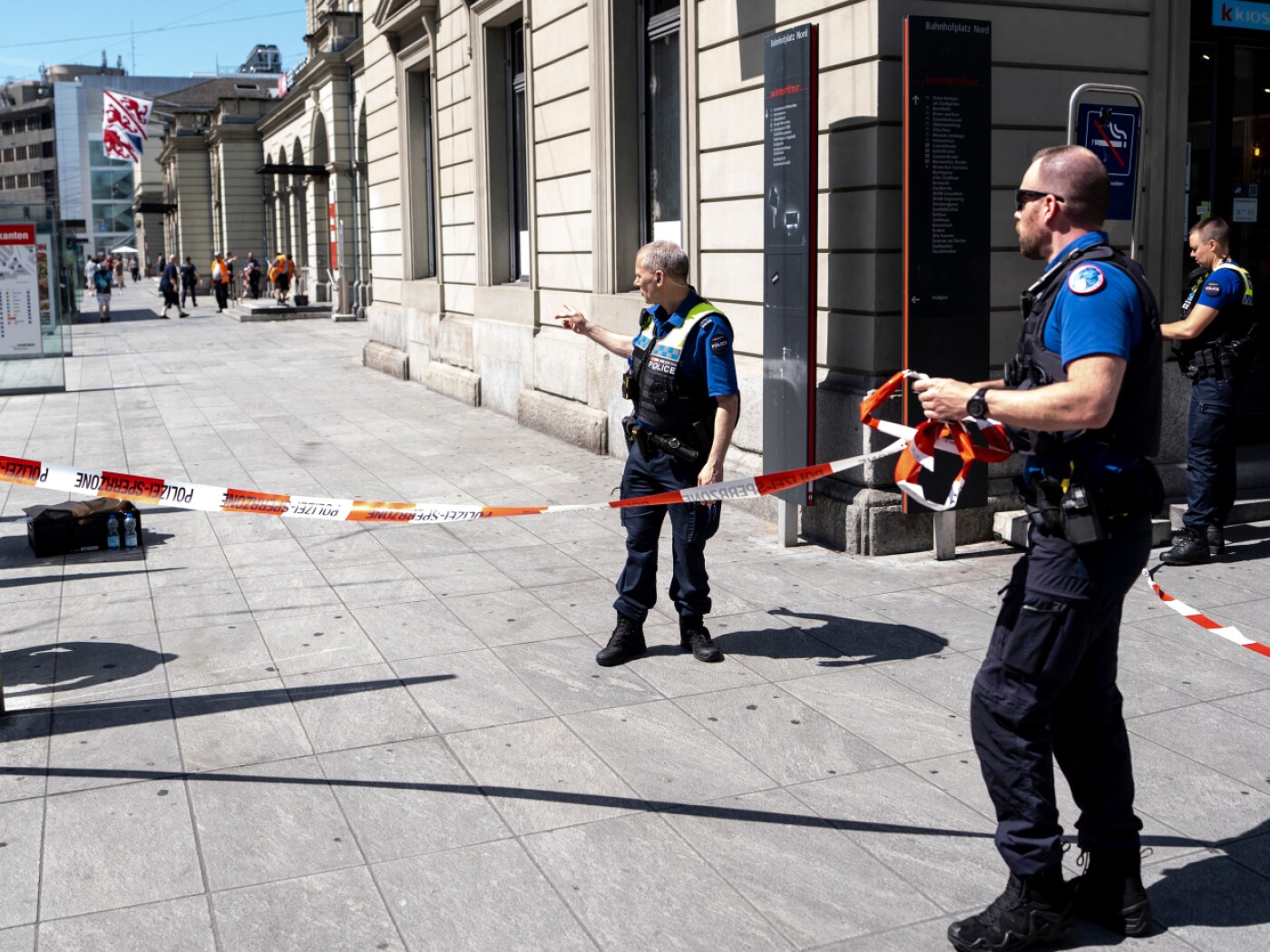
On Thursday morning, a man injured three people in a terrorist-related attack in Winterthur.
Keystone-SDA
Between radicalisation and psychological problems: Saturday’s newspapers feature views from forensic doctors and psychologists on Thursday morning’s knife attack in Winterthur.
+Get the most important news from Switzerland in your inbox
For German psychologist Ahmad Mansour, it is possible to diagnose mental illness, but not enough to detect radicalisation tendencies. “Psychological instability and ideology do not exclude each other, but coexist and reinforce each other,” he told Blick.
Mansour is critical of the clinic that discharged the 31-year-old the day before he attacked and injured three people. “I think it [the clinic] assessed the psychological situation, but not the ideological risk. To only look at one aspect is to set yourself up for failure.”
More
More
Swiss psychiatric ward launches probe after knife attack
Psychologist and criminologist Jérôme Endrass sees the situation differently. As the man showed no signs of immediate danger, the clinic let him go, he told the Neue Zürcher Zeitung. “Of course, the doctors treating the patient take into account danger to others, but they don’t carry out a risk assessment,” said Endrass, the deputy director of canton Zurich’s Office of Corrections and Rehabilitation.
Psychiatric establishments are not informed if an individual has Islamist links. This is a political choice to protect citizens, Endrass added. Clinics have no access to court documents and, conversely, police and judicial authorities do not have access to medical files.
Islamist motive?
Endrass said an Islamist motive is debatable in this case. According to currently knowledge, there are many indications that psychosis was at the forefront, reflected in the perpetrator’s behaviour.
“For the time being, it seems that this man stabbed in a very random manner, which is unusual for ideologically motivated attackers,” he said. Islamist-motivated attackers normally target symbols of the West, Jewish individuals or institutions, or other Muslims who, in their view, practice their faith badly.
More

More
How the heightened IS terror threat affects Switzerland
Prioritising treatment
Psychiatrist and forensic scientist Frank Urbaniok also has doubts that political radicalisation is at the forefront. However, he told the Schweiz am Wochenende paper, it is too early to say clearly.
Deporting the attacker, an option raised by canton Zurich’s Security Director Mario Fehr, would in principle be possible for Urbaniok, but in the case of schizophrenia, treatment must take precedence.
In psychiatric hospitals, there is an above-average proportion of patients from immigrant backgrounds suffering from serious illnesses. “This over-representation is a problem,” says Urbaniok.
No such thing as zero risk
Géraldine Casutt, who leads radicalisation prevention efforts in canton Vaud, told Le Temps that there has been a change in the profile of people coming on her radar. “We are increasingly faced with minors fascinated by violence and strongly influenced by social media,” she said.
There are always other profiles with a history of radicalisation and whose acts remain unpredictable, despite professional care, Casutt said, confirming that the line between psychiatric disorder and radical ideology is not always easy to define.
Carers and close contacts can do their best, but “there is no such thing as zero risk”, Casutt said. “A person who is not under court order has full freedom.”
Adapted from French by AI/dos
We select the most relevant news for an international audience and use automatic translation tools to translate them into English. A journalist then reviews the translation for clarity and accuracy before publication.
Providing you with automatically translated news gives us the time to write more in-depth articles. The news stories we select have been written and carefully fact-checked by an external editorial team from news agencies such as Bloomberg or Keystone.
If you have any questions about how we work, write to us at english@swissinfo.ch


