


Members of the left-wing Social Democratic Party on Sunday celebrate early projections that show Swiss voters have said “no” to the initiative to cap the population at ten million.
Keystone / Anthony Anex
Voting closed at midday on Sunday with early projections by research institute gfs.bern showing Swiss citizens have rejected the right-wing Swiss People’s Party proposal to limit the population to ten million. The civilian service reform, on the other hand, looks set to pass.


Initial projections by gfs.bern indicate voters have rejected the “No to ten million” immigration initiative by a 55% majority, compared to 45% who approved it. Meanwhile, a legislative reform designed to make civilian service less attractive is set to pass with 53% of the vote, with a margin of error of +/- 2 percentage points.
Definitive results on both vote issues are expected in the next few hours.
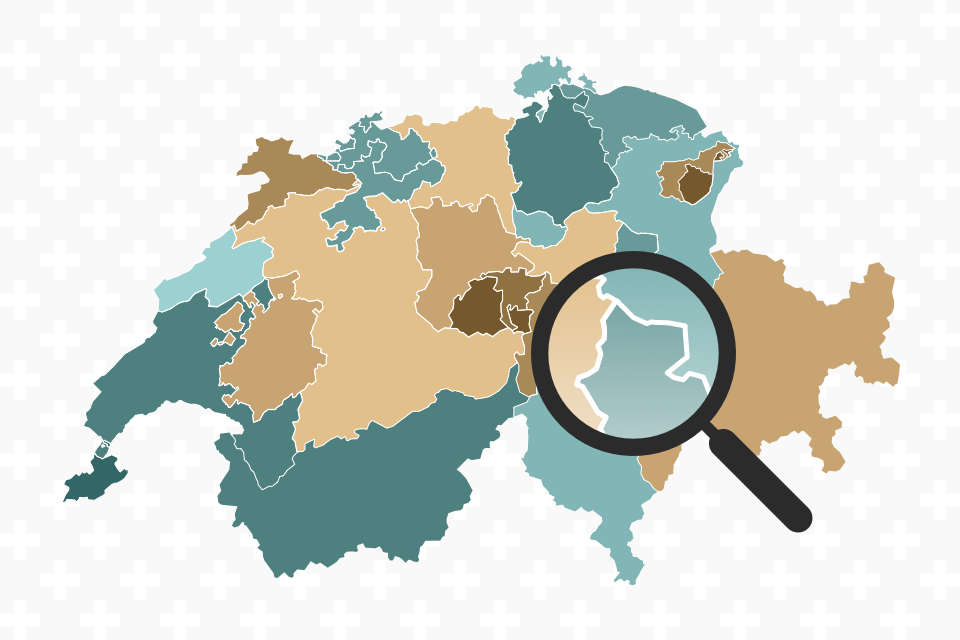
Voter turnout was high in the cities, driven by uncertainty over what a “yes” vote would mean for the economy and bilateral agreements with the European Union, said Lukas Golder, an analyst at gfs.bern. There had been a decisive rejection of the population cap initiative by French-speaking Switzerland, he added.
More
More
June 14 votes: results from across Switzerland
The People’s Party’s immigration initiative, which dominated public debate during the campaign, called for Switzerland to limit its population to ten million in response to growing pressure on the nation’s infrastructure. The People’s Party claimed that overcrowded trains, congested roads and a tight housing market could all be attributed to “uncontrolled” immigration.
The population currently sits at 9.1 million. If it reaches 9.5 million before 2050, under the initiative the government would have been forced to adopt measures to curb population growth, including restricting migrant arrivals.
>>Learn more about the “No to ten million” immigration initiative.
More

More
‘No to ten million’ vote – should Switzerland cap its population?
The government had urged voters to reject the initiative. Switzerland, it had argued, depends on immigration to address shortages in skilled labour and prop up the social security system. With the initiative, it would ultimately have to end the free movement of people agreement with the European Union, jeopardising bilateral relations with its most important trade partner. The People’s Party had argued this would be a measure of last resort under the initiative.
The initiative had divided opinion, with those on the left and in the centre of the political spectrum largely opposed, whereas People’s Party voters almost unanimously supported the proposal. The last survey before the vote, published ten days ago by gfs.bern, showed the “No” camp had a slight advantage, with 52% of respondents, compared to 45% who supported it, and 3% who were undecided.
>>What do you think: should Switzerland cap its population?
More
The “No to ten million” proposal is the latest in a line of popular initiatives put forth by the People’s Party to restrict immigration. In 2014, voters narrowly backed its “mass immigration” initiative, but the party argues it was not properly implemented.
Should civilian service be reformed?
The population cap initiative had largely overshadowed another issue on the ballot on Sunday: a reform of the Federal Civilian Service ActExternal link, backed by parliament and the government, aimed at making it harder to switch from military to civilian service.
But young people could find it harder to be accepted to do civilian service in the future. According to initial vote projections published by the gfs.bern research institute, voters could approve stricter entry requirements.
Supporters had argued that high numbers of people wanting to do civilian – rather than military – service are undermining army staffing levels at a time of heightened geopolitical tensions, particularly since Russia’s invasion of Ukraine. Their proposal aims to cut annual admissions from 7,200 to 4,000 a year.
Under existing rules, civilian service applicants must be fit for military service, demonstrate a conflict of conscience and serve one-and-a-half times longer than in the army, typically in public-interest sectors such as social services, education, healthcare and environmental protection. The reform would introduce stricter conditions, such as a minimum of 150 service days, less leeway in planning what they do and mandatory annual refresher courses.
Neck-and-neck
Sunday’s vote was triggered by a referendum against the reform which gathered 57,000 signatures under the banner “Save Civilian Service”. The campaign is led mainly by the left-wing Social Democratic Party, the Greens and the Protestant Party.
>>Read more about the referendum against the civilian service reform.
More

More
Swiss voters to decide on stricter rules for conscientious objection
Opponents argued that civilian service is vital for sectors facing acute staff shortages and warn that a 40% reduction would create gaps that cannot be easily filled. They also disputed claims that the reform would strengthen the army, noting that those unwilling to serve can still obtain medical exemptions. Critics further pointed out that the army already exceeds its legally defined personnel limits, with current numbers about 5% above the maximum threshold of 140,000.
Supporters of the proposal started with a comfortable lead but have lost ground and are now neck-and-neck with opponents. The June survey showed support at 48%, down four points from early May, with 46% opposed and 6% undecided.
Swiss citizens go to the polls up to four times a year, but not everyone living in Switzerland can vote on June 14. Only Swiss citizens over the age of 18 and not under guardianship are eligible to vote on national issues.
Voters can have their say either by postal ballot or in person at the ballot box. Those living abroad must register. A total of around 5.6 million people can vote – just under two-thirds of the country’s population of around nine million.
People living in Switzerland who do not have Swiss nationality cannot vote, despite making up about a quarter of the population.
Around half of eligible voters usually cast ballots. Over the past ten years, the annual average voter turnout has been between 41% and 57%, according to the Federal Statistical Office. In practice, this means it takes less than 1.5 million votes to win.
Edited by Reto Gysi von Wartburg/ts


