


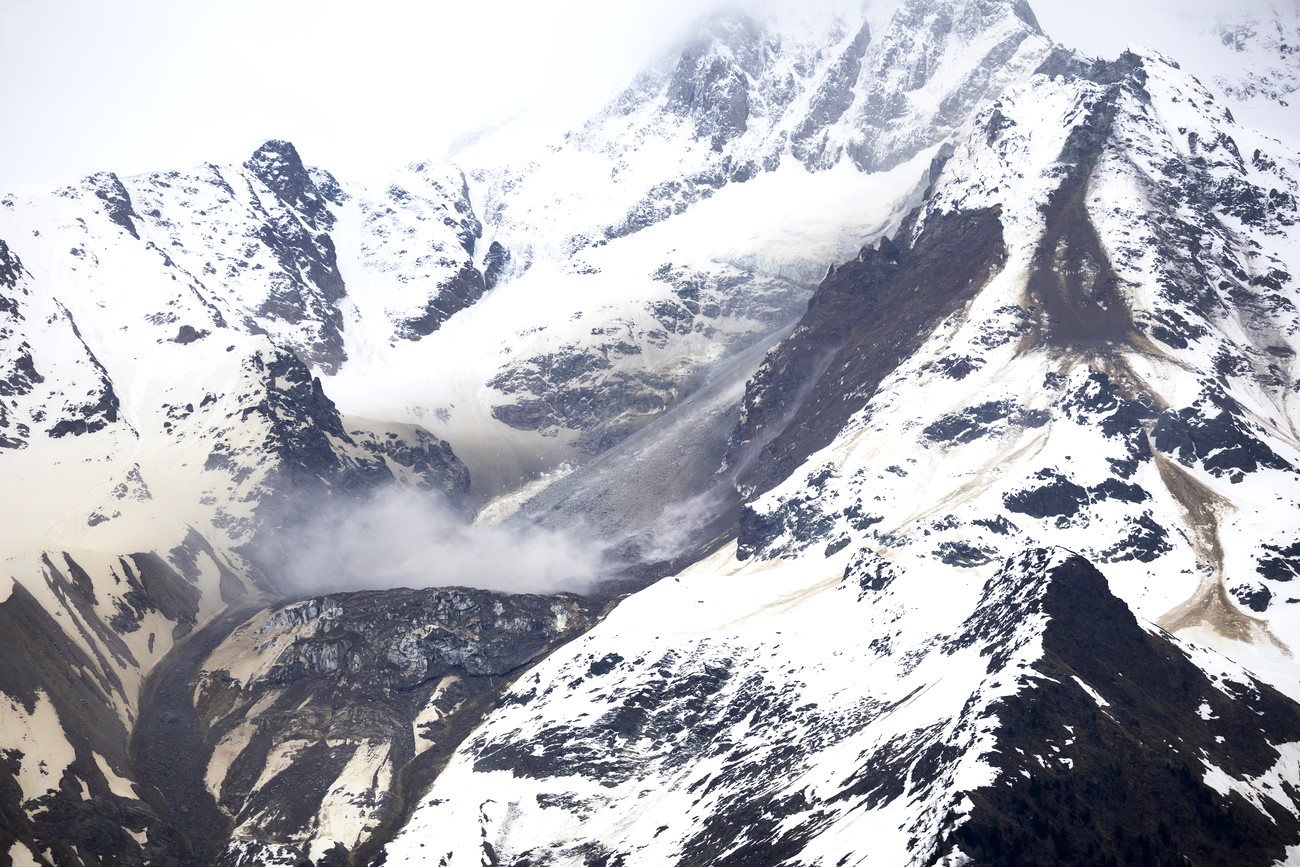
A recent view of the Oigschtchummun Glacier, near Blatten, in the Lötschental valley in southern Switzerland.
Keystone-SDA
Almost a year after the glacier collapse that destroyed the Swiss mountain village of Blatten, another ice giant in the same Alpine valley threatens to partially collapse. Authorities have stepped up monitoring but say the risk remains limited.

Glaciologists and officials in canton Valais are closely tracking the Oigschtchummun Glacier above the hamlet of Fafleralp in the Lötschental, just a few kilometres from the Birch Glacier and the devastated village. The area is largely uninhabited.
On Monday, local authorities saidExternal link satellite data and field observations had detected “isolated collapses” and other “anomalies” on the glacier in recent months. The glacier tongue has also been advancing slowly since winter, raising concerns that ice and debris could reach the cantonal road between Blatten and Fafleralp.
While the scale of the risk remains unclear, lessons from last year’s disaster have prompted intensified surveillance.
Reconnaissance flights have been carried out regularly, and on May 9 specialists surveyed the glacier using LiDAR sensors to build a detailed elevation model. A fixed camera was installed on May 13 to allow continuous observation. Authorities say the data will be analysed in the coming weeks, with a full risk assessment expected by the end of May.
As a precaution, the road between Stampbach and Fafleralp and a popular hiking trail remain closed. The restrictions affect the upper Lötschental above the former village of Blatten and could delay the planned re-opening of tourism facilities in Fafleralp in early July.
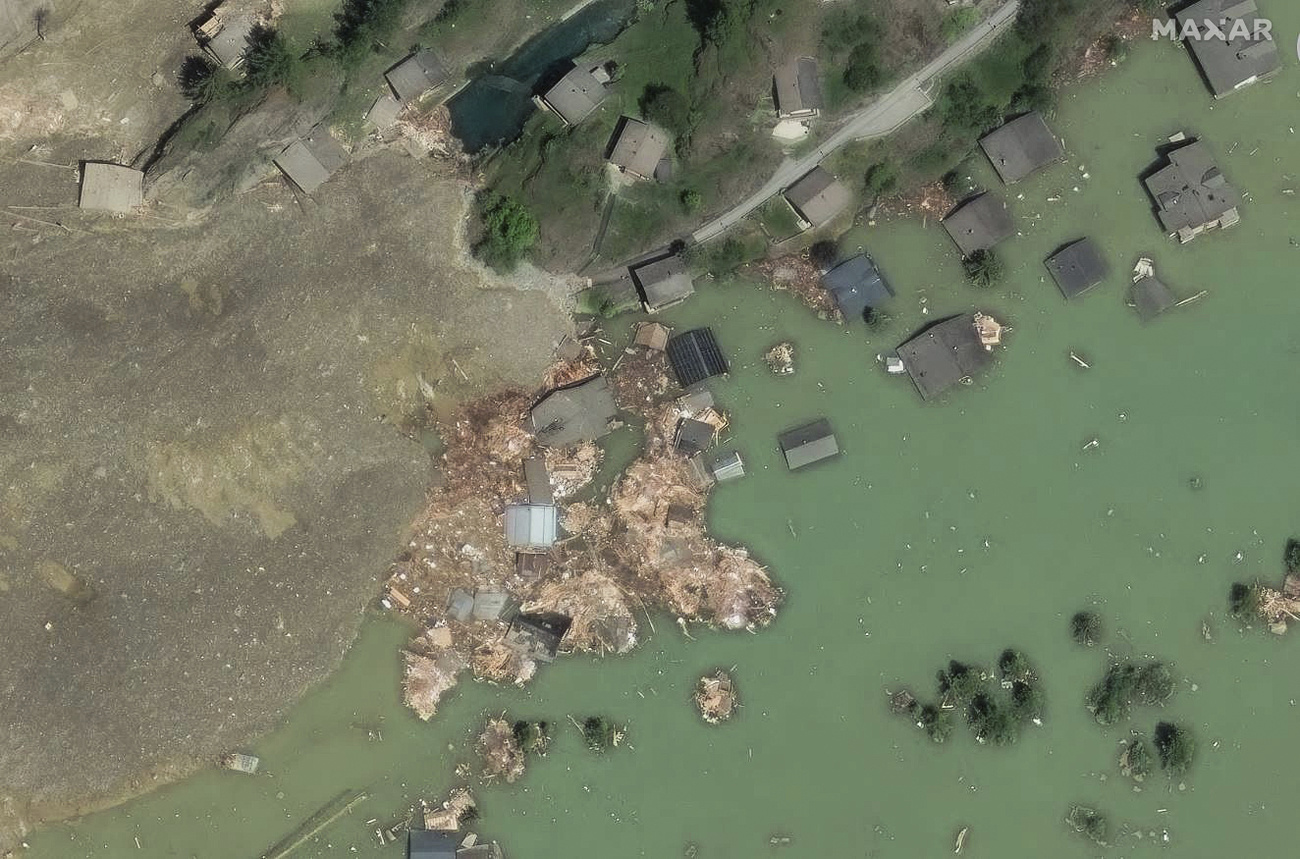
The developments come nearly a year after the catastrophic events of May 28, 2025, when the Birch Glacier collapsed under the weight of rockfalls from the crumbling Kleines Nesthorn. In 40 seconds, more than nine million cubic metres of rock, mud and ice surged down the slope at around 200km/h, engulfing the village. All 300 residents had been evacuated in advance, but one person died. The site remains largely inaccessible due to ongoing hazards.
Following the Blatten disaster, the authorities pledged to rebuild the landslide-hit village in three to five years. The plan includes a road, village square and church.
On April 28 it was reportedExternal link that work had begun on the road that will connect the village of Wiler to Blatten by the end of 2029, as well as on a temporary cable car that will link Wiler and Weissenried. A temporary emergency road has partially restored access, but it remains vulnerable to natural hazards and is impassable in winter.
Glacier on scientists’ radar
The Oigschtchummun Glacier lies south of Fafleralp beneath the Breitlauijoch ridge at around 2,600 metres (see map below). It sits below steep rock faces where erosion deposits debris onto the ice – a process scientists say is accelerating as rising temperatures and thawing permafrost destabilise mountain slopes.
The glacier has long been on scientists’ radar. During a brief period of glacier advance in the 1980s, its tongue extended more than comparable glaciers, prompting closer monitoring.
More
More
Why do Swiss mountains collapse? It’s complicated
“The Oigschtchummun Glacier bears some similarities with Birch Glacier regarding its size, exposure and slope. Interestingly, also this glacier has shown a significant increase in ice thickness at the snout starting already about ten years ago, while the upper parts of the glacier have lost thickness,” Matthias Huss, a glaciologist and director of the Swiss Glacier Monitoring Network (GLAMOS), told Swissinfo.
This is similar to the development of the Birch Glacier several years before the break-off and indicates an acceleration of ice flow speed, he noted.
Not comparable to lead-up to Birch Glacier collapse
A likely explanation for the recent advance is the gradual build-up of debris from repeated rockfalls, which adds weight and pushes the glacier forward.
“The reasons for the glacier’s advance cannot be definitively determined. It seems more likely that the increase in rockfalls, both on the Oigschtchummun Glacier and on the Birch Glacier, is decisive in explaining the advance of the glacial front,” the Valais Cantonal Natural Disasters ServiceExternal link told the Swiss News Agency Keystone-ATS.
Despite similarities, officials from the natural disasters service stress the situation is not comparable to the lead-up to last year’s disaster.
“The initial findings do not suggest a landslide on the glacier below, as was the case at the Kleines Nesthorn,” it said. “The reconnaissance flights carried out so far have not revealed any signs in this direction.”
Huss also cautioned against drawing direct parallels, noting that the Birch Glacier collapse was driven by an exceptional load of rock.
“A speed-up of a glacier can have various reasons and normally does not result in a complete disintegration,” he told Swissinfo.
More
More
The seven worst landslides in Swiss history
Christian Huggel, a glaciologist at the University of Zurich, agreed: “There are parallels to the Birch Glacier. But fortunately, the Oigschtchummun Glacier doesn’t have a mountain like the Kleines Nesthorn on its side which could load it very substantially and bring it to failure. However, given the history and characteristics of this glacier, it is very important that the authorities in Valais closely monitor it.”
Authorities say there is still no estimate of how much material could detach. Further fieldwork is needed to assess potential rupture volumes. So far, only small amounts of ice have reached the valley floor and no damage has been reported.
“Regarding the Lonza River, which flows through part of the Lötschental, there remains a slight risk that debris could reach it, but this likelihood is currently considered very low,” it added.
Edited by Reto Gysi von Wartburg/ts


