


In many countries, grids are struggling with congestion and long connection queues as renewable energy projects and large electricity users compete for access to limited network capacity.
Keystone / Christian Beutler
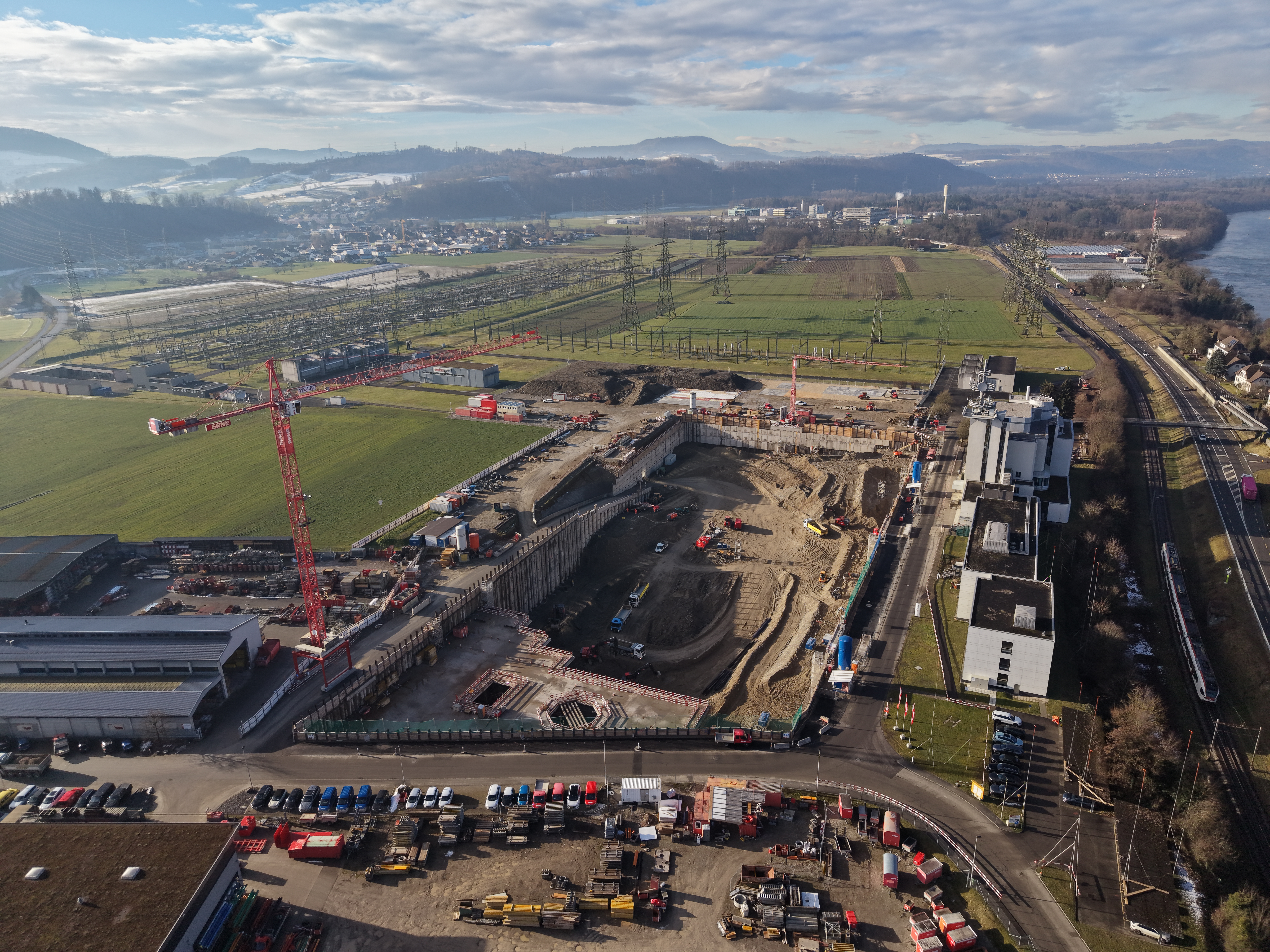
The Swiss developer of a giant underground battery system beneath a new data centre complex has given a boost to UK battery maker Invinity Energy Systems, as the quest for ways to power the AI boom steps up.
Privately held Swiss group FlexBase, which is building the complex at Laufenburg on the German border, selected Invinity for its vanadium flow batteries to provide 1.5 gigawatt-hours of storage.
External Content

This is equivalent to storing enough electricity to supply about 200,000 typical UK homes for a day, in what is expected to become one of the world’s largest flow battery installations.
Unlike lithium-ion batteries, vanadium flow batteries store energy in liquid electrolytes held in external tanks rather than in the battery cells themselves.
The battery system is intended both to smooth volatile electricity demand from AI computing and provide stabilisation services to the grid, reflecting growing efforts by data centres to present themselves as flexible power users rather than a source of grid congestion.
The Swiss battery installation could eventually expand to 2.1GWh in later phases of development, the company said.
More
More
Switzerland builds world’s most powerful redox-flow battery
Shares in Invinity rose as much as 53% following the announcement, before settling to trade at about 30% up on the day. The company, founded from the 2020 merger of two flow battery companies, is behind a demonstration project in the UK, paired with a solar array, in East Sussex.
AI systems have added huge pressure on grid capacity, driving sharp increases and fluctuations in electricity demand because of the power required both to train models and generate responses.
In many countries, grids are struggling with congestion and long connection queues as renewable energy projects and large electricity users compete for access to limited network capacity.
Invinity said vanadium flow batteries could charge and discharge multiple times a day without significant degradation and over long durations – up to ten hours in Invinity’s case – compared with the one-to-two-hour duration more typical for lithium-ion batteries.
Pros and cons
Chief executive Jonathan Marren recently told the FT the company was “talking to quite a number” of data centre operators interested in vanadium flow batteries. A low fire risk compared with lithium-ion batteries was also a consideration for systems placed beneath data centres.
“You would not put a lithium battery beneath the data centre because of the fire risk. You just wouldn’t get the insurance,” Marren added.
However, vanadium flow batteries remain at a relatively early stage of commercial deployment and are generally more expensive than lithium-ion alternatives, limiting adoption so far.
Their lower energy density also makes the systems bulkier and less suitable for other applications, such as electric vehicles.
More

More
How AI data centres risk straining Switzerland’s water resources
Data centres are increasingly trying to persuade grid operators that they can become more flexible electricity users in exchange for faster access to constrained power networks.
Britain’s National Grid recently partnered with Nvidia and other AI groups to test whether data centres can respond to sudden fluctuations in electricity demand. The companies said about 100 Nvidia chips were able to reduce power consumption by more than a third within a minute during simulated grid events without disrupting critical computing tasks.
Fintan Slye, chief executive of the National Energy System Operator, told the FT last month that attitudes among data centre operators were changing “because of the need for the system to have flexibility in order to be able to accommodate them and connect them”.
Copyright The Financial Times Limited 2026


