

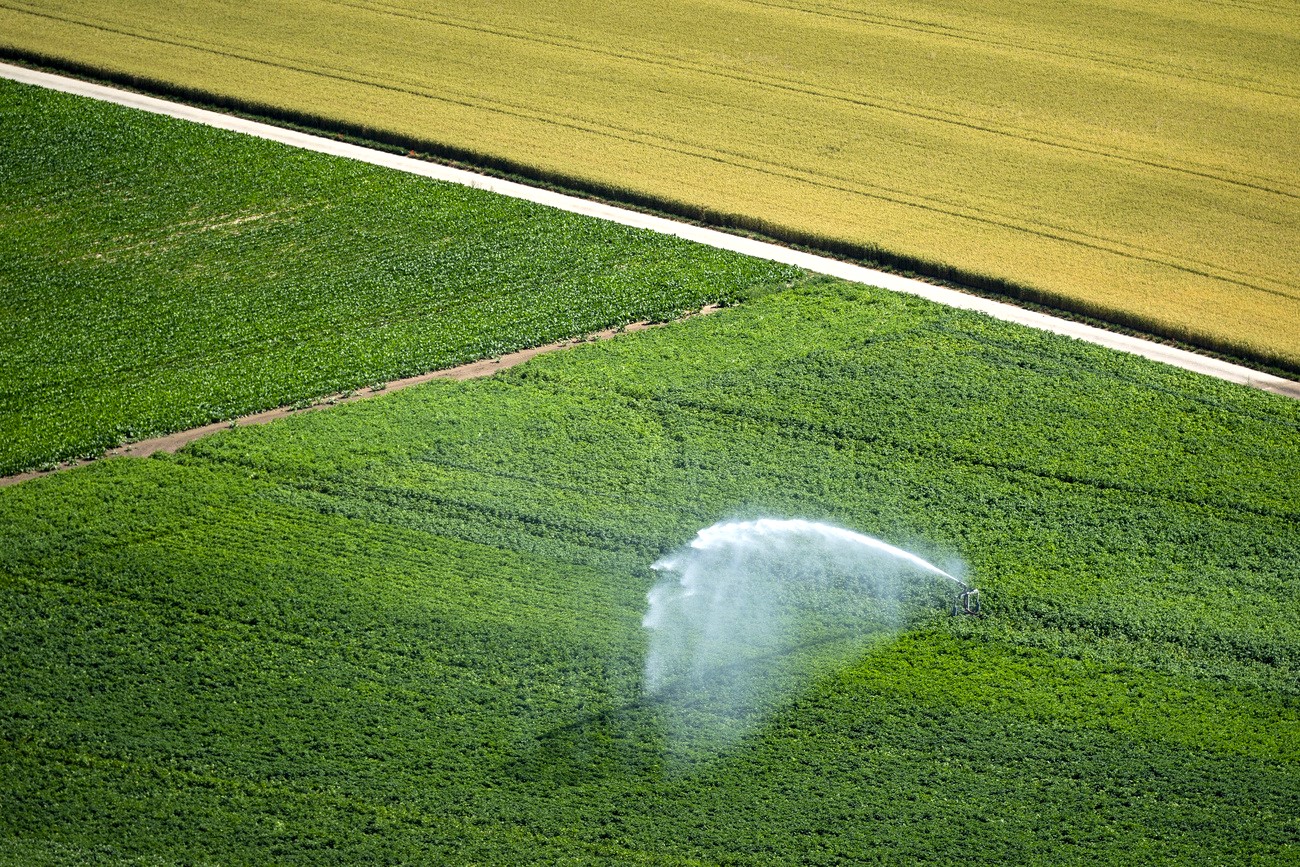
The new irrigation project aims to ensure there is enough water during droughts.
Keystone / Til Bürgy
This year’s drought has placed Swiss agriculture under severe pressure. In canton Bern, a new 90-kilometre network of underground pipes is expected to secure water supplies for almost 200 farms.
The Bernese Seeland region in the northwest of the country is preparing for one of Switzerland’s largest irrigation projects. Costing around CHF15 million ($18.6 million), it will combine underground pipelines with electric pumps to deliver water across some 1,700 hectares of farmland.
The region’s existing irrigation system relies on a network of canals between lakes Biel, Murten and Neuchâtel. But the infrastructure is increasingly struggling to meet demand.
“Our canal system was designed primarily to ensure water drainage,” says Aurelia Marti of the Ins-Gampelen-Gals land consortium.
While the canals have been used for irrigation for years, farming conditions have changed dramatically. Hotter, drier summers and rising quality standards mean crops require far more frequent watering than they did in the 1970s.
The solution is a closed underground pipe network. Instead of drawing water directly from canals with mobile diesel pumps, farmers will receive water through fixed pipelines connected to collection points on their land.
The system will also expand distribution capacity. “Farmers will be able to irrigate simultaneously during periods of peak demand,” Marti says.
Water will be sourced from the River Broye and the Zihl Canal. Even at maximum capacity, withdrawals would represent only around 2% of the waterways’ average flow, according to the consortium.
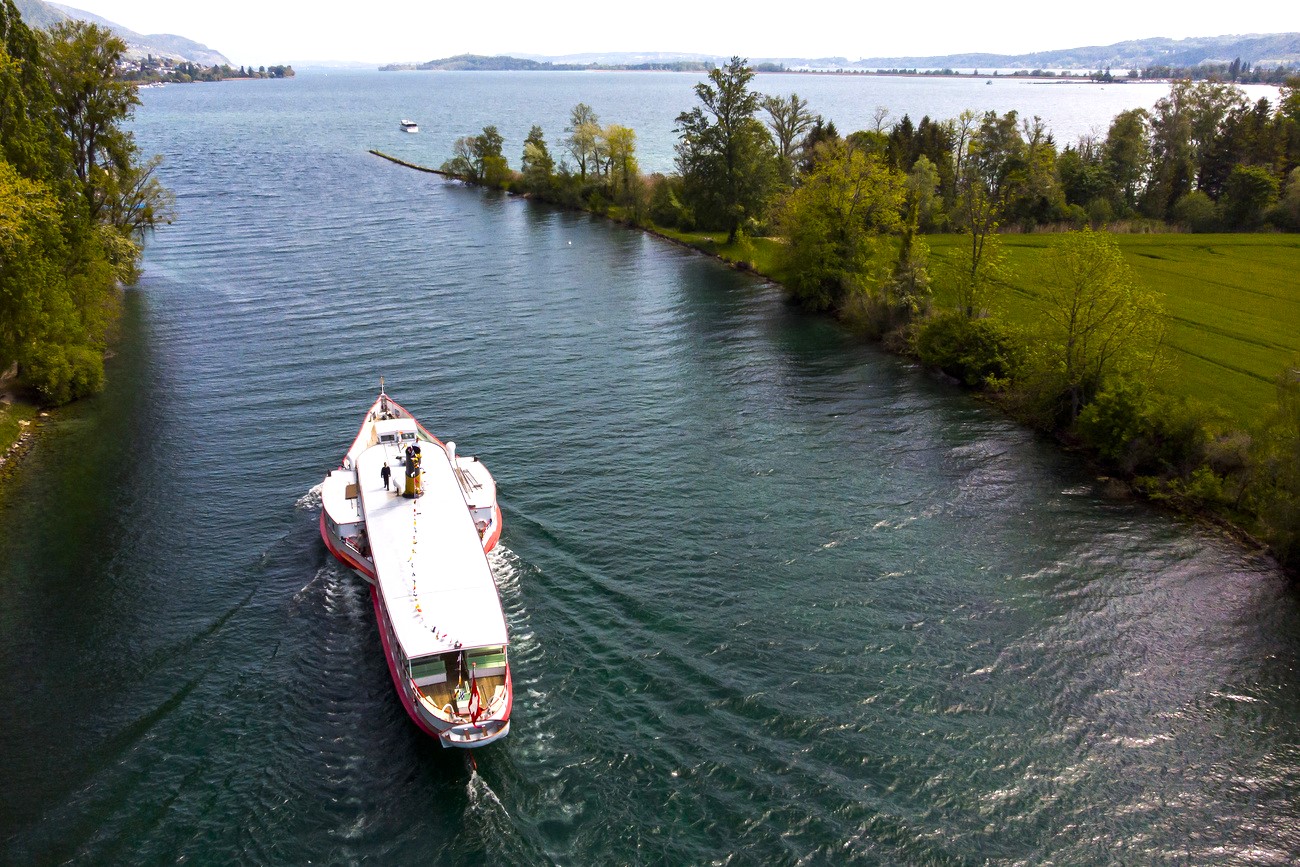
The Zihl Canal connects Lake Neuchâtel and Lake Bienne/Biel.
Keystone / Jean-Christophe Bott
Water still needs to be used sparingly
The project will be financed jointly by the Swiss federal authorities and landowners, mainly the municipalities of Ins, Gampelen, Gals and Vinelz.
Marti says the system should also reduce water wastage. As the maintenance and management of the network incur costs and every cubic metre of water must be paid for, farmers will have every incentive to use the resource as efficiently as possible.
A similar initiative, ArroBroye, is being developed for the Broye region spanning cantons Vaud and Fribourg. The project foresees a 150-kilometre pipeline network transporting water from Lake Neuchâtel to more than 170 farms, helping agriculture adapt to increasingly frequent droughts.
The dry summer of 2026 has underlined the need for the agricultural sector to prepare for future droughts. A similar project of comparable scale has been in the planning stage in cantons Fribourg and Vaud for several years.
Towards a quieter future
The Bernese Seeland project also aims to eliminate noisy diesel pumps in favour of electric ones.
This will not only reduce CO₂ emissions from local food production and improve its environmental footprint but also reduce noise for both farmers and nearby residents.
Vegetable grower Ueli Kirchhofer, from Ins, welcomes the plans. “Thanks to electric pumps, we will no longer depend on fossil fuels that we have to import,” he says.
Kirchhofer would also like to see solar power integrated into the system, although the consortium says this is not planned in the first phase.
If everything goes according to plan, the project will go out for public consultation in early 2027. Construction is not expected to begin until the end of 2028 at the earliest, with completion scheduled for 2035.
Translated from German and sub-edited by lj/sb
