


Swiss researchers are active in designing next generation semiconductors
Nikolai Kuznetsov (EPFL)
The United States, China, France, India and Saudi Arabia are among the countries pouring billions into their national semiconductor industries to gain a competitive edge in manufacturing chips. Switzerland, however, is pursuing a different strategy, steering smaller sums towards scientific research rather than subsidising the country’s small high-tech private sector.
+Get the most important news from Switzerland in your inbox
Semiconductors are one of the world’s most critical growth industries. Chips power not just computers and artificial intelligence (AI), but also medical devices, energy and food production, transport, factory machines, telecommunications and a host of other electronic devices.
Global demand for chips is on track to double between 2022 and 2030, according to a 2022 European Union study of the sector. Annual industry revenues are expected to reach $1 trillion by 2030, according to multiple forecasts by McKinsey, PwC and others.
+ Switzerland risks exclusion from Europe’s ‘CERN for AI’
Switzerland is by no means an international semiconductor titan, but it has nevertheless carved a solid niche in research, as well as in the production of high-end specialized chips and the equipment needed to make them.
More

More
Artificial intelligence explained
This includes specialists in the field of sensors, lasers, vacuum valves and thin film coating systems that are vital in the production of semiconductors.
Small niche industry
Switzerland employs between 15,000 to 20,000 highly skilled workers to produce chips for watches, transport, GPS systems, mobile phones, electronic goods, wind farms and photovoltaic systems – mainly for export. By comparison, the US Semiconductor Industry Association forecasts its labour force to grow from 345,000 employees to 460,000 by 2030. More than 50,000 semiconductor workers are employed in in France and around 30,000 in Britain.
According to the data research company Statista, the expected $1 billion in semiconductor revenues this year would give Switzerland a tiny global market share of 0.13%.
+ Why China’s approach to AI intrigues Switzerland
“Switzerland’s semiconductor industry faces a stark reality when comparing production capacity to global leaders, mostly through massive scale disadvantages, raw material logistics and investments,” said industry group DigitalSwitzerland.
International competition is heating up as countries seek to carve larger market shares and ditch reliance on other nations for the supply of semiconductors.
This trend has been given further impetus by US restrictions on chip exports to prevent other countries, chiefly China, from challenging its current domination of the semiconductor and AI industries.
The administration of former US President Joe Biden left Switzerland out of a list of preferred countries that could receive unlimited supplies of US-produced chips. Even though Donald Trump has ripped up this export control system, there are still unresolved doubts about getting full access to US chips.
+ Switzerland caught between US-China race for AI dominance
To help boost domestic semiconductor growth, the US CHIPS Act (2022) has pledged $53 billion (CHF43 billion) in federal funding, China has set up a $47.5 billion fund and the European Chips Act has earmarked a budget of €43 billion (CHF40 billion). Billions more have been pledged by other countries to boost their semiconductor and AI capabilities, including Britain, India, France and Saudi Arabia.
No state subsidies
The Swiss government has so far abstained from subsidising private companies in the semiconductor sector either with tax breaks or by building infrastructure. This is in keeping with its preferred policy of leaving private enterprises to compete in their respective markets.
“Switzerland may not replicate Silicon Valley’s fast-paced, profit-driven model, but does it really need to?” Patrik Wermelinger, of the Swiss export facilitator Global Switzerland Enterprise, wrote in a March article in EPFL’s Dimensions magazine.
Federal funding is instead focused on scientific research conducted by universities, the Swiss Centre for Electronics and Microtechnology (CSEM) and other institutions.
This includes the Alps supercomputer, unveiled in 2024, which required an initial investment of around CHF100 million and incurs annual operating costs of CHF37 million. It underpins some of Switzerland’s leading research into semiconductors, led by the Federal Institutes of Technology in Zurich and Lausanne (ETHZ and EPFL).
Swiss semiconductor research suffered a blow in 2021 when Switzerland was partially frozen out of EU research projects following the breakdown of talks on upgrading the terms of bilateral relations.
In 2024, the State Secretariat for Education, Research and Innovation launched a CHF33.8 million three-year initiative, called SwissChips, to help plug the research gap.
“With this transitional measure we will make sure Switzerland stays at the forefront of chip design and semiconductor research,” said SwissChips head Christoph Studer, a professor of integrated information processing at ETHZ.
“We have quite a few small and medium sized companies that specialise in chip design, which need engineers. If we stop conducting cutting-edge chip research, it would be difficult to supply them with new engineers.”
Research breakthroughs
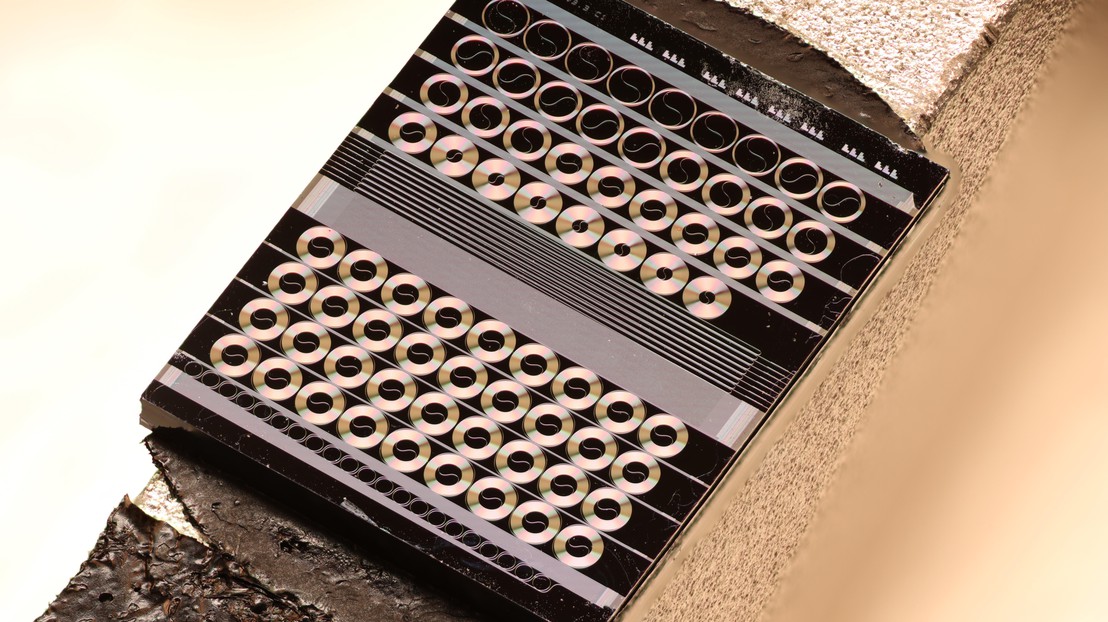
Semiconductor research in Switzerland is generating concrete results, such as an photonic chip optical amplifier innovation by EPFL and IBM that promises to boost the performance of data centres and high performance computers.
A CSEM spin-off company, CCRAFT has designed a new generation photonic chip suitable for AI data centres, the telecommunications sector and quantum technology.
Finnish chemical company PiBond has formed a strategic alliance with Switzerland’s Paul Scherrer Institute to discover and commercialise next-generation lithographic materials, which are essential for semiconductor production.
And Swiss companies also form close bonds with academic researchers. “We maintain a strong network within Switzerland and globally, working closely with leading academic and research institutions,” said Comet, a Swiss company that makes machines for testing semiconductor materials.
Some 40 companies comprise the semiconductor branch of Swissmem, the umbrella group of the electrical engineering industry. Swissmem estimates a total 160-200 semiconductor research institutions and companies, employing up to 20,000 people across Switzerland.
Here is a selection of Swiss companies that specialize in the semiconductor sector, with niche, high-end equipment.
EM Microelectronic belongs to the Swatch Group and produces semiconductors with low energy consumption, such as Bluetooth chips, for the watch industry.
Hitachi Energy produces semiconductor chips for trains, high-voltage power transmission networks, wind farms and photovoltaic systems.
STMicroelectronics is a French/Italian semiconductor venture headquartered in Switzerland.
U-Blox designs wireless semiconductors for GPS systems in the automotive and industrial markets.
VAT is a specialist in vacuum valves, which are essential for filtering out microscopic particles that can ruin a semiconductor chip.
Comet specializes in radio frequency and x-ray technology for materials testing and security inspection.
Inficon and Sensirion manufacture sensor instruments that ensure optimal production conditions by measuring gas composition, pressure and can detect leaks.
Optoelectronics company Espros and laser specialist AMS-Osram are also among the Swiss firms that contribute to the semiconductor industry.
Edited by Gabe Bullard/ac


