


More than 24.6 million people – half of Sudan’s population – are experiencing high levels of acute food insecurity, according to the IPC initiative, which tracks extreme hunger globally.
IPC’s Famine Review Committee (FRC) confirmed that famine (IPC phase 5) is present in at least five areas, including North Darfur’s Zamzam camp and parts of the Western Nuba Mountains.
The crisis is projected to expand further, with five additional areas – North Darfur localities of Um Kadadah, Melit, El Fasher, At Tawisha, and Al Lait – expected to face famine between December 2024 and May 2025.
Additionally, 17 other areas are at risk of famine, particularly those with significant influxes of internally displaced persons (IDPs). Regions affected include parts of North and South Darfur, Khartoum, and Al Jazirah states.
Prevent further escalation: UN chief
Expressing deep concern over the rapidly worsening situation, UN Secretary-General António Guterres stated that the Organization and its partners are scaling up food assistance and other essential support programmes.
However, ongoing fighting and restrictions on the movement of relief supplies and personnel continue to jeopardize aid operations, his spokesperson said in a statement.
“The Secretary-General reiterates his call for the parties to facilitate rapid, safe, unhindered and sustained access so that humanitarian assistance and staff can reach people in need wherever they are,” the statement read.
Mr. Guterres also emphasized the need for an immediate cessation of hostilities to save lives and prevent the crisis in Sudan – and its impact on neighboring countries – from escalating further in 2025.
“He also appeals for urgent international support and cooperation to bring the parties closer to a peaceful resolution of the conflict through a lasting ceasefire and step up funding for humanitarian action,” the statement added.
Most extreme human suffering
“Famine is the most extreme manifestation of human suffering, representing a catastrophic collapse of the systems and resources essential for survival,” the IPC report stated.
“It is not merely a lack of food but a profound breakdown of health, livelihoods, and social structures, leaving entire communities in a state of desperation.”
Though above-average rainfall supported agriculture in areas where security conditions allowed, ongoing conflict severely disrupted farming activities.
Farmers were forced to abandon fields, and crops were looted or destroyed, according to the report. Displaced families, particularly those in settlements and public buildings, remain cut off from the benefits of the harvest.
As a result, 8.1 million people are classified in IPC phase 4 (emergency) and 638,000 are already in phase 5 (catastrophe), adding to 15.9 million in phase 3 (crisis).
IPC phase 3 is marked by critical food gaps or reliance on crisis strategies, phase 4 involves severe malnutrition or emergency coping, and phase 5 signals famine with starvation, death and extreme malnutrition.
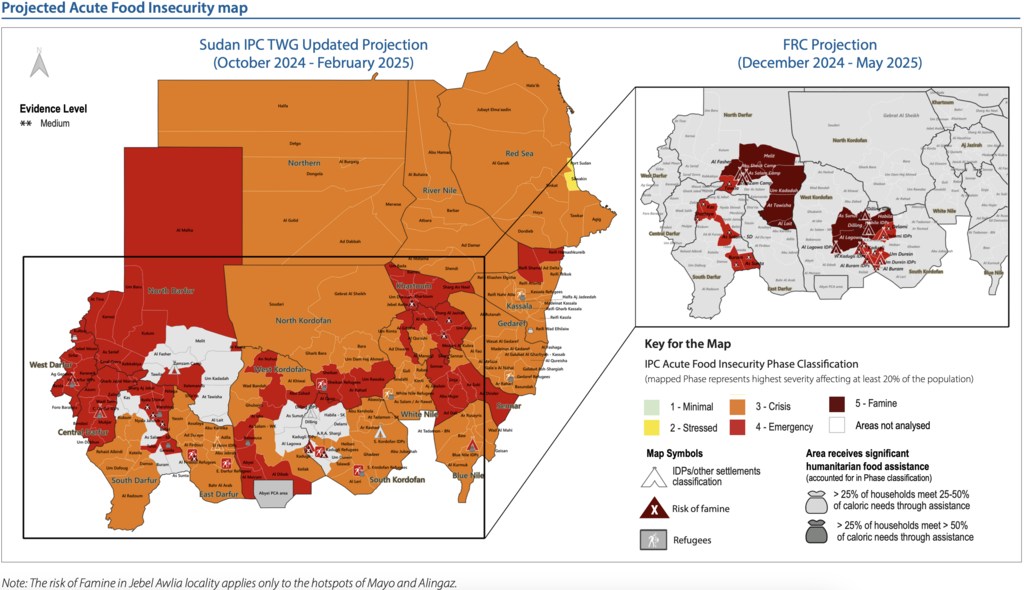
Projected acute food insecurity map.
Conflict a key driver
The brutal conflict, which erupted between rival militaries vying for power and influence last April has driven over 12 million people – nearly a quarter of Sudan’s population – from their homes, exacerbating food insecurity and overwhelming host communities.
Fierce fighting continues to rage in densely populated areas, with widespread disregard for international humanitarian law on all sides.
Civilians have been killed and injured in overwhelming numbers, sexual violence is rife, and essential infrastructure – including healthcare and education facilities – lie in ruins.
Deadly diseases such as cholera are also spreading rapidly, against the backdrop of the breakdown in essential services, including healthcare, clean water and sanitation.
Urgent recommendations
The IPC report underscored that only an immediate cessation of hostilities can prevent the crisis from worsening.
It called for the restoration of safe, unhindered and sustained humanitarian access, particularly in conflict zones, and a significant scale-up of multi-sectoral humanitarian assistance.
Alongside, it also called for scaling up treatment for acute malnutrition, providing vital agricultural inputs to help vulnerable households sustain themselves, as well as conducting food security and nutrition surveys in unassessed areas to refine response efforts.


