


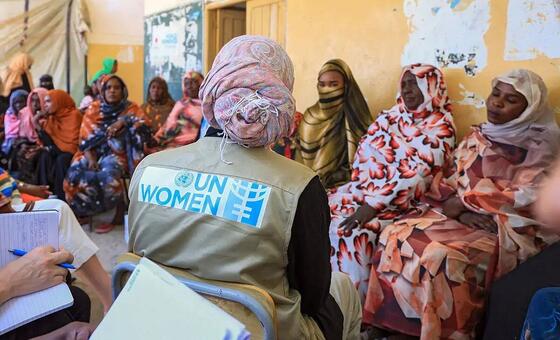
Fabrizia Falcione, UNFPA Country Representative in Sudan, briefed journalists in New York on a recent assessment based on 95 focus group discussions across 16 out of 18 states.
Roughly 1,000 women girls participated and 76 per cent of those aged 25 to 49 “reported feeling unsafe in the displacement camps and sites, but also outside the camps: in markets, water points, in firewood collection areas, roads and streets,” she said, speaking from Khartoum.
This was particularly the case at night, when going to use latrines in the camps.
“No matter where, they feel unsafe, and it’s not about a few incidents or a few locations,” she said.
Displacement, violence and danger in the dark
The conflict in Sudan has now entered a fourth year, with fighting between the Sudanese Armed Forces (SAF) and the Rapid Support Forces (RSF) showing no signs of stopping.
Ms. Falcione said the majority of women she has met in visits across the country – including in the northern states, Khartoum as well as White Nile and Blue Nile states – “have lived under shelling and active conflict for many months.”
Many have been displaced multiple times “and all of them have suffered enormous violence or witnessed violence being suffered by their families and community members.”
Furthermore, “the road to safety is actually not safe at all,” she added as women face “harassment, sexual violence, all types of physical violence, shortage of food and water, and in the areas of displacement, as I was saying, they continue to feel unsafe.”
She described visiting displacement camps, where women and children overwhelmingly comprise the majority of residents.
“The women, including pregnant women, have to walk at night inside the camps completely in the dark, trying to reach latrines with no lighting at all,” she said.
Furthermore, reporting cases of gender-based violence remains extremely difficult due to stigma, fear of retaliation, financial constraints, and distance from service providers.
What women want
Regarding what Sudan’s women need most, Ms. Falcione reported that three quarters indicated that the main priority was economic empowerment and livelihoods, while her missions confirmed that women want to return to their homes.
“They ask for three things,” she said. “Basic services and access to health; access to schools, particularly for their children, and livelihood opportunities.”
She stressed that Sudan’s women “don’t want to be fed. They want opportunities, income generation activities, opportunities to be able to feed their families and their children.”
The issue, however, is whether there will be enough financial support to meet women’s needs at a time when funding for the protection and health sectors currently stands at 14 per cent and 11 per cent, respectively.
“We keep hearing over and over that this is a protection crisis particularly affecting women and girls, it is a health crisis, and yet the funding is not following—neither the definition nor the needs that are being identified,” she said.
Safe spaces and services
UNFPA manages 88 safe spaces for women and girls across Sudan where they “find the courage to speak up, to talk about the violence that they’ve suffered, to seek help and to receive the services that they that they need the most.”
However, lack of finding makes it difficult to sustain operations.
Ms. Falcione shared the testimony of a girl, who felt safe at these spaces because she got to spend time with her friends, just like they did before the war.
“I think that this is a very important message that the world should hear,” the veteran humanitarian said, urging the international community not to abandon the Sudanese people.


