


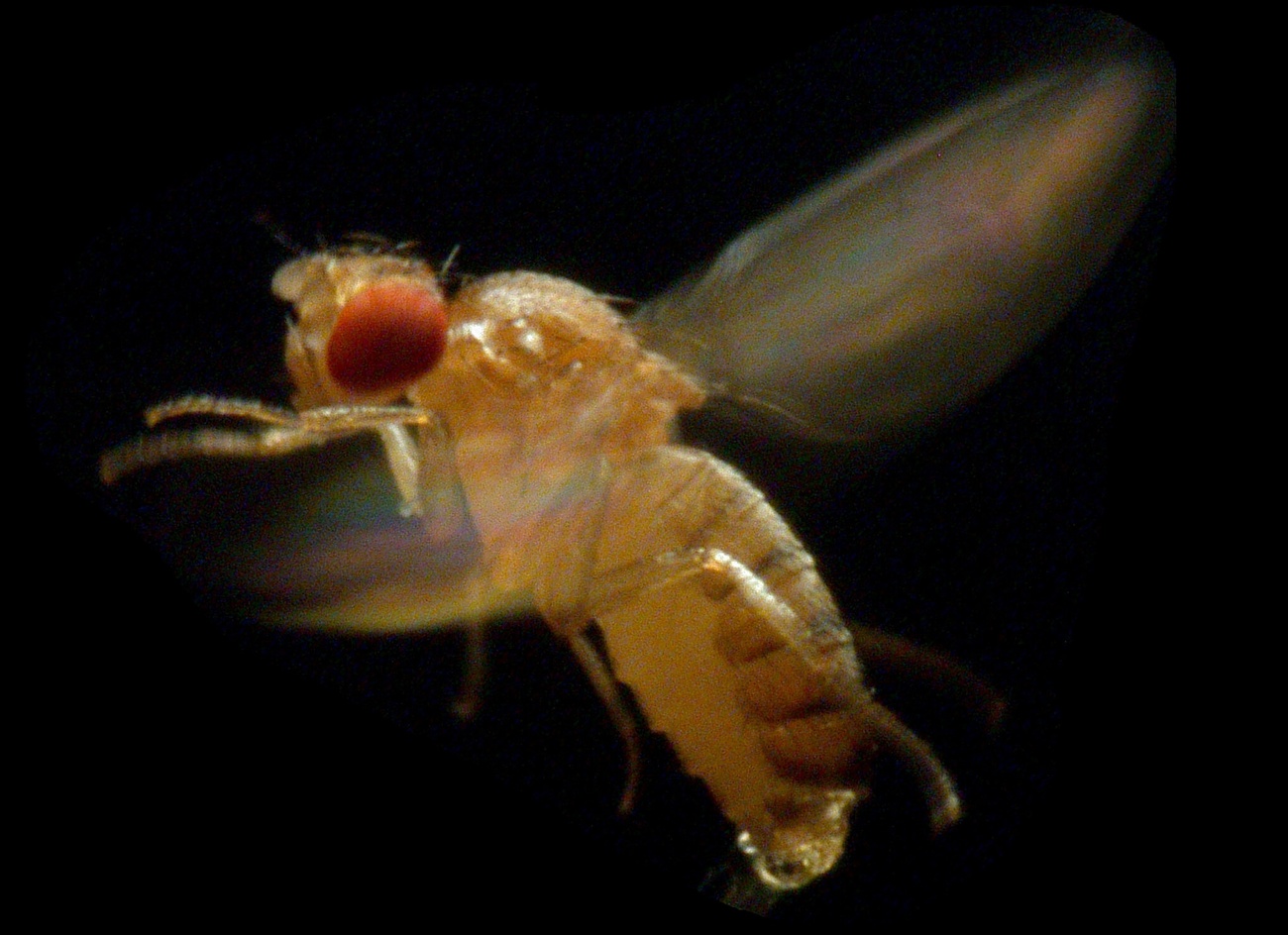
The fruit fly (Drosophila melanogaster) is inspiring robotics research in Switzerland.
KEYSTONE/STEVEN FRY
Researchers at the Swiss Federal Institute of Technology Lausanne (EPFL) are trying to replicate the brains of tiny fruit flies to create next-generation robots.
Biomimicry is a discipline that draws inspiration from nature to develop new ideas and solutions to real-world problems. From the burdock burr that led to the invention of Velcro to geckos inspiring next-generation adhesives, the list of nature-inspired innovations continues to grow. The organisms that serve as models span the animal and plant kingdoms and it’s not always the most iconic creatures that provide the most promising ideas.
The common fruit fly (Drosophila melanogaster), which seem to appear out of nowhere around ripe fruit, is often considered a nuisance. But the tiny insect is actually a favourite among scientists. Thanks to its short life cycle and genetic simplicity, the fruit fly has been a go-to model organism for over a century. Its genome has been fully sequenced, and much is known about its behaviour.
Now this humble insect is inspiring robotics research. At EPFL Professor Pavan RamdyaExternal link and his team are making groundbreaking discoveries that could revolutionise roboticsExternal link.
External Content
One of their most notable achievements has been the development of a specialised microscope that allows researchers to observe live neural activity in the fruit fly while it moves. This complex technique took years to develop but has delivered a major breakthrough: the ability to correlate every physical movement of the fly with specific patterns of neuronal activity. It’s a feat that would have been unimaginable just a few years ago.
External Content
In collaboration with other research groups, the EPFL team has also mapped the entire neural network of the fruit fly’s brain, identifying how each neuron connects to the others. These detailed insights not only deepen our understanding of the insect but also open the door to extraordinary applications in robotics.
The researchers are now working on creating a fully functional digital replica of the fruit fly’s brain, essentially a “digital brain” to serve as a control centre for autonomous robots. These machines would be designed to respond to external stimuli in real time, much like a fruit fly navigating a kitchen in search of ripe fruit.
According to Ramdya, such robots could be used to explore hostile or dangerous environments on Earth and even be deployed to other planets. The idea of insect-inspired robots aiding in planetary exploration is fast becoming a realistic prospect.
Thanks to advances in technology, biomimicry is reaching new heights, allowing scientists to apply it to even the smallest of creatures. This evolution in the field mirrors humanity’s journey from Leonardo da Vinci’s sketches of bird flight to the modern-day development of autonomous robots that may one day explore the far reaches of our solar system.
Looking ahead, Ramdya’s team is focusing on recreating the sensory structures found on fruit flies’ legs, sensors that help the insects detect and navigate their surroundings. Understanding how the flies process environmental data and make split-second movement decisions is key. Once this sensory system is replicated, it can be integrated into robots, enhancing their perception and adaptability.
In short, the fruit fly – long overlooked and underappreciated – could hold the key to the next frontier in autonomous exploration.
Translated from Italian using DeepL/amva/sb


