


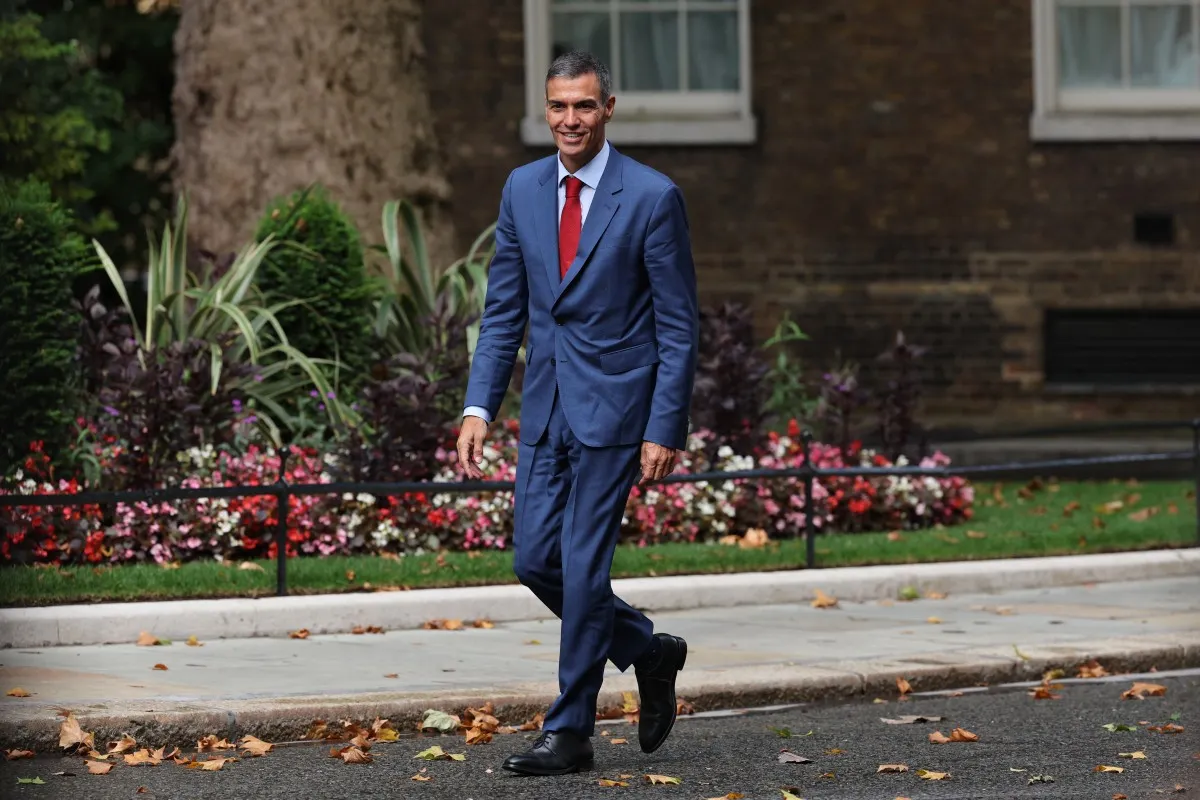
Spain’s Prime Minister Pedro Sánchez has told the international press that he will “for sure” seek re-election at the next general election in 2027, which if he were to win would extend his tenure at La Moncloa to 13 years.
Spanish Prime Minister Pedro Sánchez has stated that he intends to run for re-election in 2027, seeking what would be the Socialist (PSOE) leader’s third term.
In an interview with Bloomberg, Sánchez was asked whether he will lead the PSOE into the next general election, slated for 2027 in Spain, to which he responded: “I will do it for sure, this is something I have already spoken with my family and my party, and if they allow me I’m confident that we can repeat a majority and continue with the work.”
READ ALSO: Spain’s far-right Vox rises in the polls at expense of centre-right
Sánchez listed the growing economy and Spain’s progressive foreign policy as achievements and reasons why the Spanish left could win again. He also downplayed polling showing his Socialists falling behind the right-wing bloc of the Partido Popular (PP) and far-right Vox: “the polls are the polls” he said.
The Prime Minister also suggested that centre-right parties “are copying not only the way of doing politics of the extreme right, but also its content,” such as in migration and security policy and the interplay between them.
READ MORE: Will far-right Vox play a role in Spain’s next government?
Sánchez was interviewed in English by Bloomberg in New York while attending the UN’s High-Level week.
Elected in 2018 and then re-elected in 2023, the controversial left-wing leader has faced calls from right-wing opposition parties to resign in recent months following a succession of corruption scandals in his inner-circle and family. More extreme critics accuse him of being a self-interested ‘dictator’ and that he sullies Spain’s reputation on the international stage.
Sánchez supporters point to Spain’s growing international relevance, especially in terms of projecting a progressive foreign policy, and the country’s comparatively high economic growth rates.
A lack of intervention in the housing market is widely viewed as the major failure of the two Sánchez’s legislatures, however.
Advertisement
Following the snap general election of summer 2023, Sánchez clung to power by making deals with Basque and Catalan separatists parties. His government has not passed a budget in two years.
However, despite that, with the far-right Vox party surging in the polls and Spanish politics and society as polarised as it has been for several years, many in Spain view Sánchez as the only political leader capable of holding together a broader left-wing bloc and stopping the Spanish right from returning to power. Even within left-wing circles, no real alternative candidate has emerged.
In Spain there are no term limits on Prime Ministers. Felipe González, Spain’s third PM and perhaps the most famous PSOE leader, was in La Moncloa for 13 years and five months, the longest serving leader in Spanish democratic history.
González was first elected in 1982 and ruled until 1996.
In more recent political history, Spanish leaders have customarily served two terms.
READ ALSO: Will Spain’s PP protect foreigners’ rights if they get into power?


