


Tourists could be forgiven for gasping in horror at the first sight of the white hoods marching towards them at one of Spain’s Easter processions, argues Ilaria Grasso Macola.
For many, the first thing that comes to mind is the Ku Klux Klan, but capirotes, those eye-opening white pointy hoods, are a quintessential part of Semana Santa celebrations in Spain and don’t represent what foreign visitors think.
The KKK’s cone-shaped headwear is branded in our collective imagination as negative and has become a symbol of racism, fanaticism and violence.
Compared to the Spanish capirote, the KKK’s pointy hat is more recent. According to an article published by the Israeli newspaper Hareetz, when the Klan originally formed in 1865, members did not wear the garment, as they were “too disorganised and decentralised to wear a uniform”.
Advertisement
The group’s official uniform was introduced in the early 20th century by William J. Simmons, who re-established the KKK in 1915. Members started wearing a uniform as a way to become more cohesive and centralised.
The hoods ensured anonymity of Klansmen so that they couldn’t be recognised and held accountable for their actions.
READ MORE: The essential guide to Easter in Spai in 2025
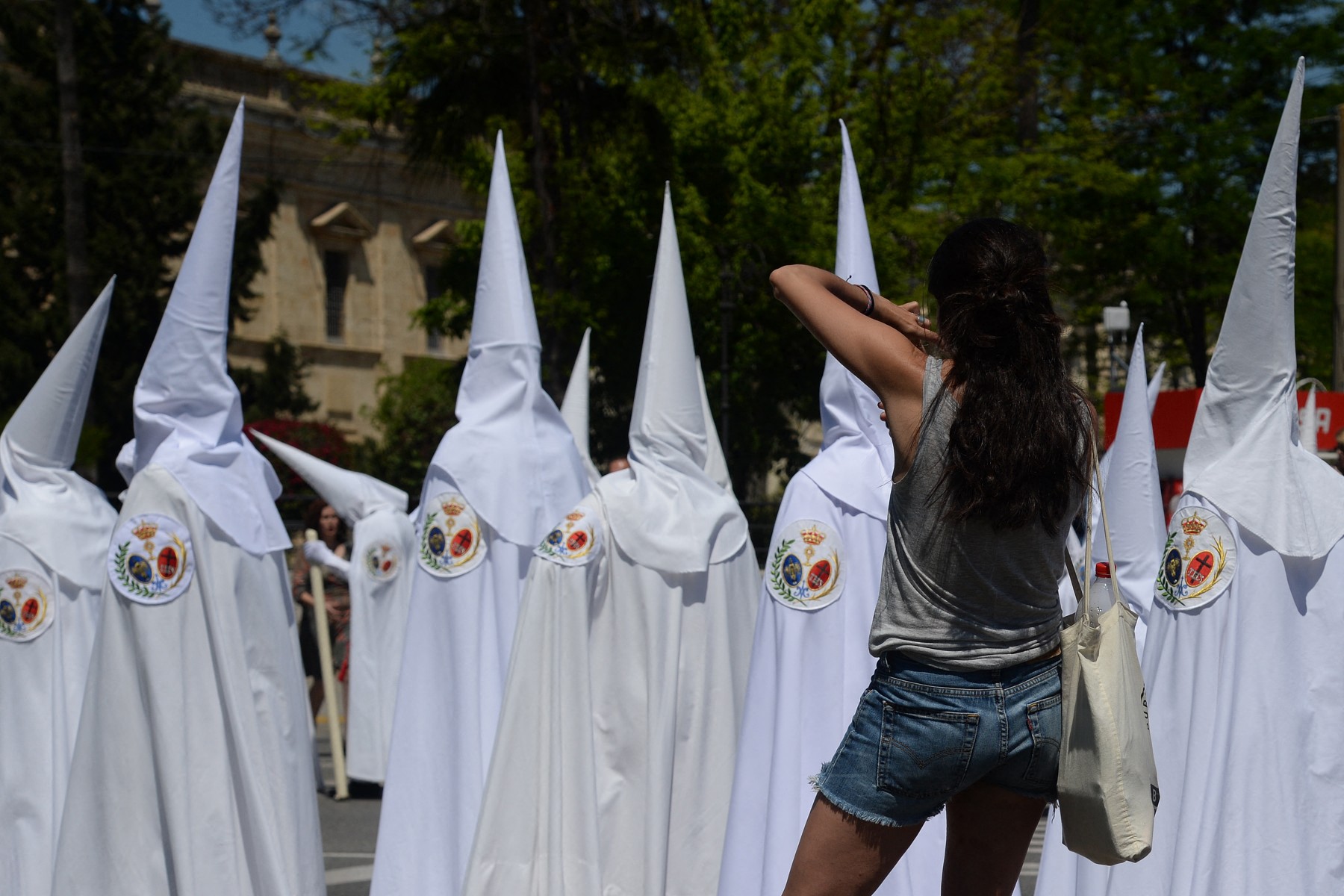
A tourist takes pictures of penitents of the ‘La Paz’ brotherhood during a Palm Sunday procession in Sevilla as part of the Holy Week. (Photo by CRISTINA QUICLER / AFP)
According to some sources, Simmons possibly decided to adopt the cone-shaped hat in order to copy the outfit present in D.W. Griffith’s classic film, ‘Birth of a Nation’. Others link the use of the pointy hat to “folk traditions of carnival, circus and minstrelsy”.
However, Spaniards don’t see anything controversial in wearing this headgear during Semana Santa celebrations.
In the week preceding Easter Sunday, Spanish cities are filled with festivities; most of them involve religious processions, where people wear traditional costumes, such as the capirote.
Traditionally, capirotes were used during the times of the Spanish Inquisition: as a punishment, people condemned by the Tribunal were obliged to wear a yellow robe – saco bendito (blessed robe) – that covered their chest and back. They also had to wear a paper-made cone on their heads with different signs on it, alluding to the type of crime they had committed.
READ ALSO: Seven surprisingly strange traditions celebrated at Easter in Spain
Centuries later, cofrades (people affiliated to Catholic brotherhoods) and nazarenos started to use them during Easter processions to symbolize their status as penitents. Today, the capirote still indicates the penitent’s attempt, through penance, to get closer to God; it also covers the person’s face, in order to mask their identity.
Whenever you see people strolling the streets of Spain wearing capirotes, you can breathe a sigh of relief, as they are not right-wing terrorists but worshippers who are doing penance.


