

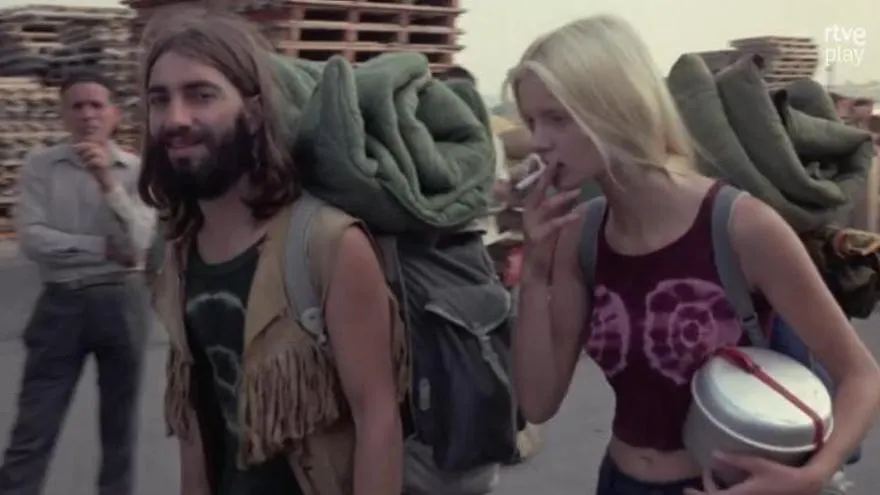
Spain’s public broadcaster RTVE has released never-before-seen footage of foreign hippies in Ibiza in the early 70s, a film reel censored by Franco’s dictatorship and which showcases how much Spanish society has changed.
RTVE is currently airing a documentary series called Los Archivos Secretos del NO-DO to mark the 50th anniversary of the end Francisco Franco’s fascist dictatorship in Spain.
NO-DO was the official newsreel of the Francoist regime which was shown before films at cinemas across the country, offering Spaniards only the news the dictatorship wanted them to see.
Whatever didn’t make the cut was consigned to oblivion in the cellars of the Spanish Film Archive.
Over half a century later, thousands of metres of censored celluloid from NO-DO are now being digitised and made available to the Spanish public, including footage of foreign hippies living in Ibiza in 1971.
The reel begins by showing a ferry packed to the brim with long-haired “extravagant characters” donning floral patterns and bell bottoms arriving at Ibiza port.
“Americans, Canadians, Australians and of course Europeans, they were discovering Ibiza as a Mecca,” journalist and novelist Víctor Amela told RTVE.
As the narrator explains, “in the late 60s and early 70s, Ibiza remained a natural paradise on the fringes of Franco’s dictatorship.”
☮️ ¿Hippies en Ibiza… durante la dictadura franquista?
¿Qué esconden estas sorprendentes imágenes que el NO-DO quiso grabar, pero no emitir?#SecretosDelNODO #LoHacemosPúblico
⭕https://t.co/eGcuDv9QhY pic.twitter.com/YPfCkx3a2L
— La 1 (@La1_tve) September 18, 2026
However, the outsiders’ “pacifist attitude, communal living and the search of universal love and happiness at all costs made the Francoist regime uncomfortable”.
Previous coverage of the hippie movement by NO-DO had been shot overseas with what’s described as “a tone that was mid-way between irony and disdain”.
“Pop festivals are all the rage among the vagabond-spririted youth of several European countries,” the voiceover of an old NO-DO newsreel quipped.
“Hippies have declared war against social obligations and jamón, enjoying instead fashionable music and a primitive lifestyle”.
The fact that Ibiza was bringing the global hippie movement to Spain wasn’t something the Franco regime wanted to make public, which explains why the reel never saw the light.
READ ALSO: Why Benidorm embraces Spain’s Franco-era mass tourism model
“What I find very interesting is that Ibiza was turned into the symbol of European counter-culture despite being an island under a Francoist dictatorship; it was an absolute paradox”, Rosa María Calaf, Spain’s first female international correspondent, explained.
“There was a lot of contrast, Ibiza was still very rural at that time, so you see how freedom and submission collided”.
Bikinis clashed with the black headscarves of Ibizan widows, but cohabitation between both groups worked quite well for the most part.
Locals would rent out abandoned houses to the foreign visitors, while the free-spirited youngsters would sell crafts and live in harmony.
There was however one incident in the village of Santa Eulalia which saw a mass hippie protest following their eviction from the homes they were renting. The police were called in and many were arrested.
“Ibiza – the island that’s now a hell for hippies” was the headline in a UK newspaper article which claimed the Spanish civil guard had acted violently against the pacifist youngsters.
READ ALSO: Spain in the 60s – Seen through the eyes of British audiences
The NO-DO reel was shot soon after this incident, increasing its likelihood of censorship even further. So why did the cameraman go to the trouble of capturing this moment in Spanish history?
“Everything was grey at that time, so to see this air of freedom – the music, the dance, the clothing – it was an explosion of freedom,” journalist Nativel Preciado journalist noted about the motives for this footage being shot.
For the modern viewer, the images reveals how conservative and cut-off Spain remained late into the Franco dictatorship, and how quickly Ibiza transformed from a traditional and rural island to a haven for jet-setters, world-renowned DJs and glitzy villas (as well as an enduring hippie movement).
Los archivos secretos del NO-DO (NO-DO’s secret files) is available to watch for free on RTVE Play from Spain but may be required you to register.
