


Tskaltubo’s Medea sanatorium, photographed in 2024
Photo: Shutterstock
Some of Georgia’s most iconic Soviet-era buildings have just gone up for sale, but prospective buyers would be advised to read the small print before signing on the dotted line.
Ten crumbling sanatoriums in the former Soviet spa town of Tskaltubo were put on the market by the Georgian government on October 20, with an online auction set to close on November 15. The town once received direct trains from Moscow, bringing holiday makers to its baths filled with warm, slightly radioactive mineral waters.
Most famous among the properties is the Medea sanatorium, whose neoclassical arches have been widely featured in Western media outlets.
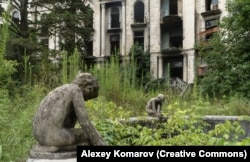
Statues in the courtyard of Medea sanatorium in 2023
Tbilisi is asking for the equivalent of $3.3 million for Medea, but the buyer must commit to a further $24 million for a renovation over five years that would result in at least 120 rooms becoming available for guests, as well as conference halls and restaurants. Other sanatoriums listed in the current auction come with similar conditions of between $1 million to $3.5 million dollars for the initial purchase, with a commitment to invest significantly more on renovations.
Frederic Le Fichoux is a commercial real estate expert who helped compile a 2020 feasibility study for the revival of Tskaltubo. The industry veteran told RFE/RL the purchase conditions of the current auction reflect the fact that restoring individual sanatoriums may not be enough to attract visitors to a town where wider infrastructure and attractions remain neglected.
“If you are one investor and you buy, you renovate that property that you bought, you turn it around,” he said, “but then the rest of the destination is still kept as a ruin.”

A theater in a partly abandoned Tskaltubo sanatorium in 2020
Le Fichoux says Tskaltubo does have commercial potential but development “needs to be kind of a joint effort between public funds to put enough effort in upgrading the access facilities like the roads, and the private sector to reinvest in the buildings to recreate an investment destination there,” he said.
Seven sanatoriums in Tskaltubo have been sold in previous auctions, but three were recently returned to state ownership, including Medea in 2024 after its buyer failed to meet unspecified contractual obligations.
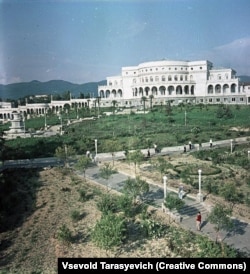
A sanatorium in Tskaltubo photographed in the 1950s
David Sichinava grew up playing among the sanatoriums of Tskaltubo and agrees his former hometown faces an “all or nothing” approach to redevelopment.
“Of course, as someone who grew up there, I would like to see the town booming again,” he said. But the Canada-based academic points to a specific detail of Georgian law that gives him mixed feelings over the potential for any economic transformation.
Georgia’s current permit laws single out Tskaltubo for exemption from permit fees for casino operators in an apparent attempt to attract investment. Such fees can cost up to $1.9 million per year elsewhere in the country.
“Balneology (the science of therapeutic use of baths) alone can’t really support the kind of tourists that this town can host,” Sichinava said.
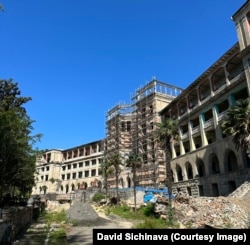
The privately owned Tbilisi sanatorium in Tskaltubo, photographed under renovation in 2023 by Georgian academic David Sichinava
Tskaltubo hit the headlines in October 2019 when Georgia’s wealthiest man and founder of the ruling Georgian Dream party, Bidzina Ivanishvili, vowed to purchase Tskaltubo’s state-owned spas and sanatoriums whose condition he described at the time as “depressing.”
Ivanishvili said he would initiate a “full-scale rehabilitation” of the crumbling infrastructure. That plan never eventuated and Georgian Prime Minister Irakli Kobakhidze, a close loyalist of Ivanishvili, told media on October 20 that those plans were scrapped due to the pandemic and what he described as “de facto sanctions” against Ivanishvili.

The interior of Tskaltubo’s Metallurgy sanatorium, photographed in 2020
Tskaltubo’s sanatoriums have served as homes for people displaced by the conflicts in Abkhazia and South Ossetia since the 1990s. Most have since moved out, and Sichinava estimates that today only around 100 to 200 internally displaced people remain in the buildings.
Madonna Mushkudiani moved into a Tskaltubo sanatorium after fleeing her home in Abkhazia in 1992. She was relocated to an apartment in the town in 2023. Although conditions in the partly derelict sanatorium were poor, she told RFE/RL that she still returns often to visit her former neighbors.
“We miss every minute we spent there. It was our second home,” she said.


