


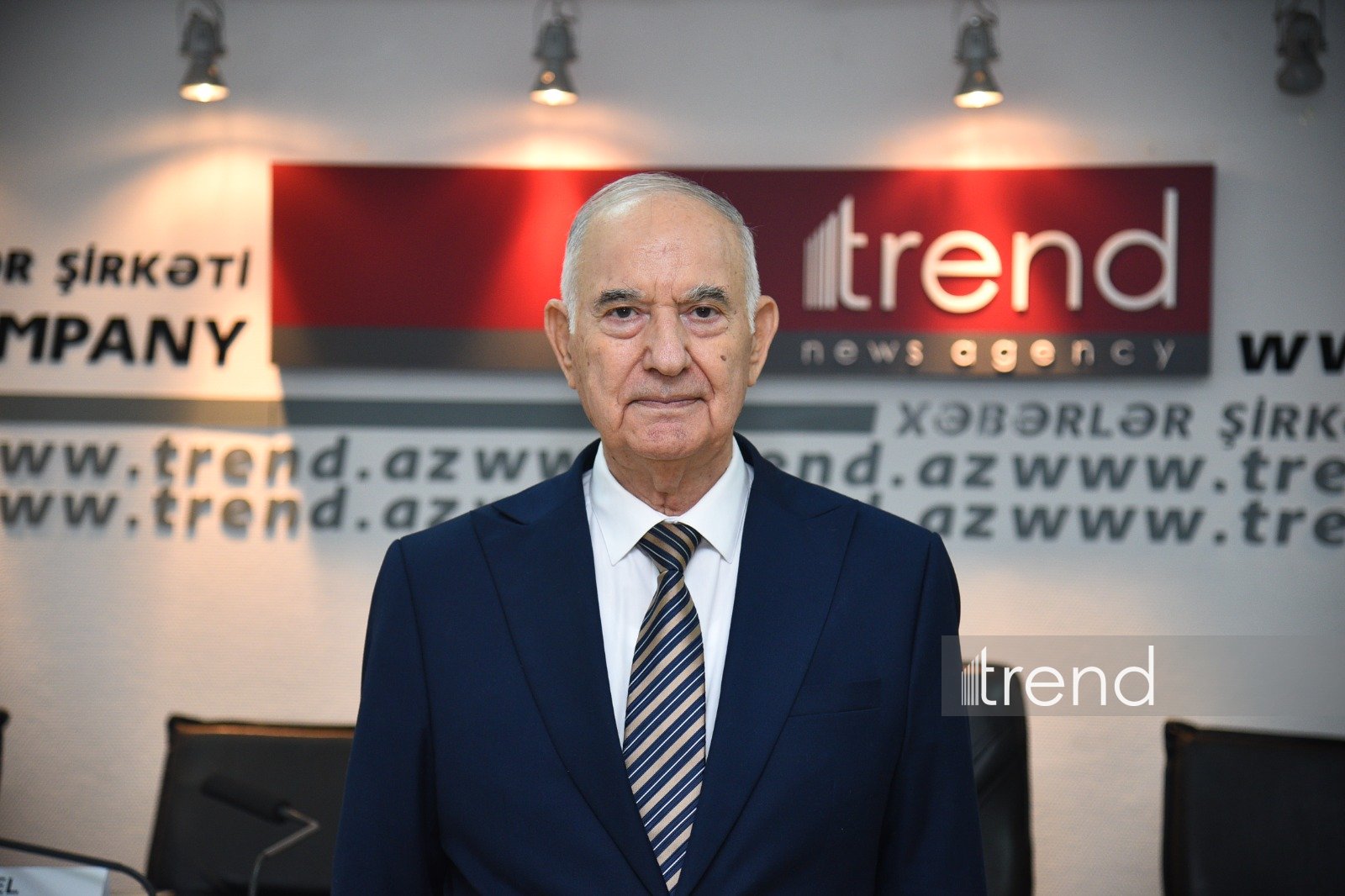
BAKU, Azerbaijan, November 9. Messages from
Shusha have demonstrated the unbreakable unity between Azerbaijan
and Türkiye, political analyst Azer Garayev told Trend.
He added that Turkish President Recep Tayyip Erdoğan’s visit to
Shusha on the occasion of Azerbaijan’s Victory Day and his joint
press statement with President Ilham Aliyev once again demonstrated
the strategic nature of relations between the two countries.
Garayev noted that against the backdrop of recent attempts to
cast a shadow on Turkish-Azerbaijani ties and create the appearance
of artificial disagreements in the fraternal relations between the
two nations, the messages delivered by the heads of state from
Shusha carry special political significance.
The political analyst said: “In reality, relations between
Ankara and Baku have a much deeper meaning than individual
political events and day-to-day discussions. These ties are rooted
in a shared history, culture, language, and spiritual values, as
well as in mutual trust that has developed over many years. And the
solidarity demonstrated by the two countries during the Second
Karabakh War confirmed that these relations are not only historical
and spiritual but also strategic in nature.
“Recep Tayyip Erdoğan’s visit to Azerbaijan on
November 8, specifically, and his tour of the territories liberated
from occupation held special symbolic significance. Six years ago,
the liberation of Shusha by the Azerbaijani army became one of the
key events that determined the outcome of the war. At that time,
Türkiye declared at the highest level that it stood with Azerbaijan
and openly demonstrated its political and moral support. Today, the
Turkish President’s presence in Shusha on Victory Day demonstrated
that this support is enduring. In his statement to the press,
Azerbaijani President Ilham Aliyev paid special attention to this
point. Recalling that Türkiye had stood by Azerbaijan from the very
first hours of the war, the head of state highlighted Erdogan’s
historic statement: “Azerbaijan is not alone; Türkiye stands by its
side.” These words hold a special place in the memory of the
Azerbaijani people. “From the very first days of the war, Türkiye’s
stance demonstrated that Azerbaijan enjoys political and moral
support on the international stage. The fact that our head of state
once again recalled this statement showed that relations between
the two countries do not depend on specific political periods and
are strengthened by shared historical trials,” he said.
Garayev noted that this is precisely where the main strength of
Azerbaijani-Turkish relations lies. These ties are built not only
on intergovernmental cooperation, economic interests, and political
agreements. A shared language, history, culture, spiritual values,
and the bond between the two peoples form the fundamental basis of
these relations. As President Ilham Aliyev emphasized, there are no
peoples or countries in the world as closely connected as we
are.
“One of the most important legal and political affirmations of
this brotherhood was the Shusha Declaration, signed on June 15,
2021. The document officially elevated relations between Azerbaijan
and Turkey to the level of an alliance. Thus, the fraternal ties
that have developed over the centuries have acquired a strategic
framework that meets the challenges of the modern era. In his
statement in Shusha, Turkish President Recep Tayyip Erdoğan
particularly emphasized the significance of this document, saying:
“The Declaration signed in Shusha on June 15, 2021, will never
achieve their goals, whether today or tomorrow, just as they failed
to do so yesterday. By the will of Allah, our unity will remain
eternally unshakable!” In doing so, the Turkish head of state
emphasized that the Azerbaijani-Turkish alliance is based not only
on historical and spiritual ties but also on firm political will.
The Shusha Declaration not only formally established the strategic
relationship between the two countries but also defined the main
directions for future cooperation.
President Ilham Aliyev, addressing the issue of preserving unity
between the two countries, delivered another important message:
“Our unity and brotherhood are unshakable. Those who seek to
undermine them will never achieve their aims; their wishes will
remain unfulfilled. We, the two peoples and, above all, the two
leaders, protect this asset and will not allow anyone to come
between us or cast a shadow over our unity, brotherhood, and
solidarity for the sake of their personal interests.” A notable
aspect of this statement is that maintaining Azerbaijani-Turkish
relations is presented as a shared responsibility of both
countries. In the President’s remarks, special emphasis is placed
on both the historical ties between the peoples and the
strengthening of interstate relations through political will. This
also reflects the two countries’ shared stance against attempts to
influence their relations from outside,” the political analyst
noted.
According to him, Turkish President Recep Tayyip Erdoğan
expressed a similar position, stating that attempts aimed at
weakening the brotherhood, which has been strengthened by allied
relations following the Shusha Declaration, will be fruitless.
Thus, the same political message came to the fore in the statements
of both leaders: the Azerbaijani-Turkish alliance has been
strengthened by the trials of the past and is grounded in a shared
determination for the future.
The political analyst emphasized that Erdoğan is also paying
special attention to the issue of Karabakh’s reconstruction.
“He highly commended the constructive work being carried out by
Azerbaijan in the liberated territories and stated that Türkiye
would continue to contribute to this process. The Turkish
President’s mention of the establishment of the Azerbaijan-Türkiye
International Forestry Training Center and the “Smart Seedlings
Enterprise” in Jabrayil, as well as the start of construction on a
school in Aghdam, demonstrates concrete results of this
cooperation. This point is particularly important, as the
Azerbaijan-Türkiye partnership is not limited to mere political
statements. The projects being implemented in the territories
liberated from occupation, infrastructure development, and
cooperation in the fields of education and agriculture reflect the
tangible results of this brotherhood. Türkiye’s participation in
the reconstruction of Karabakh is also an indicator of the desire
to make a joint contribution to the region’s future development,”
he said.
Garayev noted that Azerbaijani-Turkish cooperation goes beyond
the scope of bilateral relations and has an impact on the unity of
the Turkic world.
“Erdoğan highly praised Azerbaijan’s role in the development of
the Organization of Turkic States and stated that Türkiye will
continue its efforts to transform the organization into a stronger,
more institutionalized body. This demonstrates the two countries’
intention to develop opportunities for cooperation not only within
the context of their bilateral relations but also across a broader
geographic area. The sentiment expressed by President Ilham Aliyev
regarding the main outcome of the visit summed up all these
messages: “Türkiye-Azerbaijan unity is eternal and unshakable.”
This statement became the central expression of the visit’s
political and spiritual significance. After all, the meetings,
discussions, joint site visits, and statements made all followed
the same logic: Azerbaijani-Turkish relations are based on a solid
historical foundation and will continue to develop along the lines
of a strategic alliance in the future. Erdoğan’s visit to Karabakh
on Victory Day demonstrated once again that the brotherhood between
Azerbaijan and Türkiye, having weathered historical trials, has
grown even stronger. The solidarity demonstrated during the war
continues today in the areas of reconstruction, economic
cooperation, regional security, and the unity of the Turkic world.
The message from Shusha is clear: the common interests, mutual
trust, and fraternal ties between the two states will remain the
main pillar of their future relations,” the political analyst
added.


