

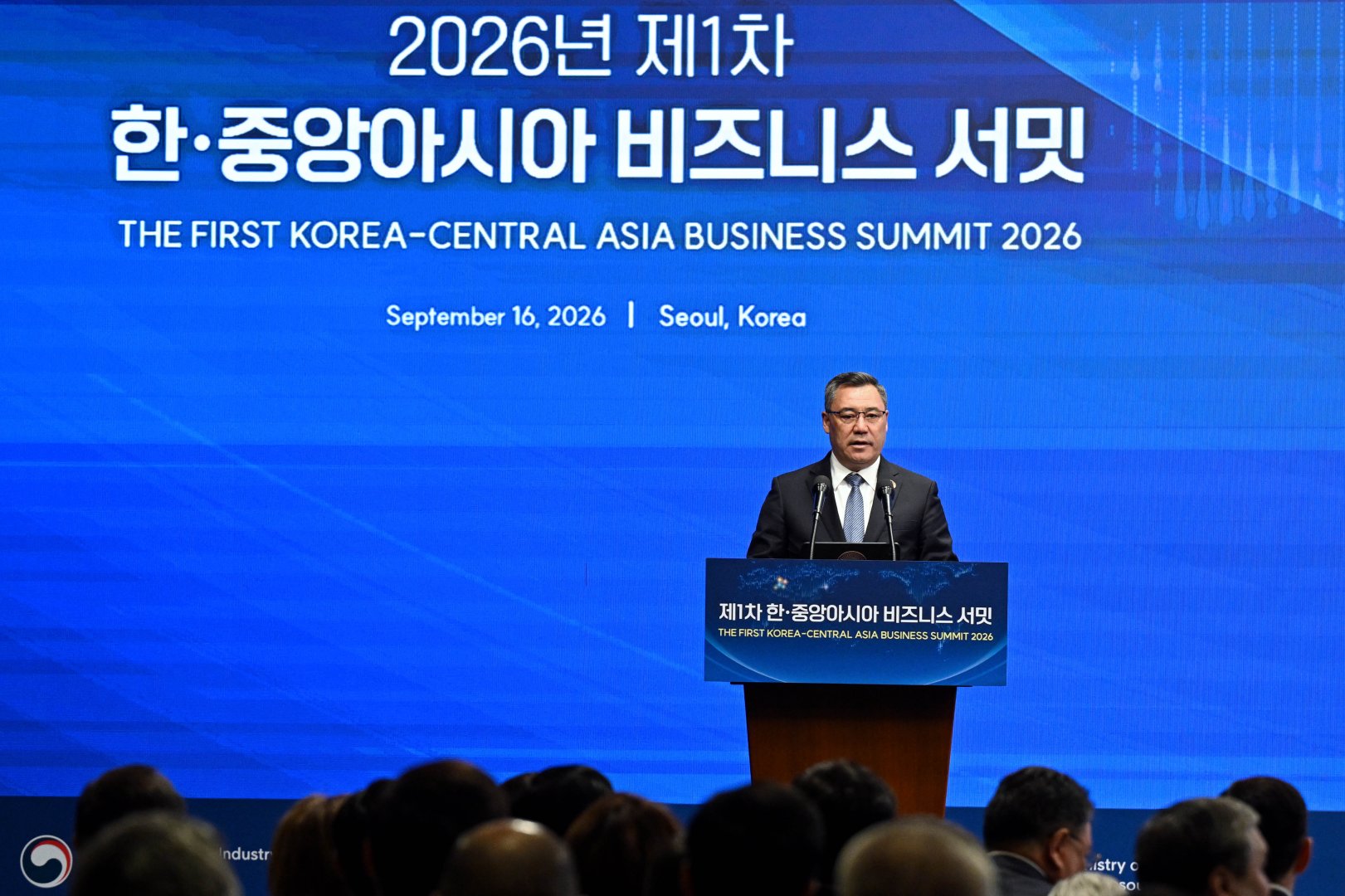
BAKU, Azerbaijan, September 17. President of
Kyrgyzstan Sadyr Japarov participated in the first Central
Asia–Republic of Korea Summit in Seoul, which elevated cooperation
between the five Central Asian countries and South Korea to the
level of heads of state and laid the groundwork for a new
multilateral format of cooperation.
The summit, chaired by President of the Republic of Korea Lee
Jae Myung, brought together the leaders of Kazakhstan, Kyrgyzstan,
Tajikistan, Turkmenistan and Uzbekistan. The discussions focused on
economic and technological cooperation, energy, transport and
logistics, critical minerals, digitalization, artificial
intelligence, human capital development and the strengthening of
regional ties.
For Sadyr Japarov, participation in the summit provided an
opportunity to position Kyrgyzstan not only as an individual
partner of Seoul, but also as part of an emerging regional economic
and technological platform. In his address, the Kyrgyz leader
emphasized the importance of translating political agreements into
practical outcomes, including investment, production, technology
transfer, and the creation of new jobs.
“Investment in the knowledge, professional skills and talents of
our citizens must become a solid foundation for technological
modernization, sustainable economic growth and the long-term
competitiveness of our countries. Political will must be
transformed into practical achievements,” Sadyr Japarov
emphasized.
Sadyr Japarov proposed reinforcing this approach through
specific mechanisms. In particular, he called for the establishment
of a Council of State Investment Institutions, the creation of a
unified portfolio of priority projects, the establishment of a
joint investment fund, as well as the development of a network of
pilot technology platforms in artificial intelligence and
digitalization. Energy, green mobility, and human capital
development were also among the key areas highlighted in his
proposals.
“The key task at the current stage is to translate the high
level of political trust into long-term economic and technological
partnership,” the Kyrgyz president emphasized.
In practical terms, Kyrgyzstan is proposing to use the new
format not only to attract South Korean investment, but also to
integrate the country into broader production, technological and
transport chains. For Seoul, Central Asia is of interest, among
other things, in terms of diversifying supply chains, energy and
critical minerals. The South Korean side also views the region as a
promising area for expanding economic cooperation.
He emphasized that by the next meeting, the Central
Asia-Republic of Korea format should demonstrate tangible results –
launched production facilities, attracted investment, implemented
technologies, and new opportunities for citizens.
In this context, Sadyr Japarov’s proposals have a broader
dimension. Kyrgyzstan has opportunities to participate in energy
and transport projects, including the Kambarata-1 hydropower
project and the China-Kyrgyzstan-Uzbekistan railway route. At the
business session held as part of the summit, Sadyr Japarov
specifically invited South Korean companies to participate in the
development of industrial parks and logistics centers along the
railway, as well as in the country’s energy projects.
Another area that Sadyr Japarov links to expanding Kyrgyzstan’s
presence within the new format is tourism and the agro-industrial
sector. In particular, he invited South Korean investors to
participate in the Ala-Too Resort year-round mountain resort
project. At the same time, the Kyrgyz side is emphasizing joint
professional training, educational programs, technology startups
and digital solutions.
The significance of the summit also lies in the fact that it is
not a one-off meeting of leaders. Following the talks, the Seoul
Declaration was adopted, providing for the regular holding of
summits every two years and the development of cooperation at the
ministerial and senior-official levels. The second summit is
planned to be held in Kazakhstan in 2028. Thus, interaction between
Central Asia and South Korea is gaining a permanent institutional
foundation.
Against this backdrop, Sadyr Japarov’s bilateral meeting with
Lee Jae Myung complemented the broader summit agenda. The leaders
discussed expanding economic cooperation, investment projects and
infrastructure. Sadyr Japarov proposed establishing a joint medical
center in Kyrgyzstan, considering mechanisms to facilitate the visa
regime and increasing Kyrgyz exports to the South Korean market.
Lee Jae Myung, in turn, noted the development of relations between
the two countries since 1992 and the importance of further
strengthening cooperation between investment agencies.
The economic component already demonstrates potential for
further growth. According to the Kyrgyz Ministry of Economy and
Commerce, trade turnover with South Korea reached $508.7 million in
2025, increasing by 17% year-on-year, while it grew 9.2 times in
2021-2025. At the same time, the structure of trade leaves room for
an increase in Kyrgyz exports to the South Korean market.
Going forward, several avenues could emerge for developing the
initiatives outlined by Sadyr Japarov at the summit. One option is
a transition from signed agreements to the implementation of
specific investment projects in energy, industry, transport and
tourism. Another could involve the gradual expansion of Kyrgyz
exports to South Korea and the integration of local producers into
broader regional supply chains.
A separate trajectory could develop around technology and human
capital. The establishment of joint educational and technology
platforms could provide a foundation for training specialists in
AI, digital technologies, and engineering, while creating
conditions for the emergence of new joint ventures.
Another option involves strengthening the multilateral dimension
itself. In this case, Kyrgyzstan could use the regular summit
format to promote joint regional projects related to transport
connectivity, energy, digitalization, climate resilience and
investment.
Thus, the first Central Asia-Republic of Korea Summit creates
several levels of interaction, ranging from political dialogue
among heads of state to concrete business projects. For Sadyr
Japarov, this provides an opportunity to advance Kyrgyzstan’s
bilateral agenda while also strengthening the country’s position
within a new regional format, whose further substance will depend
on the implementation of the agreements reached in Seoul.
