


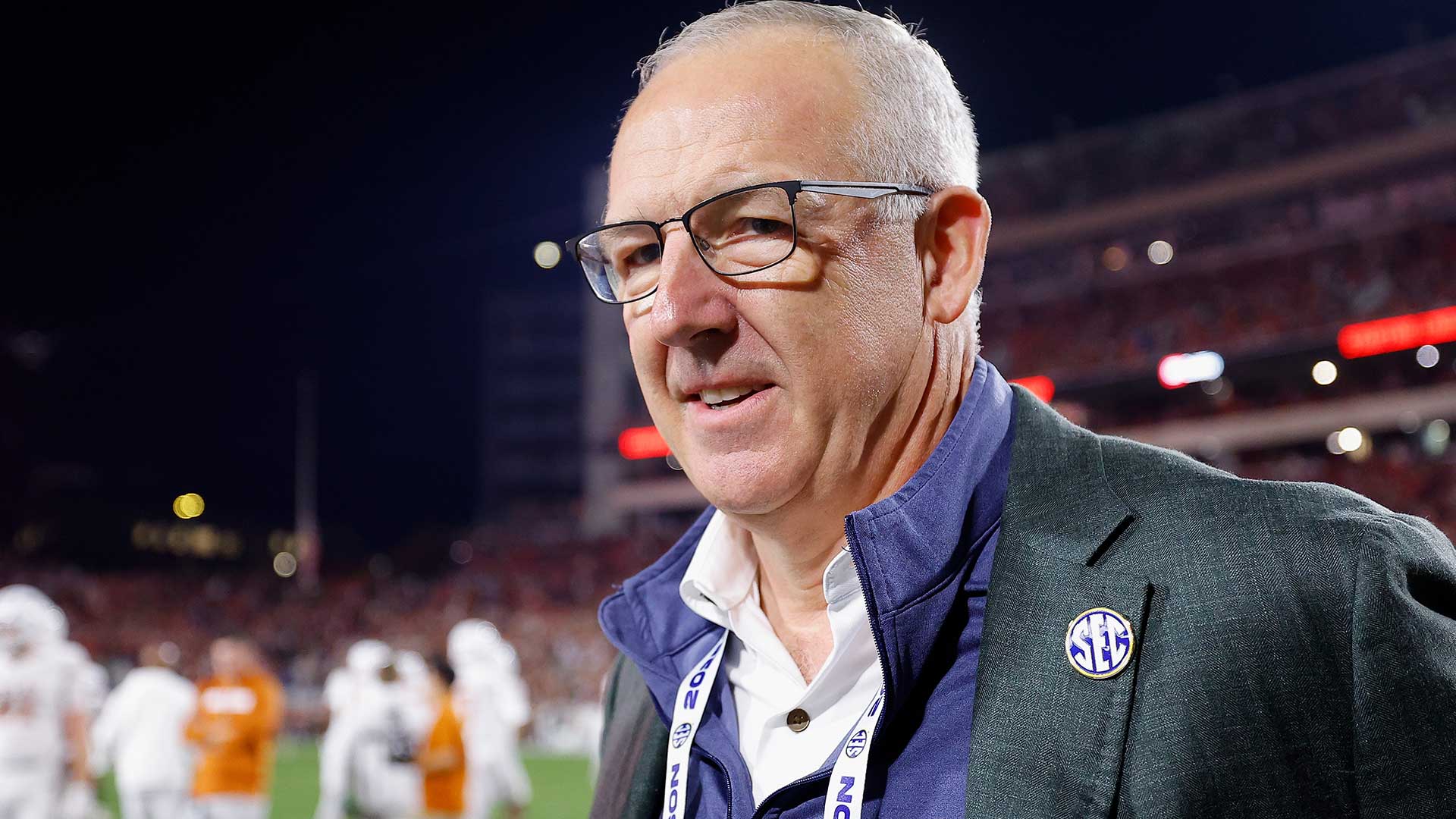
Southeastern Conference Commissioner Greg Sankey said Monday that leaders of the powerhouse league — some of them frustrated over the changes upending their industry — are having “real” conversations about breaking away from the rest of college sports, though that is not the preferred solution.
“They’re real,” Greg Sankey said Monday of talks with school presidents involving the SEC separating itself from the rest of the NCAA. “They’ve opined about the frustrations that bring them to the point of saying we should look at something significantly different.”
Sankey’s 45-minute meeting with reporters to kick off SEC football media days detailed the several issues that college sports is trying to find solutions for: Congressional legislation, litigation stemming from the new five-year eligibility rule, the future of the College Football Playoff and an overall lack of transparency regarding name, image and likeness payments to players.
Sankey acknowledged the conference’s unhappiness with the handling of all those issues, but also touted the league’s 13 national championships won last season across a variety of sports as a key reason it’s in no rush to move away from the current framework.
“There is meaning and value and I do think a national expectation that we participate in a national organization,” he said. “But that national organization must function in a healthy manner; otherwise, that simmering will continue”.
The SEC and Big Ten produced a 10-point paper about changes they would like to see to the Protect College Sports Act, a bipartisan piece of legislation in the Senate. The SEC and Big Ten are negotiating with lawmakers over potential tweaks.
Tennessee chancellor Donde Plowman, the chair of the SEC presidents, released a statement saying conference leaders “have provided feedback from the perspective of university leaders who are trying to navigate the current state of college athletics.”
The SEC argues the bill does not go far enough in limiting the possibility of lawsuits against conferences and schools, and also needs better language to preempt state laws in favor of a national one regarding the tens of millions in NIL payments now so common at the top of college sports.
Sankey called the rollout of the recent NCAA rule that rewrote eligibility standards and has induced lawsuits — players mainly get five years to play five seasons — “magnifies frustration” among some in the SEC. Plowman said the SEC “applauded” how transfers and eligibility were addressed in the Senate bill.
“That means student-athletes would not be able to transfer every year, putting their educations and team dynamics at risk — or toggle back and forth between professional teams and university teams with no intention of getting a degree,” she said.
The SEC remains the Power Four’s only holdout over expanding the 12-team playoff to 24. Sankey said more research is needed, especially regarding “media interest” — likely shorthand for media rights interest — in adding more games.
There is also the underlying issue of what an expanded playoff would do to conference title games. Symbolic of the wide range of opinions on that topic, Missouri coach Eli Drinkwitz said in his own media session that he favored conference play-in games to determine CFP spots and he doesn’t think title games should be put on the chopping block.
“Throwing those away so you can get a bad matchup between 24 and 18 doesn’t make sense to me,” Drinkwitz said.
Sankey said he also wants more transparency about who pays players and for what. Among the SEC’s proposed changes to the Senate bill would be clearer guidelines for paying players, including “NIL, pay-for-play (which is not allowed), revenue sharing and other forms of compensation.”
The commissioner conceded that the SEC is not bent on getting its way regarding every issue that college sports is trying to solve. But as one of the biggest, richest and most influential leagues in a quickly changing business, it does want to lead the way.
“I think we do a better job now than has ever been done in college athletics,” Sankey said. “But we haven’t achieved that level of stability as we go through change that’s needed at this point.”
Reporting by the Associated Press.


