


Fleets of unusual vehicles have been spotted in Minsk in recent days that may be linked to a murky trade deal with Indonesia.
Trucks with a military color scheme and nearly identical to the Belarus-made MAZ-5316 have been seen sporting the logo “HAL” in place of the usual MAZ badge.
The MAZ-5316 is a heavy-duty 4WD truck produced since the early 2000s by the Minsk Automobile Plant. The vehicles are used for civilian and military purposes, including as troop carriers.
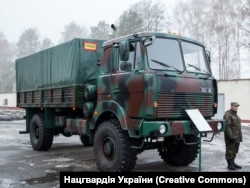
A 2016 file image of an MAZ-5316 in service with the Ukrainian military
Sightings of HAL-branded vehicles first emerged this summer, when dozens of trucks covered with concealing material were spotted in Indonesia. Reports from the Asian country claimed the partially concealed vehicles were part of an order of some 1,500 Belarusian trucks for Indonesia’s Defense Ministry.
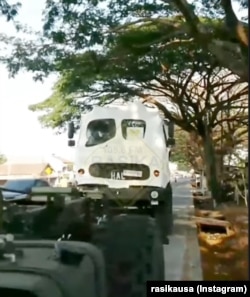
A screengrab of a video shows concealed trucks with the HAL brand.
In May, an Indonesian delegation toured Belarus’s MAZ plant as part of a trip to “explore the company’s export potential.” In July, Belarusian leader Aleksandr Lukashenko visited Indonesia to meet with the country’s president, Prabowo Subianto.
Belarus declared the primary purpose of the July trip to be “issues of bilateral military-technical cooperation” and “the deepening of industrial cooperation between Minsk and Jakarta.”
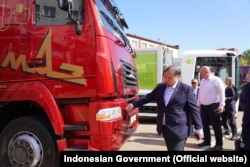
Indonesian Economics Affairs Minister Airlangga Hartarto inspects a MAZ truck during a trip to Belarus in May.
So what is HAL, and why would Belarusian trucks sport the unfamiliar logo?
Belarusian truck manufacturer MAZ is under EU and US sanctions, a status that blocks many countries from dealing with the company. Indonesia has not imposed sanctions against Belarus but faces the risk of secondary penalties for dealing with entities on Western blacklists.
An Indonesian company called PT HAL Teknologi functions as a distributor for supplies of specialized equipment for defense agencies and other entities in the country, but it is unclear if the company has been involved in vehicle imports from Belarus.
Uladzimer Zhyhar from BelPol, an organization of former Belarusian security officials, told RFE/RL’s Belarus Service there is a history of sanctioned Belarusian businesses creating new branding to minimize the risk that purchasing countries will be stung for dealing with sanctioned entities.
“Previously, they tried to organize something similar with [Belarusian heavy transport equipment company] BelAZ deliveries to Poland. They sold entire dump truck assemblies without labels, without the country of origin. And then it was all pieced together [in Poland], but the dump trucks were branded as something else,” Zhyhar said.
He added that for some militaries, the kinds of hardware produced in Belarus is desirable enough that risky, complex import schemes are deemed worthwhile.
Factories such as MAZ, Zhyhar said, “generally produce a product that, I would say, belongs to previous generations. But this is exactly what some countries need, because the types of weapons that they have require exactly the older, ‘quasi-Soviet’ models,” he said.
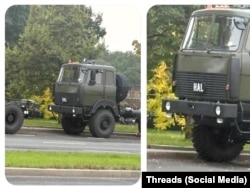
An image shared on social media purporting shows a HAL-branded truck near the MAZ factory in Minsk.
In some cases, Zhyhar said, products from sanctioned Belarusian companies have been paid for through bartering to avoid financial services that are closely watched by regulators.
Belarusian state-linked brands order commodities up to the value of the products being exported, resulting in “goods, not money going to Belarus,” Zhyhar said.
The National Statistics Committee of Belarus has not published detailed data on foreign trade since 2021, but in 2020 Indonesia purchased 8 unidentified trucks from Belarus at a cost of $56,138 per vehicle.
Recent reports from the Indonesian Statistics Service do not include information on truck deliveries from Belarus, though there is data on small deliveries of parts including brake systems and clutches.
The Minsk Automobile Plant did not response to a query from RFE/RL’s Belarus Service on whether MAZ was involved the production of trucks with the HAL logo.
Amos Chapple contributed to this report.


