


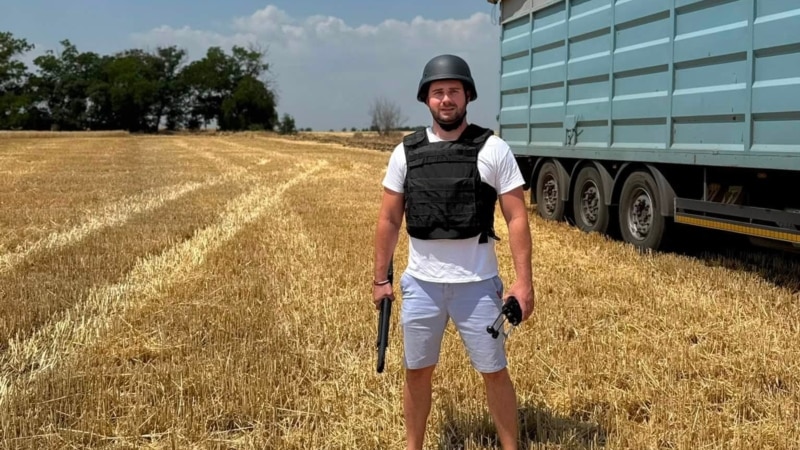
Viktor Hordiyenko recently saw two years of hard work literally going up in flames, when Russian forces attacked his fields with incendiary bombs.
It was yet another huge blow to Hordiyenko, a farmer in Ukraine’s Kherson region who last year lost his father in a Russian drone strike — and this year has endured what he says is a massively upscaled Russian campaign to pound his country’s vital agricultural sector.
“A hundred a day. This is not an exaggeration. A hundred drones a day. Shelling every day. They’re hunting us. They burnt 2,000 hectares of my wheat in a single night,” he told RFE/RL’s Ukrainian Service.
“Winter wheat, all the crops you see, have been scorched,” he said, adding that drone attacks were now — at harvest time — three times higher than a few months ago.
‘Increasing Terror’
The regional military administration said that in June, Russian forces dug in on the opposite bank of the Dnieper River fired some 32,000 shells. This was a 26 percent increase on March, and a 13 percent increase on numbers from April and May.
It also noted a rise in drone strikes, with an average 5,500 launches per week compared to 2,500 last year. There were 28 civilian deaths in June, a 78 percent increase on March.
“The security situation in the Kherson region continues to deteriorate,” said Oleksandr Tolonnikov, deputy head of the administration. “Russia is not reducing the intensity of strikes, but, on the contrary, is systematically increasing terror against civilian residents.”
The surge in attacks is the latest blow to an agricultural sector already struggling after nearly five years of all-out war.
Hordiyenko’s farm is in the Beryslav district on the Ukrainian-held right bank of the Dnieper, which essentially forms the front line in the Kherson region as it flows southwest to the Black Sea. Like the city of Kherson, Beryslav and the surrounding district were occupied by Russian forces near the start of the full-scale invasion in February 2022 but were liberated in a Ukrainian counteroffensive that fall.
Hordiyenko’s father, Oleksandr, spoke to RFE/RL in May last year about the threat of Russian drones. His house was bombed in July and was subsequently killed in a strike in September.
Together, father and son had worked to clear their land of mines following the Russian retreat.
“We spent two years cultivating this land, two years investing, and took nothing from this land. Just so you understand, this is not a year of work, but two years of work that they burned for me in one night,” said Hordiyenko, who drives into his frontline fields in a helmet and bullet proof vest, carrying a gun.
Economic Disaster
Recent weeks have also seen a new tactic — attacks on farm workers’ homes, he added.
“They have destroyed eight of my workers’ houses,” he said. “They fly into villages with incendiaries, drop them from all sides…knowing that the emergency services won’t come because of the shelling. And if we go to put out the fire, they attack us.”
Agriculture is central to Ukraine’s economy, and wheat is its prime product. Known as the breadbasket of Europe, the country has 42 million hectares of farmland.
The sector was hit hard by Russia’s full-scale invasion in 2022, as attacks on export terminals, ports, and shipping disrupted wheat exports. It did recover somewhat after a UN-brokered grain corridor opened in the Black Sea, but ongoing attacks have destroyed agricultural equipment, left unexploded ordnance on farmland, and disrupted internal transport and power infrastructure. The war has also caused a labor shortage.
Hordiyenko says he has lost nearly $3 million worth of crops, and that neighboring farms have suffered the same attacks.
A state subsidy for agricultural losses due to war is available but is capped at 2,000 hectares and pays just $100 per hectare.
“We’re in debt. Millions of dollars in debt. I don’t know what to do,” said Hordiyenko. “Bread is burning.”


