

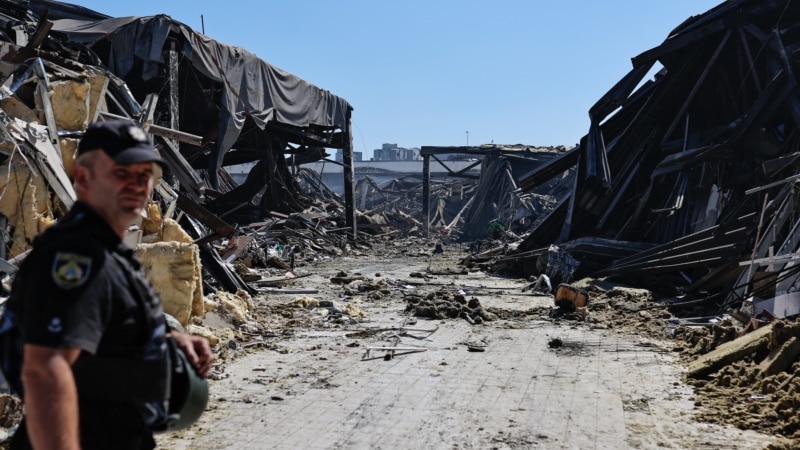
Search-and-rescue operations continued at the site of a devastating Russian drone attack on a shopping mall in the Ukrainian city of Kryviy Rih, as Russia continues to launch strikes across Ukraine.
Two Russian jet-powered drones struck the largest shopping mall in the south-central city on the afternoon on August 21, as many residents were out shopping at the end of the work week.
The attack killed at least 16, leaving more than 130 others injured, including 23 children, some of whom are in critical condition. A day later, four people remained unaccounted for.
“There was smoke. Everyone was shouting,” Yuliana, a mall employee, recalled of the first moments following the attack in an interview with RFE/RL’s Ukrainian Service.
She said the attack caused parts of the ceiling to collapse in a parking garage where some shoppers and staff had sought shelter during an air-raid alert, and that a car was blocking the entrance, forcing people to climb over metal barriers.
The fire at the site engulfed over 9,000 square meters and took hours to extinguish.
Ukrainian Foreign Minister Andriy Sybiha said Russia deliberately struck the site twice, and that the second wave of drones came after emergency responders arrived at the scene.
“Such barbaric double-tap strikes are intended to maximize civilian casualties. They prove Russia’s status as a terrorist state,” he wrote calling for “criminals responsible for such atrocities” to be brought to account.
President Volodymyr Zelenskyy, a native of Kryviy Rih, reiterated his call for air defense support — new supplies of ballistic and other missile interceptors — from international partners.
“Every day that Ukraine lacks air defense is a sacrifice that could have been avoided,” he wrote on August 22.
European Union foreign policy chief Kaja Kallas said the bloc’s defense and foreign ministers would discuss Ukraine’s air defenses during their first meeting after the summer break in September.
The attack “shows the absolute and utter depravity of Moscow’s war,” Kallas wrote on X. “This is terror by design. Russia wants to make Ukrainian cities unliveable.”
She also vowed to unveil “the most far-reaching Russia sanctions listings since the start of the war” to further increase pressure on Russia to end the war.
On August 22, Russia’s air attacks continued to pound places across Ukraine, leaving at least 4 people killed and more than a dozen of others injured.
Zelenskyy said the Odesa, Dnipropetrovsk, Kharkiv, Donetsk, Sumy, Kherson, Chernihiv, and Mykolayiv regions came under attack overnight, with damage reported to residential buildings, energy and railway infrastructure facilities, and civilian enterprises.
Moscow has gained little ground at the front line in Ukraine since the beginning of the year, and has intensified its strikes against the country, often hitting civilian infrastructure and causing civilian casualties.
Ukraine has sought to bolster its air defense capabilities with help from the United States and its European partners but is struggling with a lack of US-made Patriot missiles. Washington has sent mixed signals about a potential agreement to grant Kyiv a license to produce Patriots.
Separately, since the beginning of summer, Kyiv has been actively responding to Russian attacks by targeting oil and military infrastructure inside Russia, leaving the country facing its worst fuel crisis in years.
Early on August 22, Ukrainian drones hit an oil refinery in Novokuybyshevsk in Russia’s Samara region, 900 kilometers away. One person was killed, the local governor said.
The day before, the Ukrainian military targeted a Russian oil facility in Perm, more than 1,600 kilometers from Russia’s border with Ukraine, and a military air base in the Volgograd region.
Kyiv’s forces also hit a warehouse of major e-commerce retailer Ozon on August 22, expanding its attacks on the sector after weeks of strikes on facilities belonging to Russian online giant Wildberries.
Ozon confirmed the strike, saying 500 employees were evacuated “within minutes,” but added that some had sustained injuries.
“We continue, through our long-range sanctions, to bring the consequences of the war back to where it came from,” Zelenskyy said on August 21, referring to the campaign.
