


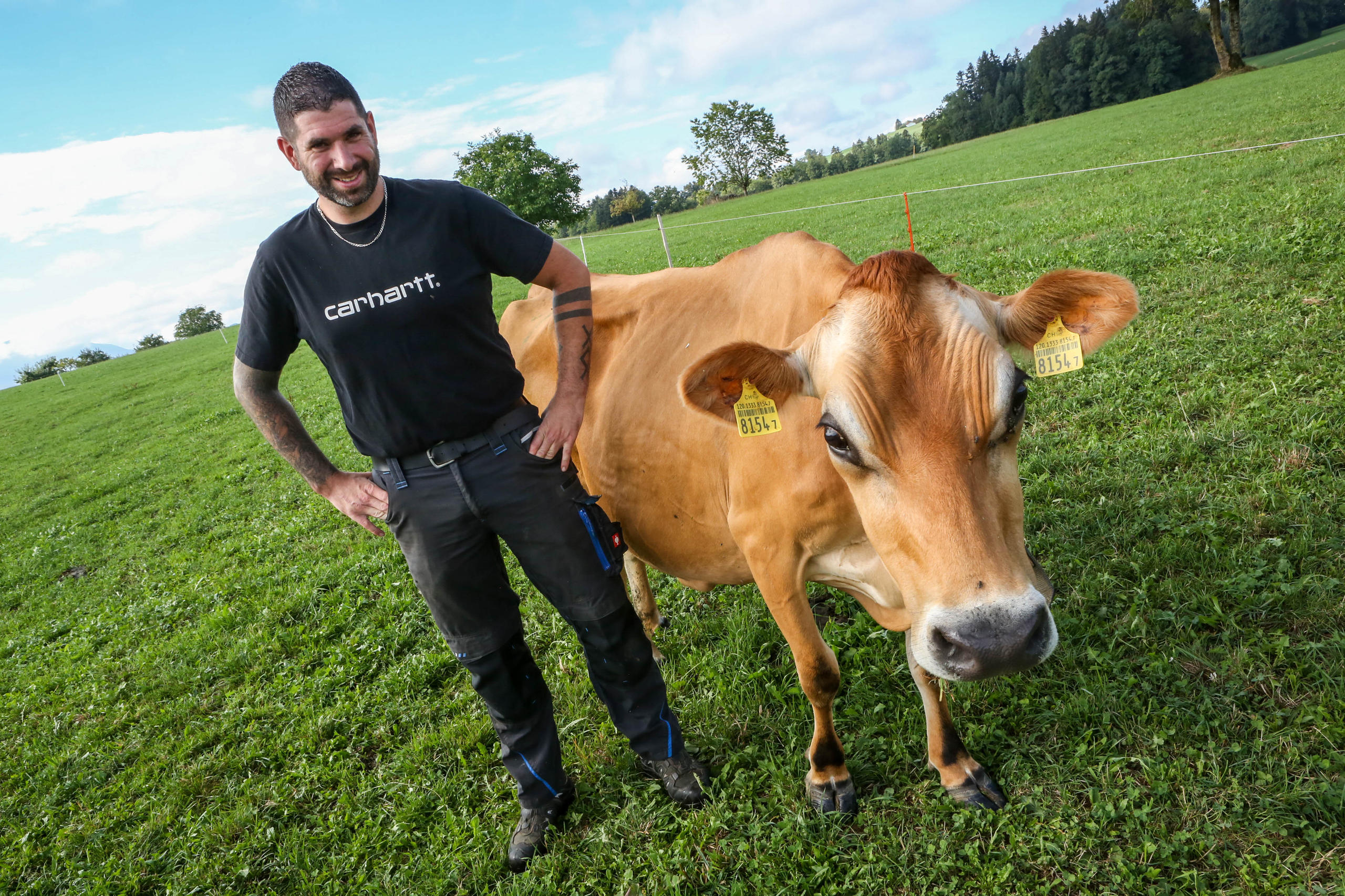
Livestock farms account for around a third of global anthropogenic methane emissions.
Keystone
The fight against climate change runs through cattle barns. A Swiss startup aims to eliminate methane, a powerful greenhouse gas produced by livestock farming.
Strategies to tackle the climate crisis tend to focus on reducing carbon dioxide emissions from fossil fuels. This priority is justified, as CO2 is the main greenhouse gas responsible for global warming. But it isn’t the only one.
Methane also contributes significantly to rising global temperatures. Although it’s present in the atmosphere at lower concentrations and remains there for a shorter period than CO2, methane’s warming effect is much stronger. Yet historically, this gas, produced largely by agriculture and the oil and coal industries, has received relatively little attention in climate mitigation discussions. Keeping global warming well below 2°C, as envisioned by the United Nations’ Paris Agreement on Climate Change, will not be possible without a sharp reduction in methane emissions. According to some Swiss researchersExternal link, cutting these emissions is one of the most effective measures for limiting climate change in the short term.
Sixteen44, a startup based at the Swiss Federal Institute of Technology Lausanne (EPFL) Innovation Park in Lausanne, seeks to eliminate methane directly at the source: cow farms. The sector is responsible for around one-third of global anthropogenic methane emissionsExternal link, but the low concentrations of the gas found in barns (less than 5%) make it difficult to capture and reuse economically.
“This is the situation for most of the methane emitted around the world,” William Ramsay, chemist and co-founder of Sixteen44, told Swissinfo.
The startup recently tested its technology – a device that captures methane directly from cows – at the Strickhof experimental farm in Lindau, canton Zurich. According to Sixteen44, this is the world’s first demonstration plant capable of treating the highly diluted methane emissions typical of cattle farming.
“We need to tackle this low-concentration methane if we want to make a meaningful impact on the climate,” Ramsay says.
Cutting methane emissions from cows by 60-70%
Methane is produced by bacteria in the digestive systems of cattle and other ruminants. The gas forms mainly during the fermentation of plant fibers and is released primarily through the animal’s mouth when it exhales or belches.
Unlike CO2, methane is chemically inert and difficult to capture directly from the air, Ramsay explains. For this reason, Sixteen44 has fitted cows with a device that looks like a ventilation unit (see picture below). Inside, a plasma oxidation process occurs: An electrical discharge generates highly reactive particles that convert methane (CH4) into water and carbon dioxide. This reaction also occurs naturally, but in this case it is accelerated by a catalyst. “The main advantage of methane oxidation is that methane can be converted simply by bringing it into contact with a heated catalyst,” Cyril Brunner, an expert in greenhouse gases and CO2 removal at federal technology institute ETH Zurich, told Swissinfo. There is no need to separate methane from the air first, a step that requires large amounts of energy and represents one of the main limitations of carbon capture technologies.

Sixteen44 has tested its methane removal technology in an experimental cattle shed in canton Zurich.
Sixteen44
Sixteen44’s device reduced methane levels in the barn by 60-70%, according to Ramsay. Unlike other technologies designed to remove low-concentration methane, it operates at around 40°C rather than 400-500°C, resulting in lower energy consumption.
Methane oxidation, Ramsay says, is complementary to feed additives incorporated into livestock diets. These substances, such as seaweed or clove-based preparations, reduce the amount of methane produced during digestion.
>>Food additives added to animal feed can reduce emissions from cattle:
More
More
Swiss farmers trial methane-busting feed for cows
Financing methane reduction through carbon credits
Sixteen44 has financed the development of its technology through public funding, private investors and a crowdfunding campaign. So far, it has raised CHF750,000 ($906,443) and aims to secure an additional CHF1 million.
In the future, its business model could be based on the sale of carbon credits. As is already the case for CO2 reduction and removal projects, the start-up (or farmers using its system) could earn certified credits for avoided methane emissions. These reductions would be converted into CO2-equivalent units and traded on carbon markets, as an additional income source for farmers. According to Ramsay, the cost of a device for a medium-sized barn in Switzerland would be in the range of CHF40,000 to CHF50,000.
One greenhouse gas replaced by another
The Swiss start-up’s solution is not without limitations. It cannot eliminate methane emitted outside barns while cattle are grazing. More importantly, methane oxidation produces CO2: one climate-warming gas is destroyed only to generate another.
According to Ramsay, however, this is not a major concern. Over a 20-year period, methane is around 80 times more potent as a greenhouse gas than CO2. Removing one ton of methane is equivalent to removing around 80 tons of CO2 he explains. The resulting carbon dioxide could also be captured and permanently stored using other technologies.
“It’s not a silver bullet,” Ramsay acknowledges. “But it can make a meaningful difference because even a 30% reduction in methane emissions has an immediate impact on global warming.” Sixteen44’s ambition is to use its device to eliminate methane not only from cattle farms but also from landfills, wastewater treatment plants and coal mines
Methane emissions are rising globally, but not in Switzerland
Methane emissions are increasing worldwide due to intensive livestock farming for meat and dairy production, waste treatment, and the extraction and production of fossil fuels. In 2025, the concentration of methane in the atmosphere was 267% higher than in 1750, according to the World Meteorological Organization.External link
The International Energy Agency estimates that methane is responsible for around 30% of the current rise in global temperatures. Methane emissions have already contributed more than 0.6°CExternal link to global warming, which is expected to exceed 1.5°C in the coming years.
In Switzerland, methane – most of it from agriculture – accounts for around 12% of total greenhouse gas emissions. Methane emissions have fallen by about one-fifth since the 1990s, mainly due to a sharp reduction in emissions from landfills.
How else can methane in the atmosphere be reduced?
In 2021, Switzerland and around 100 other countries pledged to reduce methane emissions by 30% by 2030External link.
According to Cyril Brunner, targeted measures are needed for every major source of emissions, from phasing out fossil fuels and reducing natural gas leaks to using feed additives for livestock and cutting food waste. Removing methane directly from the air, for example in cattle barns, can also play a role.
“It is not straightforward, but the technology [by Sixteen44] could be developed to the point where it makes a meaningful contribution to achieving our climate targets,” says Brunner.
Other companies around the world are also developing solutions to eliminate methane at low concentrations. Denmark’s Ambient Carbon uses ultraviolet light to oxidize methane in livestock buildings, while US-based Windfall Bio uses bacteria to convert it into fertilizer and biomass. Switzerland’s Daphne Technology, from which some of Sixteen44’s co-founders originate, applies a similar technology to engine exhaust gases, where methane concentrations are higher.
Targeting large-scale livestock farms in the United States and Brazil
Sixteen44’s next step is to assess the effectiveness of its technology in a large livestock barn and at a wastewater treatment plant in Switzerland. The company plans to expand across Europe, starting with the Netherlands, before moving into large-scale livestock operations in the United States and Brazil.
Reducing methane emissions is one of the most effective ways to slow global warming in the near term. If solutions like the one developed by the Swiss start-up prove effective at scale, livestock barns could become a new frontline in the fight against climate change.
More
Edited by Gabe Bullard / VdV


