


In early April, Hamid Ali Shah was ordered by his employer, Etihad Rail, the operator of the United Arab Emirates’ national railway network, to report to the police. The civil engineer was questioned for several hours, held in detention for several days, and then deported to his homeland, Pakistan.
“I was on duty when I got the call,” Shah told RFE/RL. “After two hours of questioning, I was bundled into a van along with 13 others and taken to an immigration detention center. On April 6, I was put on a flight and deported from the UAE.”
Shah is among the thousands of Pakistanis who have been deported by the UAE since the United States and Israel launched a bombing campaign of Iran on February 28, according to a Pakistani lawmaker and media reports in the South Asian country.
Many of them are Shi’ite Muslims, a religious minority in Sunni-majority Pakistan, where they number around 35 million people. The community has ties with Iran, the world’s largest Shi’ite-majority country.
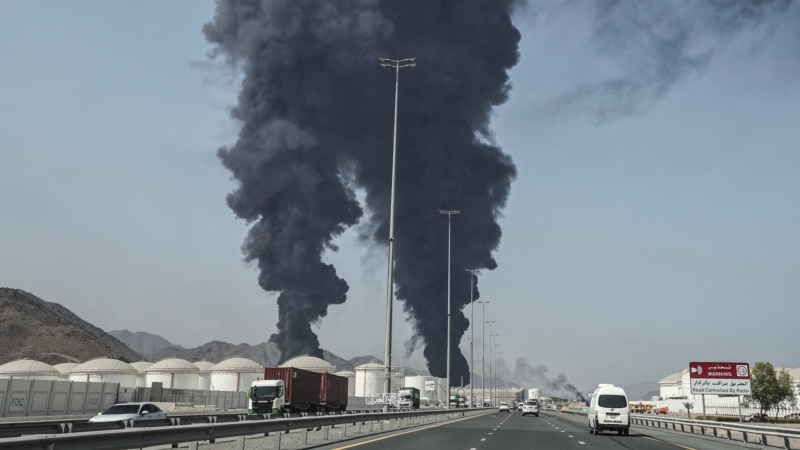
In response to the war, Iran fired hundreds of drones and missiles at its neighbors in the Persian Gulf, including the UAE, an ally of the United States and Israel that has borne the brunt of Tehran’s retaliation.
Pakistan, a key mediator in efforts to end the war, has been a longtime ally of the UAE. But there has been tension as Islamabad deepens its alliance with Saudi Arabia, a rival of Abu Dhabi.
The UAE is home to an estimated 2 million Pakistani migrant workers. The billions of dollars in remittances they send back home every year keep thousands of impoverished families afloat in Pakistan, which has grappled with an economic crisis in recent years.
“UAE-based Pakistani Shi’a appear to have become the scapegoat for the worsening tension between the UAE and Pakistan,” said Michael Kugelman, senior fellow at the Atlantic Council, a Washington-based think tank.
“There is also a perception in the UAE that Pakistan is simply getting too close to Iran and becoming too sympathetic to it, especially as Pakistan jockeys to mediate in the war and tries to project itself as a neutral mediator,” added Kugelman.
No Warning
RFE/RL spoke to a dozen Pakistanis who were deported from the UAE in recent weeks. Many said they were deported without warning or fair hearing. Others said they were told not to return to the Middle Eastern country while on vacation.
Among them was Rizwan Haidar, who worked for 15 years for the Roads and Transport Authority, the government body responsible for transportation in Dubai, the largest city in the UAE.
Just before the Iran war broke out, Haidar traveled to his hometown of Parachinar in northwestern Pakistan on vacation. A day before he was set to return to the UAE, Haidar was informed that his visa had been revoked.
“I immediately rang my manager, who told me that my visa and work permit has been cancelled and I was no longer in the employment of the Roads and Transport Authority,” he said.
The UAE has not officially commented on the deportations. RFE/RL requested comments from the UAE’s Foreign Ministry and Pakistan’s Foreign Office.
Pakistan’s Interior Ministry denied Pakistani workers were being deported from the UAE. “No country or sect-specific deportations of Pakistanis from any country including the UAE are being carried out,” the ministry said in a statement on May 8.
But an official at Pakistan’s Federal Investigation Agency (FIA), the country’s top law enforcement body, told RFE/RL that there has been a wave of deportations in recent weeks.
Sher Afzal Marwat, a Pakistani lawmaker from the country’s northwest, told reporters on May 14 that as many 8,000 people from Parachinar alone had been deported.
“The Foreign Office is telling lies by denying the deportations,” said Marwat, who spoke after visiting the UAE. “I met scores of Pakistanis. From taxi drivers to businessmen, whoever has names such as Hassan, Hossein, Ali, the UAE authorities are deporting them.”
Hassan, Hossein, and Ali are common male names in Shi’ite Islam.
‘Absolutely Fine’
Pakistan’s Interior Minister Tallal Chaudhry told parliament on May 14 that the country’s relationship with the UAE was “absolutely fine.”
But tensions have been brewing for months. Last month, Abu Dhabi cancelled a $3.5 billion loan to Islamabad.
Experts say the turning point was Pakistan and Saudi Arabia signing a strategic mutual defense agreement in September 2025. That deal came amid a deepening rift between the UAE and Saudi Arabia.
The United States and Israel’s war against Iran has exacerbated tensions between Pakistan and the UAE, experts say.
“The UAE is very unhappy about Pakistan’s growing alliance with Saudi Arabia, particularly as the UAE tension with Riyadh grows,” said Kugelman of the Atlantic Council. “The UAE also has been unhappy what it perceives to be Pakistan’s rather soft reaction to Iranian strikes on the UAE.”
Pakistani journalist and political commentator Hamid Mir said worsening Pakistan-UAE relations is a lose-lose situation.
“The expulsion of Pakistani workers from UAE will put pressure on Pakistan’s economy for the time being,” Mir told RFE/RL. “But it is also going to affect the UAE mainly because they will have a scarcity of skilled labor in the longer term.”


