

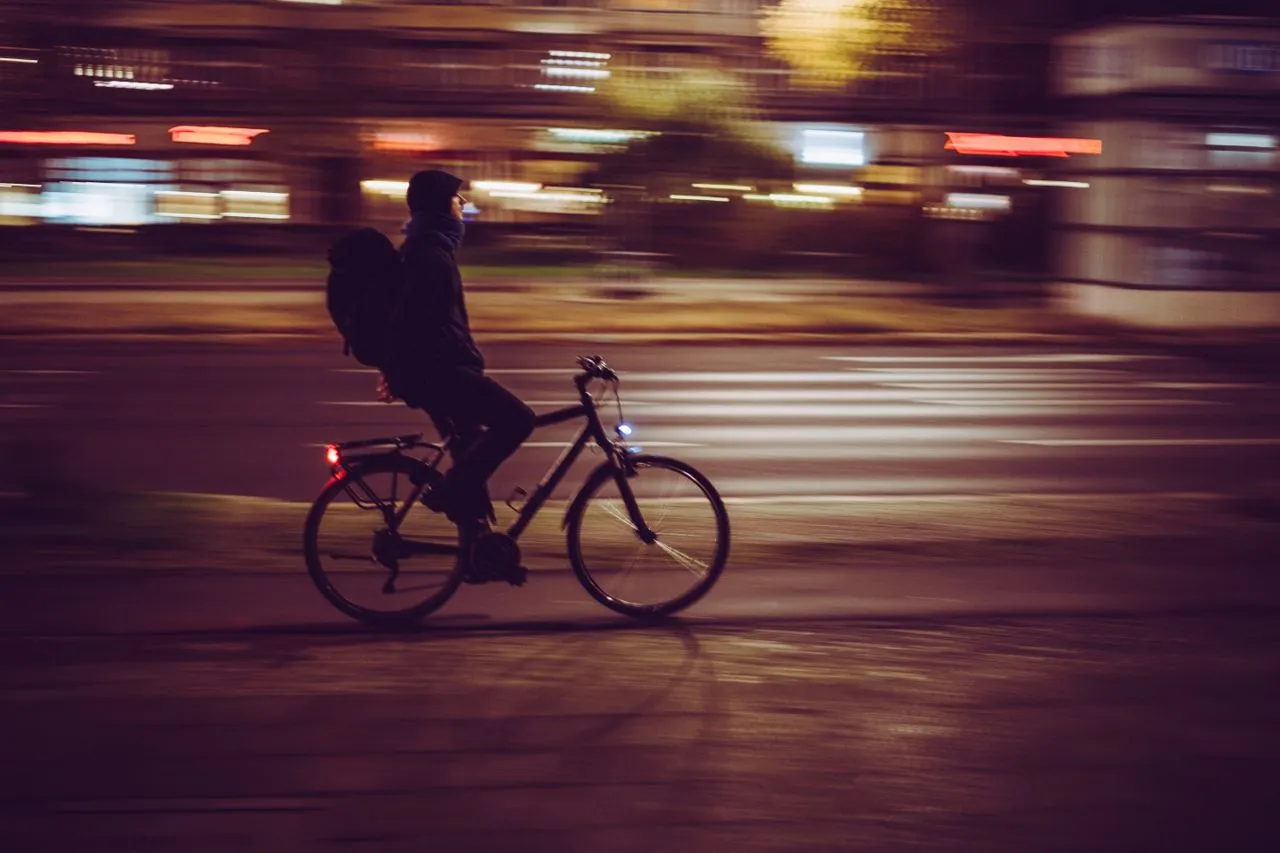
With daylight hours now shorter, people are riding their bikes in the dark more frequently than during the summer months. The Swiss Council for Accident Prevention (BFU) has tips to keep them safe.
According to BFU’s data, most cyclists in Switzerland are poorly equipped as winter approaches, which is why it launched a new campaign on November 5th to emphasise that “visibility is essential for road safety, and can be a life saver.”
First, the good news: Between 2022 and 2025, “the proportion of cyclists who, at dusk or in the dark, rode with their bike lights on while also using at least one other visibility aid doubled from 14 to 28 percent,” the BFU said.
One of the goals of the new campaign is therefore to get more bicycle riders to properly ‘illuminate’ themselves.
“The measures used include reflective strips, safety vests, and helmets equipped with reflective elements.”
That’s obviously a positive thing, but it may bot be enough to guarantee safety, the organisation says.
Another statistic that definitely needs improving is that the degree of visibility often depends on the type of bike ridden.
For instance, only 21 percent of cyclists on standard bicycles achieve optimal visibility, compared to 36 percent for those on slow e-bikes and 56 percent for on fast e-bikes.
Don’t miss our journalists’ daily news roundup from Switzerland
Let there be light
Research on human perception shows that “seeing does not mean being seen…A cyclist who already detects the headlights of another vehicle from afar is not necessarily seen from afar,” BFU points out.
So an important thing is to ‘reflect’ – in this context, t maximise their exposure by combining lighting with other safety measures, particularly in the case of non-motorised bicycles.
In fact, at dusk and in the dark, the contrast with the surroundings and movements play a particularly important role because these reflective elements stand out clearly from a dark environment – which means the cyclist will be seen by other vehicles earlier.
Therefore, visibility aids worn on moving parts of the body, notably on the ankles but also on the helmet “are particularly effective, the BFU said, adding that “being visible does not primarily mean being as bright as possible but, rather, being identified as early as possible.”
How safe is it ride a bike in Switzerland?
Unfortunately, there is much room for improvement.
That’s because there are plenty of recommendations on how to stay safe – like the visibility ones provided by the BFU – but in some cases legislation backing up this advice is lacking, or else not consistent.
The case in point are helmets.
While they are obligatory on fast e-bikes with pedal assistance up to 45 km/h, they are merely recommended (but not mandated) for slower e-bikes r ‘regular’ bikes.
These are the other cycling ‘do’s’ and ‘don’t’:
READ MORE: The rules cyclists in Switzerland need to know
There is, however, another cycling regulation that’s in the making.
The Swiss government wants to increase penalties for cyclists who ride with a phone ‘glued’ to their ear.
The Federal Roads Office (ASTRA) is considering increasing the fine for this of kind of infraction – currently 40 francs – though the new amount has not yet been determined and is a subject of an upcoming consultation process.
With this measure, the federal government is responding to the growing problem of ‘rider distraction’.
In 2025 alone, this kind of reckless behaviour on the part of cyclists caused 184 serious accidents, according to ASTRA.
READ MORE: Cyclists caught on their phones face higher fines in Switzerland


