

Photo: Arashan.kz (Courtesy Image)
A new Kyrgyz sheep breed is sparking a speculative frenzy across Central Asia, where rams are changing hands for extraordinary sums.
The Arashan breed was officially registered in Kyrgyzstan in April 2021. Since then, prices have soared as images of the variety’s giant rams have gone viral on social media.
In 2023 a single Arashan breeding ram was sold for $150,000, and prices have reportedly climbed since. At a sheep fair in April, a young ram was “valued” at $500,000, and after a September 19 event near Bishkek reports emerged that a Kyrgyz-raised Arashan lamb had recently been sold to a Kazakh breeder for $1 million.
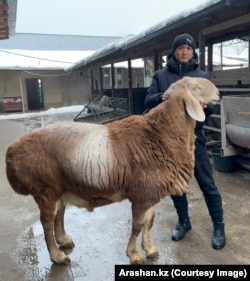
An image shared on the Arashan.kz Instagram page in December 2025 features an Arashan sheep named President.
“The lamb that sold for $1 million is called Antibiotic,” Kyrgyz sheep farmer Ulan Atabaev, who claimed to know the breeders involved in the reported deal, told RFE/RL.
The Kazakhstan-based buyer of the prized lamb passed questions from RFE/RL on to a lawyer who said only that “Antibiotic was sold to breeder Kuanysh Myktybayev for a substantial sum.”
Mirlan Satybekov, chairman of the Kyrgyz Public Association of Sheep Breeders, told RFE/RL the Arashan breed’s value comes from their size, rapid growth, and hardiness demanded by the harsh climate and landscape of Kyrgyzstan. “On top of that, they are just very beautiful sheep,” Satybekov said.
Arashans of valuable bloodlines feature prominent “Roman noses,” long ears, and wobbly, fat-filled tails. The sheep are raised for their meat, with lamb and mutton being staples of Central Asian diets.
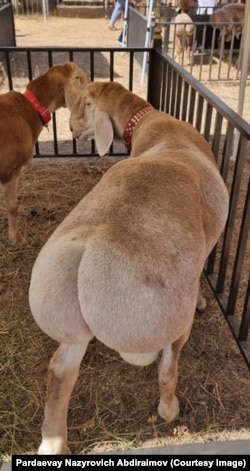
An Arashan sheep at a fair in Kyrgyzstan. The sheep are one of the world’s fat-tailed variety, that store pouches of fatty tissue above the hind legs. The animals can draw from the fatty deposits when fodder is scarce.
Satybekov told RFE/RL that giant specimens of Arashan breeding rams are used as “improvers” to increase the size and subsequent market value of the next generation of sheep flocks. Farmers pay substantial fees to owners of famed Arashan rams to inseminate their ewes. Additionally, young males from a famous father can be sold to other breeders for house-sized prices. Earlier this year, Kazakh breeder Myktybayev posted a video of two Arashan rams being sold to an Uzbek breeder for a claimed total of $275,000.
Some Kyrgyz commentators have compared the speculation frenzy over Arashans to Ponzi schemes, with debate breaking out online over reports of people taking out risky loans or selling cars or homes to buy breeding rams.
In contrast to the fortunes paid for elite breeding animals, the price for an average adult Arashan is tied to the market price of mutton. Once slaughtered, an adult Arashan yields several hundred dollars’ worth of mutton from its roughly 50–60 kilograms of meat at current market prices.
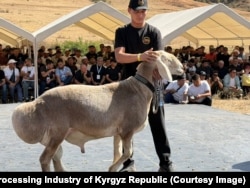
An Arashan sheep being displayed during the September 19 fair near Bishkek.
The Arashan sheep emerged from a breeding experiment that took place in the Kyrgyz city of Kant in the 1970s.
“During the Soviet period there was an agricultural machine-testing station [in Kant] and its director at the time was a man named Zubkov,” Satybekov told RFE/RL. “He brought breeding rams of the Hissar variety from Tajikistan and began crossing them with our indigenous local meat-and-fat sheep.”
There are currently around 48,000 Arashans in Kyrgyzstan, a fraction of the roughly 5.6 million total sheep population of the country.
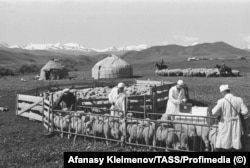
A corral of sheep at a collective farm in Soviet Kyrgyzstan in 1973.
The record weight for an Arashan was set in June 2026 at 236 kilos (520 pounds), a fraction lighter than a Suffolk ram in the United States that tipped the scales at 247.2 kilos in 1991 to become the heaviest domestic sheep ever recorded.
Amid a ban on sheep exports that sought to curb rising meat prices in Kyrgyzstan, an exemption was made for Arashans this summer.
“Over the past two months, we’ve exported 215 Arashan sheep to Uzbekistan” since the ban was lifted for Arashans, Satybekov said. “There’s also interest from Russia and farmers have visited us from Moldova and Georgia, as well. They’re looking at how they can take animals back with them but for now we’re working out how all of this can be done.”
Sindre Langmoen contributed to this report
