


 Getty Images
It will be a “mammoth task” to identify the bodies brought up from a disused mineshaft in South Africa this week, a police spokesperson says.
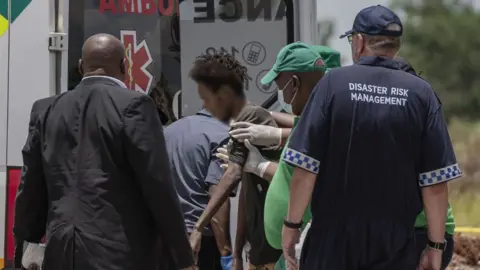
Seventy-eight corpses, along with more than 240 illegal miners, have been hoisted to the surface since Monday as part of a rescue operation, Brig Athlenda Mathe told journalists close to the top of the mineshaft in Stilfontein.
They had been underground since at least November.
That was when the authorities stepped up efforts to bring an end to illicit mining activities by surrounding the entrance to the shaft and refusing to let food and water to go down.
The police always said the miners were free to come out at any time.
This story contains a video that some people may find distressing.
The mine has now been cleared of both bodies and people alive, the police say.
Only two of the deceased have been positively identified so far, Brig Mathe said.
“Some of [the corpses] were decomposed bodies that came up mostly as bones,” she added.
DNA tests are being done but a further challenge to figuring out the identities is that “the majority of [those found] are undocumented migrants”, she added. Their families may not be aware that they were down the mineshaft in the first place.
The vast majority of those who came up alive were from neighbouring countries such as Mozambique and Zimbabwe.
A trade union and rights activists have accused the authorities of overseeing a massacre.
But the police have defended their actions, saying that they were dealing with criminality and it was the kingpins in charge of the illicit mining who were controlling the flow of supplies and trying to prevent people from resurfacing.
 Reuters
During a visit on Tuesday, the police and mines ministers were insulted and told to leave by an angry crowd that blamed the government for the deaths.
Police said that more than 1,500 miners had come to the surface before the rescue operation began.
However, others remained underground, either because they feared arrest or were forced to stay there by gangs that control the mine.
Many mines in South Africa have been abandoned over the last three decades by companies that did not find them economically viable.
The mines have been taken over by gangs, often former employees, that sell minerals they find on the black market.
This includes the mine in Stilfontein, some 145km (90 miles) south-west of the country’s biggest city, Johannesburg, which has been the focus of government efforts to clamp down on the illegal industry.
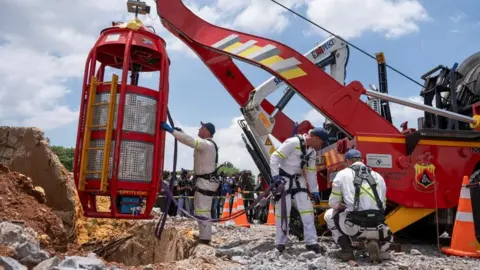
A rescue cage had been making trips down a shaft to reach the miners thought to be at least 2km (1.2 miles) underground.
Many of the survivors had been without food and water since November, leaving them emaciated. They are now receiving medical care.
The authorities say they will be charged with illegal mining, trespassing and contravention of immigration laws, as the majority of the miners are undocumented migrants.
“It’s a crime against the economy, it’s an attack on the economy,” Mines Minister Gwede Mantashe said on Wednesday as he defended the hard line taken against the miners.
South Africa relied heavily on miners from countries such as Lesotho and Mozambique before the industry went into decline.
Unemployment in South Africa is currently more than 30% and many former miners say they have little alternative source of income.
You may also be interested in:
 Getty Images/BBC

