


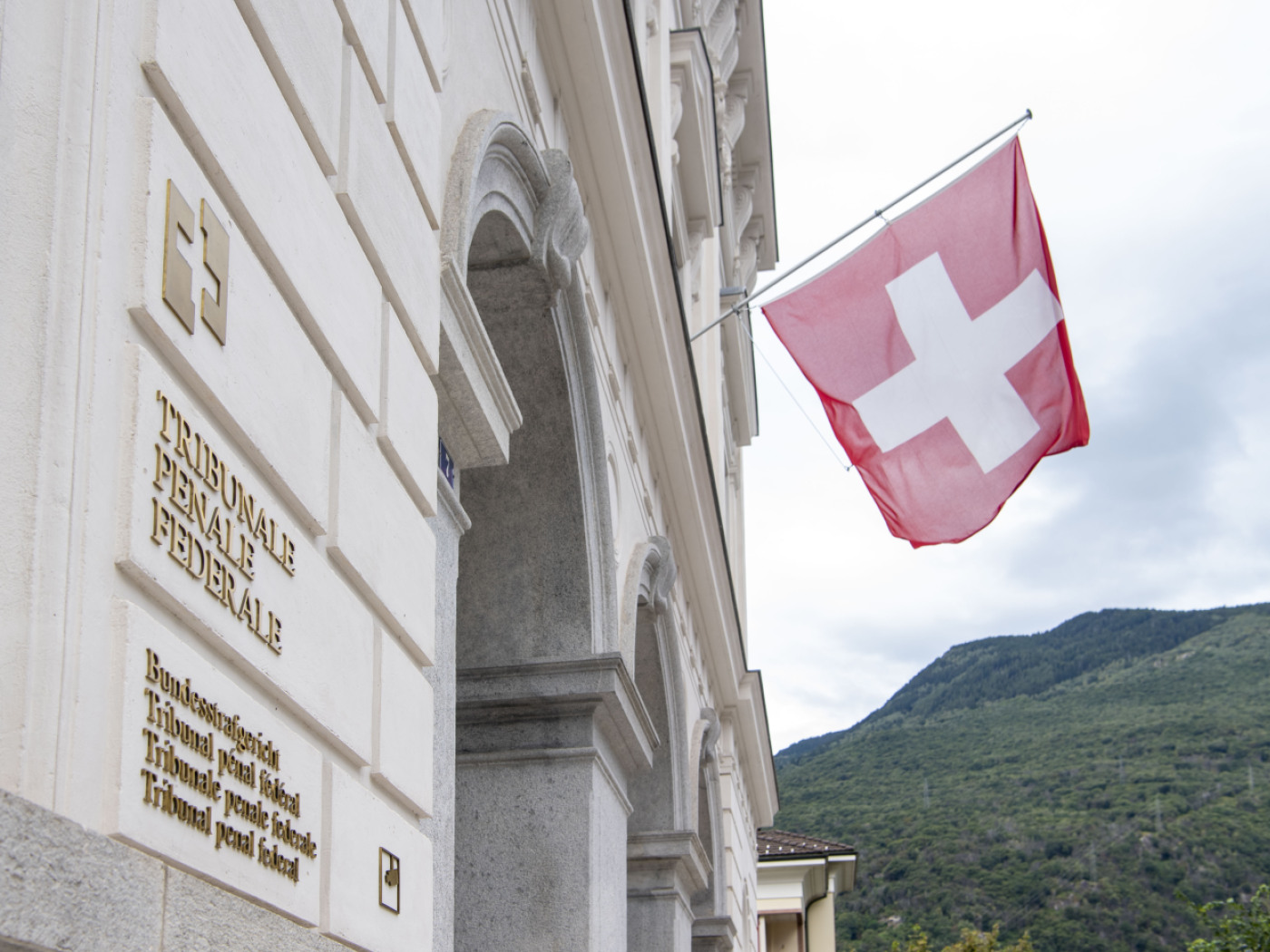
The Karimova case: a fine of CHF3 million for a Geneva-based private bank.
Keystone-SDA
The Swiss Federal Criminal Court has fined the Geneva-based private bank Lombard Odier CHF3 million in the money laundering case involving former Uzbekistan President’s daughter Gulnara Karimova.
On Monday, the Federal Criminal Court handed down its judgement in the Karimova case. It convicted a former banker of money laundering and imposed a fine on Lombard Odier. However, it dismissed the proceedings against the daughter of the former Uzbek president and one of her associates.
More

More
Uzbek former first daughter goes on trial in Switzerland
The Criminal Division of the Federal Criminal Court sentenced a former client manager at Lombard Odier to a 24-month suspended prison sentence for aggravated money laundering. The Geneva-based private bank, for its part, was fined CHF3 million (about $3.6 million) for failing to put in place the necessary organisational measures to prevent these offences.
The court, however, dismissed the case against 54-year-old Karimova and a co-defendant, as stated in the operative part of the judgement published on Monday and in a press release. It ruled that no judgement could be handed down against eldest daughter of the late Uzbek leader Islam Karimov, who ruled Uzbekistan with an iron fist for more than 25 years following the collapse of the Soviet Union.
Karimova is being held in Uzbekistan, where the authorities refuse to allow her to leave the country. Her absence from the hearing in Switzerland cannot therefore be held against her. According to the Court, neither release nor extradition is possible before the expiry of the statute of limitations.
Proceedings against the co-defendant residing in Russia have also been discontinued, as he has been permanently prevented from travelling to Switzerland through no fault of his own. He was regarded as Karimova’s right-hand man.
Criminal organisation
At the heart of the case was a criminal organisation known as “Office”. According to the Court, it received funds derived from bribes paid by foreign telecommunications companies operating in Uzbekistan. In return for these payments, these companies sought favours from Karimova.
The funds were then channelled, via opaque financial transactions, into “Office” accounts held at several banks, including Lombard Odier in Geneva. The convicted former bank employee managed these accounts at the Geneva branch. Although he was aware of indications of corruption, he limited himself to superficial checks.
He is accused of failing to verify the origin or destination of the funds. The charges against him, which are not time-barred, relate to credits of over $120 million and debits of over $20 million.
Organisational failings
Lombard Odier private bank was found guilty of organisational failings. According to the Court, it failed to take all reasonable and necessary measures to prevent the money laundering committed by its employee. Although it was also aware of indications of corruption, the relevant departments failed to ensure that adequate checks were carried out.
When determining the sentence, the court considered the long period of time that had elapsed since the offences, which were committed in 2011 and 2012, as a mitigating factor. Proceedings relating to offences committed prior to July 27, 2011 were discontinued due to the expiry of the limitation period.
Over CHF400 million confiscated
Finally, the Court ordered the confiscation of over CHF400 million in assets derived from money laundering or placed under the control of the “Office”.
According to the operative part of the judgement, the criminal proceedings against Karimova and the other defendants cost approximately CHF2.3 million. A sum of CHF500,000 is to be borne by Karimova that will be deducted from the seized assets. The same applies to her lawyers’ fees, that add up to nearly CHF1.1 million.
In a statement sent to news agency Keystone-SDA, Lombard Odier announced its intention to appeal. The Geneva-based private bank asserts that, at the time of the events, it had “robust internal controls and effective anti-money laundering procedures” in place. It also points out that it was the bank itself that initiated the proceedings by filing a report with the Money Laundering Reporting Office.
The judgement is not final. It may be appealed to the Court of Appeal of the Federal Criminal Court.
*This news article has been updated to include the statement of Lombard Odier.
+ How we produce English news
Translated from German, reviewed by an English Department journalist.


