


ASTANA — As Eurasia undergoes a profound transformation in its geopolitical relationships, economic networks and trade routes, Kazakhstan is seeking to define its role in the emerging regional architecture through more than geography, natural resources and transit potential.
The broader question is whether Kazakhstan can move beyond being a country situated between major centres of power and become a centre of gravity in its own right — for trade, investment, diplomacy and international dialogue.
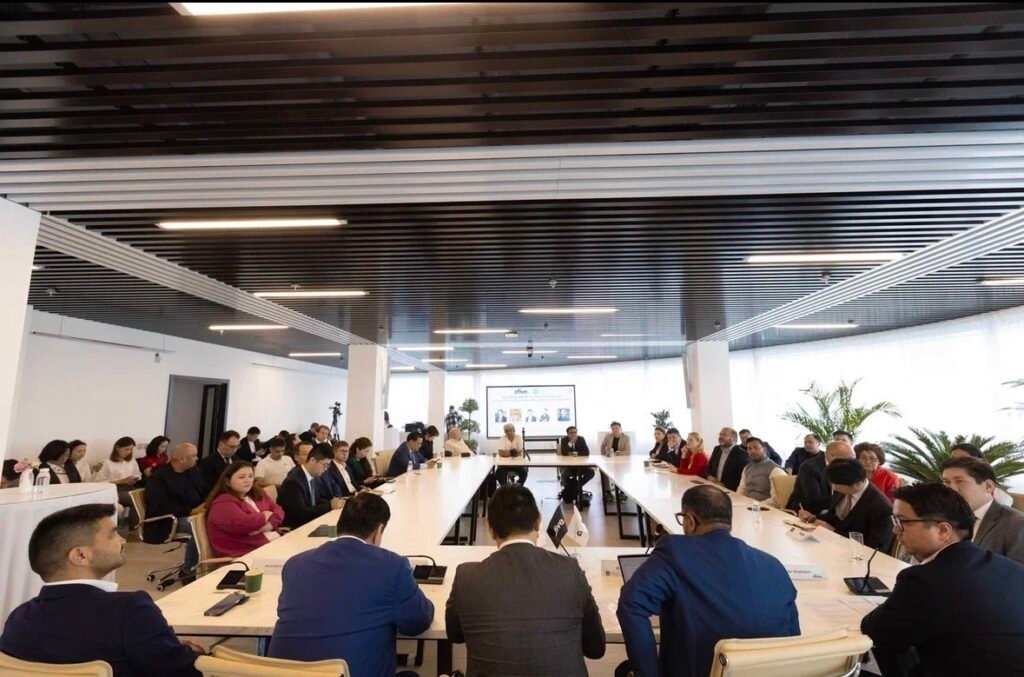
That question was at the heart of the expert discussion “Kazakhstan and the New Eurasian Landscape: Strategic Partnerships, Connectivity and Economic Opportunities,” held in Astana on August 21. The event was organised by the CFive Intellectual Platform at Astana International University in cooperation with the Hudson Institute.
The meeting marked the Hudson Institute’s first event in Central Asia and brought together diplomats, former ambassadors and senior officials, international experts, representatives of national companies, academics and business leaders.
Moderated by Iskander Akylbayev, Chairman of CFive, the discussion went beyond transport corridors, energy routes and competition among major powers. At its core was a broader question: what role can Kazakhstan play in a Eurasia where established economic and political relationships are being rapidly reshaped?
Eurasia Is Changing — and So Is the Importance of Central Asia
In recent years, Central Asia has ceased to be viewed merely as a peripheral region situated between major global centres.
The region is gaining importance as a source of energy and raw materials, an expanding consumer market, a transit space and a potential platform for new production and supply chains.
At the same time, the logic of Eurasian trade is changing.
Governments and businesses are looking for additional supply routes, seeking to reduce dependence on individual transport corridors and increasingly viewing overland connectivity as an element of economic resilience.
Kazakhstan occupies a particularly important position in this emerging landscape.
Ken Moriyasu, Senior Fellow at the Hudson Institute, described Kazakhstan as one of Eurasia’s important “swing states,” whose strategic relevance is increasing as competition between the United States and China intensifies.
One of the clearest examples is the Middle Corridor, linking China and Central Asia with the Caspian Sea, the South Caucasus and European markets.
But Kazakhstan’s prospects extend beyond a single transport route.
The development of energy links, expanding trade, new Caspian connections, and the potential integration of Afghanistan and Pakistan into emerging regional networks could contribute to a much broader system of Eurasian connectivity.
For Astana, this creates a strategic choice: whether to remain primarily a territory through which goods and energy resources pass, or to use connectivity to build its own economic and geopolitical value.
From Geography to Trust
This is where a resource that cannot be built through infrastructure alone becomes particularly important: trust.
As Muise Wahabdeen, an expert at the Geneva Nations Institute, noted, Kazakhstan’s advantages cannot be reduced to its geography or natural resources.
One of the country’s most significant strategic assets, in his view, is its ability to maintain working relationships with states and institutions whose interests may themselves be complex or competing.
This gives Kazakhstan an opportunity to move beyond the conventional role of a transit hub.
The country could increasingly develop as an investment, intellectual and diplomatic centre, where not only transport flows but also capital, expertise and international networks converge.
For Central Asia, this is particularly significant.
In a region where the interests of Russia, China, the United States, the European Union, Türkiye and other external actors increasingly intersect, the ability to maintain dialogue with different sides can itself become a strategic advantage.
Diplomacy as a Form of National Capital
Kazakhstan’s foreign policy has traditionally been built around maintaining relationships with as broad a range of international partners as possible.
In the current environment, this approach is taking on renewed importance.
Bulat Sarsenbayev, a diplomat and former Ambassador Extraordinary and Plenipotentiary of Kazakhstan, stressed the need to assess the ongoing geopolitical transformation primarily through the national interests of Kazakhstan and the wider Central Asian region.
From this perspective, multi-vector diplomacy is no longer simply a response to external pressure.
It becomes a means of expanding the country’s room for independent decision-making.
Particular attention during the discussion was given to President Kassym-Jomart Tokayev’s international experience, including his work within the United Nations system and his diplomatic service in Geneva.
For Kazakhstan, this experience has significance beyond biography.
Work in multilateral institutions provides an understanding of how states with different interests interact and how dialogue can be maintained even when political compromise is difficult to achieve.
Amid growing international fragmentation, such diplomatic capacity represents a strategic resource that may not be easily measured in economic terms but can directly shape a country’s international standing.
Domestic Reform Is Becoming Part of Foreign Strategy
Yet a country’s international role cannot be built on diplomacy alone.
It also requires a strong domestic foundation.
This is why Kazakhstan’s current political modernisation is significant not only for its internal development but also for its international positioning.
The new Constitution, which entered into force on July 1, 2026, established a new institutional framework for the legislative branch. The previous bicameral Parliament was replaced by a unicameral Kurultai, defined by the Constitution as the country’s highest representative body exercising legislative power.
The Kurultai consists of 145 deputies, elected for five-year terms through party lists in a single nationwide constituency. Elections are based on universal, equal and direct suffrage by secret ballot.
On August 23, 2026, Kazakhstan will hold its first elections to the Kurultai.
Their significance extends beyond the formation of a new legislature.
They represent the first major political process following the entry into force of the new Constitution and, consequently, the first opportunity to assess how the new institutional model will function in practice.
This is where an important distinction emerges between reform as a constitutional document and reform as a functioning political process.
Kazakhstan’s Model of Political Modernisation
Against the broader Central Asian backdrop, Kazakhstan is increasingly seeking to establish itself as a country capable of pursuing political modernisation while maintaining institutional and economic stability.
This is particularly important given the country’s geopolitical position.
Kazakhstan operates in an environment where major regional powers retain significant influence, while simultaneously seeking to deepen its relations with the European Union, the United States, China, Türkiye, the Middle East and other international partners.
Under these circumstances, domestic stability becomes part of the country’s external attractiveness.
For investors, Kazakhstan’s appeal is not limited to oil, uranium, transport infrastructure or market access. The quality of public institutions, regulatory predictability, governance and the ability to provide stable conditions for long-term economic activity are equally important.
Political reform and economic strategy are therefore becoming increasingly interconnected.
If the new representative system functions effectively, it could further strengthen Kazakhstan’s image as one of Central Asia’s most institutionally developed and politically modernising states.
At the same time, the ultimate assessment of the reforms will depend not simply on the holding of elections, but on how the new system performs afterwards.
The August 23 Elections as the Beginning of a New Phase
The upcoming Kurultai elections therefore carry a dual significance.
Domestically, they will establish a new legislative institution.
Internationally, they will provide one of the first indications of how Kazakhstan is translating its stated constitutional modernisation into the practice of governance.
The Kurultai has broad constitutional powers, including lawmaking, participation in the formation of the government and mechanisms of parliamentary oversight.
For this reason, the key question after August 23 will no longer be the architecture of the new system itself, but its effectiveness.
How actively will the new legislature operate? How substantive will political competition be? And will the Kurultai become an effective channel for representing a broad range of public interests?
The answers will shape perceptions of Kazakhstan’s reform process far more than constitutional provisions alone.
Energy: Traditional Resources in a New Geography
The economic dimension of the emerging Eurasian architecture cannot be separated from energy.
Abzal Narymbetov, an energy-sector expert and founder and CEO of Energy Analytics, stressed that conventional energy resources remain highly significant to the global economy despite the accelerating energy transition.
For Kazakhstan, this creates a need to preserve the competitiveness of its traditional energy sector while expanding opportunities to diversify export routes.
The Caspian dimension is particularly important in this regard.
The discussion also addressed Turkmenistan’s energy potential and the prospects for closer transport connectivity involving Afghanistan and Pakistan.
If such projects advance, Central Asia could strengthen its position not only as a resource-producing region but also as a space through which important trade and energy links between East and West are channelled.
The Next Stage
Kazakhstan is entering a new period in which foreign policy, economic connectivity and domestic reform are becoming increasingly interconnected.
If political modernisation is supported by effective institutions, economic strategy by diversification, and diplomacy by the ability to preserve space for dialogue, Kazakhstan will have an opportunity to strengthen its distinctive position in Central Asia.
This moment matters beyond Kazakhstan itself.
For the wider Eurasian region, the country may become an example of how a middle-sized state can seek to transform a complex geopolitical environment into a source of opportunity.
August 23 will be only the first test of the new political architecture. The more consequential question will be whether Kazakhstan can, over the years that follow, turn its reforms, diplomatic assets and geographic position into a durable national advantage.
If it succeeds, Kazakhstan’s role in the new Eurasia will be defined not by which powers it stands between, but by what it is able to connect among them.

