

One of the issues the Swiss will vote on this month is the so-called Food Initiative which, among other things, is pushing for high-quality, locally-grown food supply. What is the situation in Switzerland in this regard right now?
The initiative, instigated by a small group of individuals led by an environmental activist Franziska Herren, states that the Swiss population “must have access at all times to sufficient quantities of high-quality and affordable food,” with Swiss agriculture providing the bulk of the supply.
What the initiative is seeking is obviously the ideal, ‘best-case’ scenario, but the opponents, including the government, say this goal is not realistic and hardly achievable – if only because Swiss farms are able to supply just under half of domestic food consumption, with th rest being imported.
READ MORE: Why the Swiss will vote on the country’s vital food needs
Can you be sure the food you buy in Switzerland is safe?
According to the government, yes.
“The food and agriculture sector ensures that the public has access to safe, high-quality and sustainably produced products,” it writes.
“Accreditation ensures that laboratories, inspection bodies and certification bodies operate independently and in accordance with recognised standards.”
Further, “in agriculture and throughout the food supply chain, accredited bodies test, inspect and certify production processes, product safety, animal welfare and hygiene.”
So you know the food you consume is safe, but is it of high quality?
Overall, the answer is ‘yes’, though it pretty much depends on what you are looking to buy – fruit, vegetables, meat and dairy products, or sugary snacks with high saturated-fat content?
Here are some of the positive and negative aspects of food in Switzerland.
First, he positive:
Lots of organic (‘Bio’) food
The Swiss consume more organic food than any other Europeans, spending an average of 454 francs per person on it each year.
And the good news that this kind of ‘clean’ and sustainably produced food is plentiful at Coop and Migros, and to some extent at Aldi and Lidl as well.
READ MORE: What does the ‘bio’ label on foods in Switzerland really mean?
Locally-grown
Even if they don’t carry the ‘Bio’ label, Swiss favour locally-grown and produced food over imported one, especially when it comes to items like eggs, butter, fruits, and vegetables – even if it they are more expensive.
It is easy to find these products, labelled ‘regional’ or ‘from the region’ in stores.
Now for the negatives
Alongside the healthy and nutritious, are the processed foods and sweetened beverages, which rank among the most unhealthy because of their high content of empty calories, sodium, and harmful fats.
Why are they being sold in the first place?
Because there is demand for them.
Interestingly enough, the consumption of junk food in Switzerland varies by linguistic regions.
According to a study by University of Zurich, “in German-speaking Switzerland, people eat a lot of cheese and dairy products and are very partial to chocolate, while those in the French-speaking part drink more alcohol. In both regions people eat a lot of meat and cold cuts, sometimes too much. And unsurprisingly, the people in the Italian-speaking part of the country eat the closest to the ideal of the Mediterranean diet, which has long been held up as the healthiest way to eat.”
What the government says
Despite the availability of healthy foods, “the Swiss population does not eat a balanced diet. They consume too many sweets, too many salty and fatty snacks, and not enough fruits, vegetables, and legumes.”
This is the finding of the Federal Food Safety and Veterinary Office (FSVO), which developed the so-called ‘food pyramid’ showing what the population should eat to stay healthy.
“It is advisable to consume five portions of varied fruit and vegetables per day, favouring regional and seasonal products. Finally, the beverages group – and more particularly water – remains the most important group from a quantitative point of view, while sugary drinks, sweets and salty snacks are considered optional products in the daily diet.”
This food pyramid shows what, and how much, you should eat on daily basis:
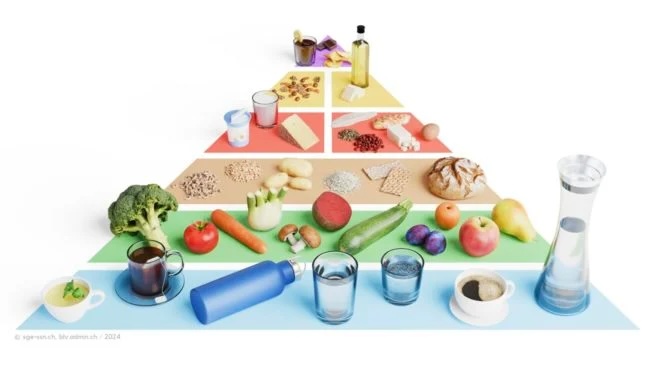
FSVO
READ MORE: What the Swiss government wants you to eat to stay healthy
In conclusion…
Swiss supermarkets offer plenty of healthy options, so it is easy – though not necessarily cheap – to consume high-quality food.
However, many people give in to the temptation of eating too much food with no nutritional value whatsoever.
