


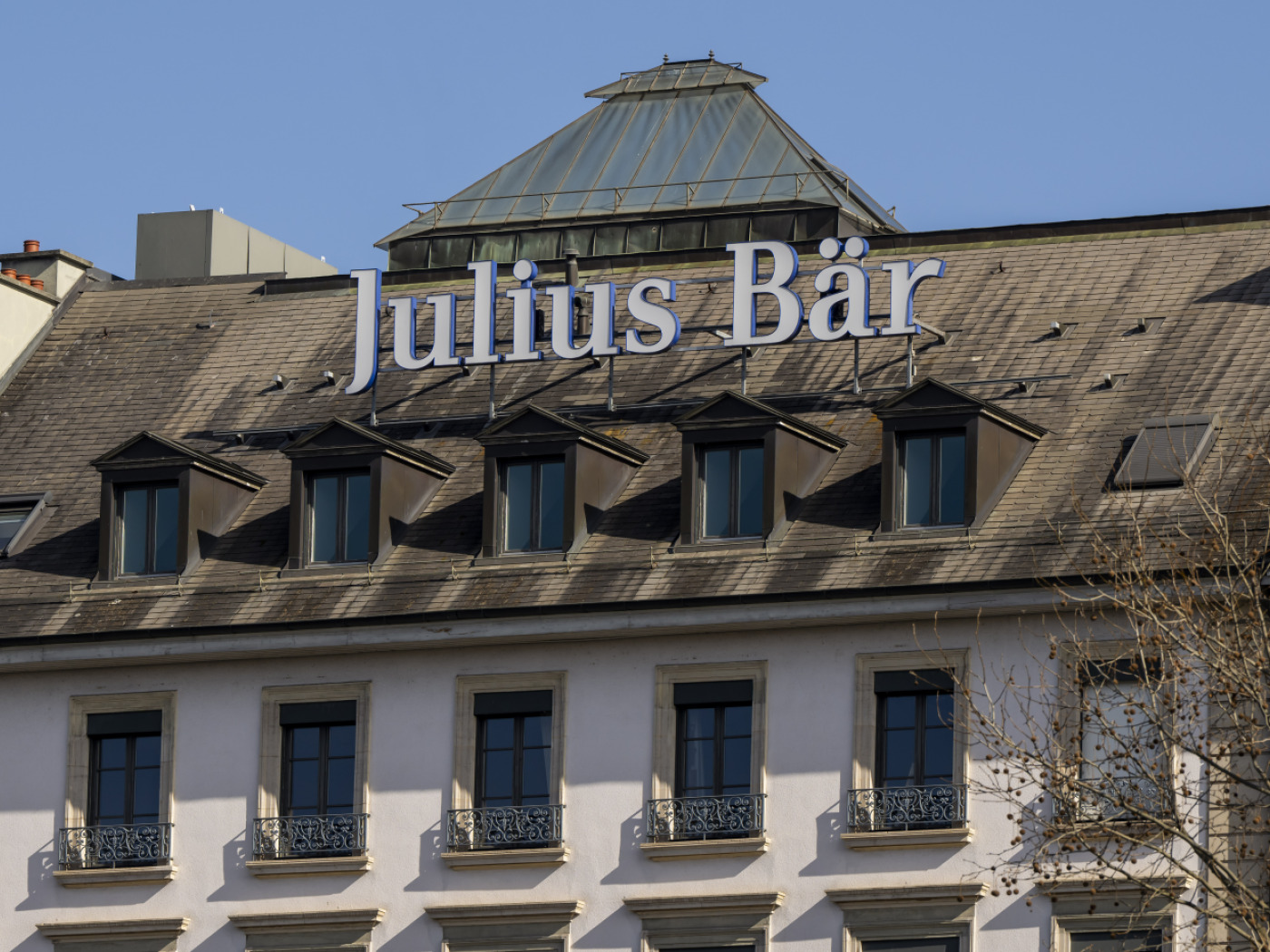
A Julius Baer logo in central Zurich.
Keystone / Steffen Schmidt
The dismissal of an appeal by its former managing director paves the way for the conclusion of a civil case against the Swiss private bank.
Private bank Julius Baer is under renewed pressure over a CHF20 million ($24 million) legal claim after Switzerland’s highest court upheld the conviction of one of its former bankers who stole millions from two of its wealthy clients and used the money to buy a yacht.
External Content

Benjamin Guzman, a former Julius Baer managing director, lost his appeals against convictions for misappropriation and criminal mismanagement in the Federal Court in a judgment published this month, paving the way for the conclusion of a civil case against the Swiss bank.
Gregory and Vera Mirlas have been pursuing Julius Baer since 2022 through a legal claim filed in Zurich’s Commercial Court, but those proceedings have been in limbo while the criminal appeals ran their course.
The case, which involves the purchase of a luxury yacht and millions transferred through the bank’s payment systems, raises questions about how far Swiss lenders are responsible for protecting clients from fraud committed by their own employees and external wealth managers.
The civil court has yet to determine whether Julius Baer itself bears responsibility for the losses. Similar cases involving fraud by private bankers have resulted in successful civil claims against their employers, although the bank’s liability must be established separately.
The Federal Court found Guzman had used €1.5 million (CHF1.38 million) from accounts belonging to the Mirlases to help buy himself a yacht called My Celtic Dawn while still working at the bank.
Guzman created a payment order marked “on behalf of one of our clients”, despite the couple having given no such instruction, according to the judgment. The Mirlases’ names have been changed in this article at the couple’s request.
More

More
A brief history of Swiss banking oversight and its scandals
After leaving the bank to become an independent wealth manager, Guzman used a further CHF8.78 million of the couple’s money to buy shares in a company called Sunbay, including through a CHF8.25 million Lombard loan provided by Julius Baer.
He registered the shares in his own name, leaving the couple without an enforceable claim to the investment. In another transaction, he transferred CHF4 million into his own account after misleading the couple about its purpose.
The Supreme Court dismissed appeals by Guzman and his former wife, leaving intact his three-year prison sentence, of which 18 months must be served.
Julius Baer has disputed responsibility, arguing in the civil proceedings that the Mirlases failed to adequately monitor their accounts over many years, according to the couple’s legal representatives.
The Federal Court upheld findings that the couple had placed considerable trust in Guzman and signed documents he presented to them without properly examining them, although the ruling did not address Julius Baer’s own potential liability.
The case is another legal challenge for Julius Baer, which has spent years battling scandals and regulatory failures, most recently suffering heavy losses from the collapse of Austrian property group Signa.
Chief executive Stefan Bollinger, who joined last year, has sought to draw a line under the bank’s legacy issues as part of a broader turnaround, with Julius Baer’s shares rallying over the past year as investor confidence in the lender has recovered.
In September, Swiss regulator Finma concluded its latest enforcement proceedings against Julius Baer, acknowledging improvements under new management while imposing additional capital requirements.
More
More
Swiss financial watchdog ends Julius Bär proceedings
A spokesperson for the Mirlases welcomed the ruling after years of legal proceedings, saying three Swiss courts had now confirmed what happened to the couple’s money. But they said it remained to be seen whether the bank they had entrusted with their savings would “take responsibility for the loss”.
Julius Baer declined to comment.
Copyright The Financial Times Limited 2026


