


In mid-January, a White House reporter asked newly elected US President Donald Trump about what to expect from Nato countries that spend the least amount of money, like Spain, Trump responded that Spain’s contribution “is very low”, before mistakenly referring to Spain as a BRICS country.
During his first term in office, the Republican leader often criticised European Nato countries for failing to meet the agreed defence spending target of two percent of their GDP, but more recently he has demanded that countries up their spending even further, to at least five percent of their GDP.
Now that Trump has blindsided European allies with plans for direct negotiations with Russia to end the war in Ukraine, leaders from key European powers gathered in France to come up with their own plan, with spending budget one of the discussion points.
READ ALSO: Europe’s security is at a ‘turning point’, EU leader warns
Back in July 2024, the Financial Times ran an article titled “Why Spain is Nato’s laggard on defence spending” in which it explained why the EU’s fourth-biggest economy contributes a lower share of its GDP to the military than any other Nato ally”.
The FT is not alone in pointing this out, as after all it is true to Spain’s 1.28 percent of GDP spent on defence is lower than any other Nato country.
But does Spain really deserve to be singled out for not pulling its weight militarily on the global stage?
For reference, Poland is the only European country that comes anywhere close to spending five percent of its GDP in defence.
In 2023, just nine countries in the whole world spent five percent of GDP or more on defence. This included Algeria, Armenia, Israel, Lebanon, Oman, Russia, Saudi Arabia, and South Sudan. Most of these are still or were at war at time.
While 72 percent of Nato allies were predicted to meet their two percent goal for defence spending last year, a total of eight countries spent less than this on their military budget. One of these was Spain, along with Slovenia, Luxembourg, Belgium, Canada, Italy, Portugal, and Croatia.
READ ALSO: Spain says it’s ‘too soon’ to talk about sending troops to Ukraine
Advertisement
In a response to Trump’s January comments, Prime Minister Pedro Sánchez defended Spain’s efforts by saying: “In the last 10 years, we have increased by 70 percent our total defence expenditure. If we take those figures in absolute terms, what we can say is that Spain is the 10th top contributor to Nato”.
This is true that when it comes to total Nato budget, Spain is among the top 10 contributors, actually coming in at number seven, contributing 5.8 percent of the total budget, just behind Canada.
In fact, a report from the RAND Global Studies Centre, commissioned by President Trump himself, suggests that collective defence should be measured not only by countries’ spending, but by their true capabilities. This new scale puts Spain in a much better position than in last place.
This system is what they call the “burden sharing index” and involves knowing what to ask and from which country, depending on specific needs.
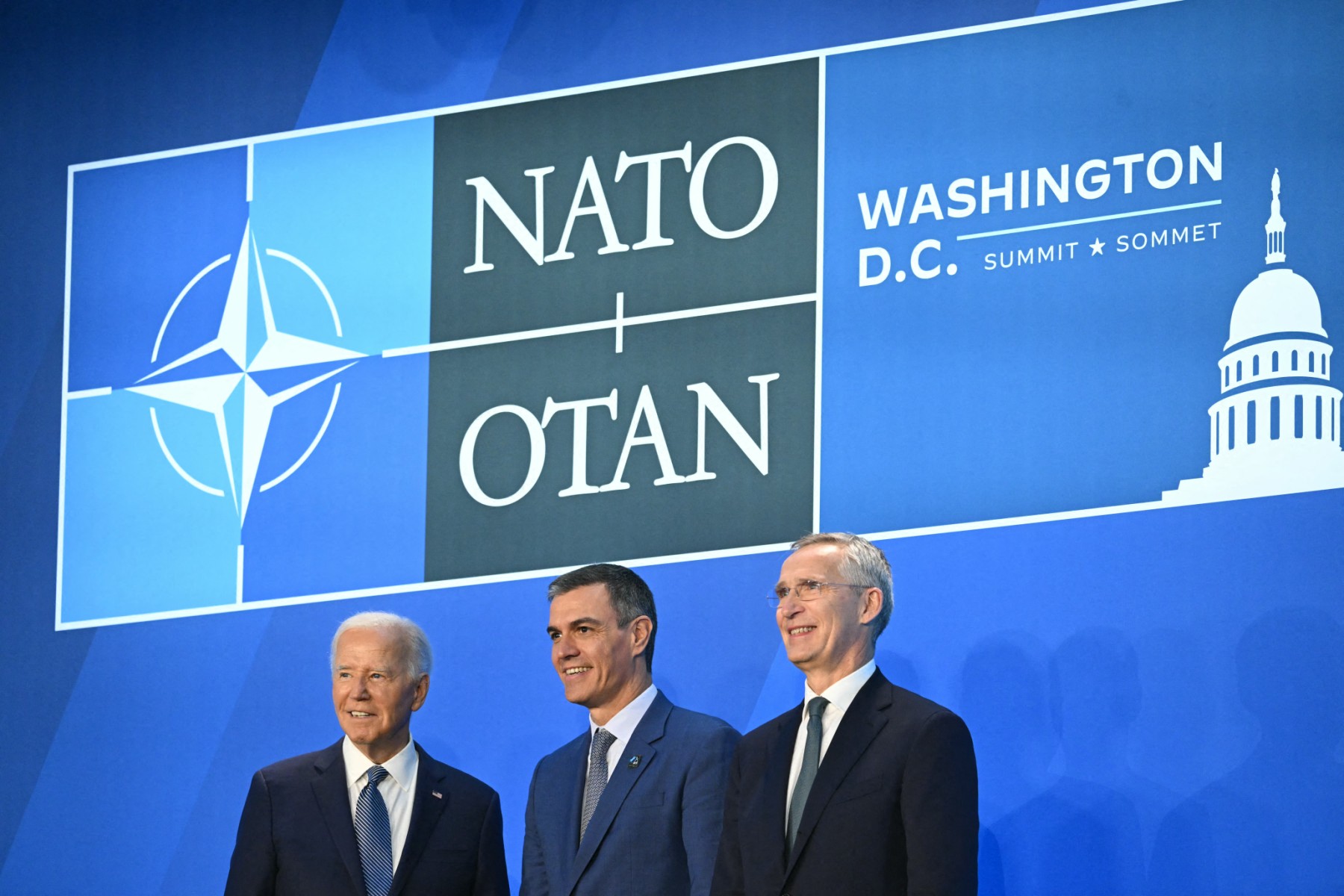
Spanish Prime Minister Pedro Sánchez (C) is welcomed by now former US President Joe Biden (L) and NATO Secretary General Jens Stoltenberg for the NATO 75th anniversary summit in Washington in July 2024. (Photo by SAUL LOEB / AFP)
The burden ratio is calculated by comparing the percentage contribution of each ally to the total burden of collective defence with its participation in the total allied GDP.
This system offers a more sophisticated and precise picture than the current measuring bar, which is focused solely on military spending as a percentage of GDP.
Advertisement
This may seem unnecessarily complicated and confusing, but in fact it’s not. RAND researcher Charles King Mallory explained the system by giving an example of one country that pays 2.1 percent of its GDP to maintain old equipment and pay pensions to retired military officers compared with another that spends 1.9 percent, but has a well-trained army, modern equipment and a cutting-edge military drone industry.
The first country spends more than the two percent, but the second country is using its resources more efficiently, so it doesn’t always come down to who spends the most money.
This new scale places Spain as one of the top five countries that contribute the most to Nato.
According to this index, Spain contributes 3.03 percent to Nato, measured in economic burden.
READ ALSO: Where are the US’s military bases in Spain and why are they there?
Advertisement
Germany for example contributes a higher percentage of its GDP to defence than Spain, but allocates a high percentage of its budget to administrative expenses. Spain’s expenses on the other hand are focused mainly on combat capabilities – around 70 percent, according to Mallory.
Despite all of this, Spain is planning on upping its military spending even more in the coming years, following all the pressure from the US and other Nato members, but primarily as a result of the recent wakeup call among EU nations that they have to take care of their own security.
According to Spain’s leading national daily El País, whose reporters had access to the draft bill on Spain’s increased military spend, this year the country will contribute 1.32 of its GDP to defence and this will rise year on year until it reaches two percent in 2029.
In five years, Spain’s defence budget will go from €17.5 billion to €36.56 billion, which is more than double.


