

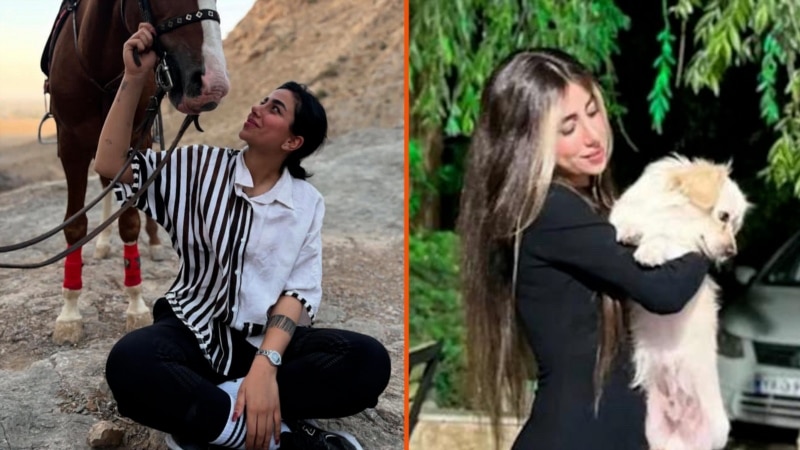
Iranian twin sisters Taraneh and Romina Rahimi turned 20 behind bars this year, awaiting the outcome of a case that has drawn scrutiny over allegations of torture, forced confessions, and severe mistreatment of the defendants.
The sisters are among 16 people tried in Isfahan, in central Iran, in connection with demonstrations in the city during mass nationwide protests in January.
“These children have been and are still under enormous pressure, both psychologically and physically,” their cousin, Masud Nurmohammadi, told RFE/RL’s Radio Farda.
The sisters have been convicted of moharebeh, or “waging war against God,” aiding and abetting moharebeh, destruction of public property amounting to moharebeh, assembly and collusion, and propaganda against the Islamic republic.
Taraneh and Romina have both been sentenced to death and 25 years in prison, according to their family.
Torture Allegations
Nurmohammadi, who lives in the United States, said Taraneh had undergone surgery on her leg and had screws and plates inserted before she was detained. He said her condition deteriorated significantly in prison following what he described as repeated torture.
“We don’t know whether her leg was broken, whether the screws and plates were displaced, or what happened,” he said.
According to Nurmohammadi, a prison doctor ordered that Taraneh be urgently taken to a hospital for treatment, but prison authorities prevented her from receiving the care.
“They repeatedly told Taraneh, ‘You’re going to be executed. Whether you have a broken leg or a healthy leg, you’re going to be executed. It doesn’t matter whether you have a leg or not.'”
Nurmohammadi said Taraneh eventually told relatives during a phone call from prison that she could no longer walk.
“A 20-year-old girl who should now be standing on her own feet, riding her horse, and playing sports,” he said.
The Rahimi sisters were arrested a week after the peak of the protests on January 8-9. Nurmohammadi said masked security forces raided the home where Taraneh was staying and tied her hands and feet before taking her away. Romina was later arrested in a similar raid on their mother’s home.
The family say they believe the sisters’ close relationship was used against them during interrogations.
“My guess has always been that they took Romina because of the pressure they put on her and the torture they inflicted on her, to force Taraneh to confess,” Nurmohammadi said, “because they are twins and are very close to each other.”
The defendants were accused of making Molotov cocktails at a shoe store near Shahada Square in Isfahan. Prosecutors have also alleged the defendants were responsible for the deaths of two people during the unrest, but no murder charges were brought.
Thousands were killed in the unrest that swept Iran in January, as the authorities shut down the Internet and cracked down on protesters. The 16 people in Isfahan were charged following the death of an Islamic Revolutionary Guards Corps (IRGC) commander in the city during violent demonstrations on January 8.
Nurmohammadi rejected the allegations against the sisters, saying their lawyers had found no evidence linking them to the charges.
“The lawyer says there is nothing in this case against these children,” he said. “No evidence has been presented. There is no evidence.”
He also alleged that Taraneh was subjected to severe physical abuse during interrogation, saying her face and body were swollen and bruised when her aunt finally saw the sisters after months in detention.
“They had pulled them by their hair from one cell to another, from one room to another, to the point that all their hair had been pulled out,” he said.
Rape Threat
Nurmohammadi said interrogators threatened to sexually assault Romina in front of Taraneh if she refused to confess.
“They told her, ‘If you don’t sign this paper we’re giving you, if you don’t say the things we want, we’ll rape your sister in front of you,'” he said.
He said Taraneh was then forced to listen to the sounds of her sister screaming during alleged torture.
“Anyone would break under these circumstances,” he said.
The family has also raised allegations of sexual assault against Taraneh in prison. Nurmohammadi said lawyers have filed complaints over the alleged sexual abuse and torture, but that the complaints have not progressed in Isfahan’s courts.
The sisters’ lawyers have now been allowed to review the case file — after their conviction — and are preparing an appeal, he said.
Rights groups have for years raised concerns about Iran’s treatment of protesters. In January, Amnesty International warned that thousands of people “arbitrarily detained” in relation to the protests were “at risk of torture and other ill-treatment, including sexual violence, and grossly unfair trials leading to prolonged imprisonment and the death penalty.”
Meanwhile, their family say their condition remains dire.
“The situation of the children in prison is terrible,” Nurmohammadi said. “I never thought an Iranian could treat another Iranian this way…depriving them of water or seeing a doctor. The conditions are horrific.”
Nurmohammadi described Taraneh as a kind and compassionate young woman who loved animals and was an equestrian. Romina, he said, was representative of a younger generation of Iranians: “bold, brave, and fearless.”
