


Iran and three members of a regional mutual-defense pact have agreed to continue talks after their first meeting in Tehran, Iranian state television reported.
Iranian officials met with representatives of Saudi Arabia, Pakistan, and Turkey, the signatories to the Mecca Defense Alliance on October 26, to defuse tensions in the region.
The sides “agreed to continue discussions to strengthen cooperation…including on regional peace and security,” state television said.
The meeting came as the US-Iran war and increasing attacks by Iran-aligned Houthi rebels on Saudi Arabia have left the region reeling and are impacting global flows of oil and other cargo.
‘Last-Ditch Effort’
Ahead of the meeting, a senior security official in Islamabad told RFE/RL that one of the main points of the meeting was to try to convince Iran to use its influence over Houthis to stop attacks on Saudi Arabia. The official said the alliance countries were prepared to raise the prospect of closer Saudi-Israeli security cooperation as leverage.
“The key question is why Iran should comply? The answer is that Saudi Arabia may ask for support from Israel and that will potentially require them to join the Abraham Accords,” said the official.
The accords, signed in 2020, normalized relations between Israel and several Arab states, including the United Arab Emirates and Bahrain.
“Since Turkey has already diplomatic relations with Israel, the trio might place this scenario on the table should Tehran refuse to rein in the Houthis,” said the official. While Iran may comply by using its influence over the Houthis, the official added that it is unlikely that the regime would soften its stance on negotiations with the United States over the war.
Islamabad-based analyst Azaz Syed said the US-Iran conflict would be just as important during the meeting amid fears Washington is preparing to renew its military attacks on Iran.
Pakistan’s powerful army chief, Asim Munir, was in Tehran last week where he reportedly delivered a “last warning” to the Iranian government.
“Apparently, this was a last-ditch effort to convince the Iranians” to come to a negotiated settlement with the United States, Syed told RFE/RL.
“The three partners will ask for an end to Houthi attacks, of course, but the key message is the broader settlement.”
Hamidreza Azizi, senior analyst at the Belgium-based International Crisis Group, said that the meeting in Tehran was a last-minute attempt to prevent another escalation.
“The immediate priority seems to be finding a way to prevent the resumption of war between Iran and the United States,” Azizi told RFERL.
Azizi said the October 26 meeting was essentially a continuation of diplomatic efforts already under way, and the timing suggests that regional countries are increasingly concerned that these efforts may be running out of time.
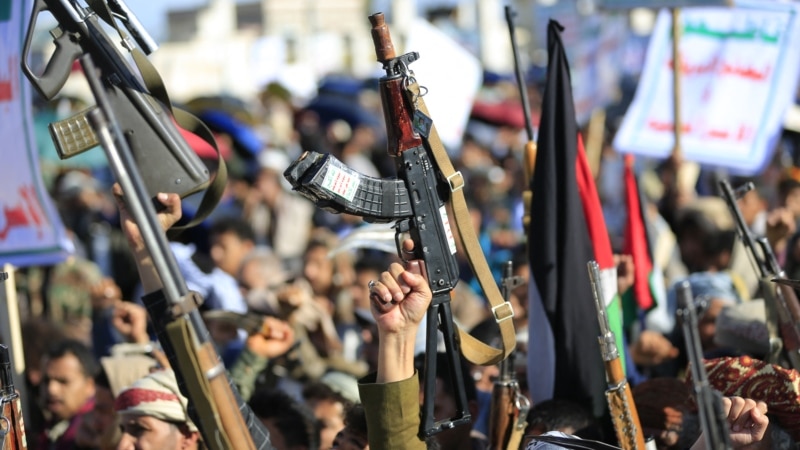
The Houthis, allies of Tehran who primarily operate from Yemen, have intensified their missile attacks on Saudi Arabia, targeting airports and oil infrastructure at a time when energy transit in the Middle East has already been curtailed by the closing of the Strait of Hormuz, the waterway that normally sees around one-fifth of the world’s oil and gas flows transported through it.
Earlier this month, Houthi rebels attacked Riyadh’s King Khalid International Airport, killing 13 people and wounding more than 300. The rebels have also warned airlines against using Saudi airspace.
Saudi Arabia has in turn launched strikes on Houthi targets in Yemen.
The conflicts have shed light on the complex diplomatic relations between nations across the Middle and Near East.
The Mecca Alliance enshrines a collective security arrangement modeled on NATO’s Article 5, stating that “any armed attack against any one of the three states shall be regarded as an attack against them all.”
Iran-Pakistan Tensions
The meeting also came amid already heightened tensions between Iran and Pakistan after Islamabad closed two border crossings between its Balochistan Province and Iran’s Sistan-Baluchistan Province.
Pakistan has also introduced changes in its E-form procedure, a digital declaration authorizing the tracking of foreign currency remittances, for Iranian exports coming into the country.
Sources say Islamabad has also suspended operating clearance for Mahan Air, the Iranian airline believed to have links with Iran’s Islamic Revolutionary Guards Corps (IRGC). Iranian and Pakistani authorities have neither admitted nor denied the reports.
The Iranian side, in reaction, stopped the export of Liquified Petroleum Gas (LPG) to Pakistan causing manifold increase in gas prices for domestic and commercial consumers. Pakistan imports around 7,000 metric tons of LPG every day from Iran.
“The visit also underscores the pivotal role of the Mecca Pact states in fostering regional security and stability, and their commitment to working with all nations in the region toward achieving this goal,” said Saudi Deputy Minister for Public Diplomacy Rayed Krimly in a social media post.
Commenting on the closure of Iran-Pakistan border crossings, Tehran envoy to Islamabad Reza Amiri Moghadam said in a social media post that consultations with the Pakistani side are under way to address the issue of cross-border trade.
Moghadam said several hundred trucks carrying LPG have crossed the Rimdan border into Gabd on the Pakistani side. However, despite having remained there for several weeks, these trucks have yet to be unloaded or cleared up, further complicating the movement of goods and the smooth flow of bilateral trade.
Significant Step
Rabia Akhtar, a professor of international relations at the University of Lahore, said the immediate concern among the three partners was to prevent the current confrontation from escalating further.
“Nobody at that table really benefits from another regional war,” Akhtar told RFE/RL, who added that if the participants can establish some understanding on restraint — particularly regarding Saudi security, the Houthis, and further escalation with Iran — that would already be a meaningful outcome.
“So I would see this as an attempt at regional crisis management rather than the birth of a new security architecture. And in the present circumstances, even that would be quite consequential,” Akhtar said.
Azizi of the International Crisis Group said the meeting could help reduce tensions, at least temporarily, by keeping channels of communication open.
“But the main problem remains unresolved: Iran wants credible security guarantees against renewed attacks, while the regional mediators have limited ability to influence Washington’s decisions.”


