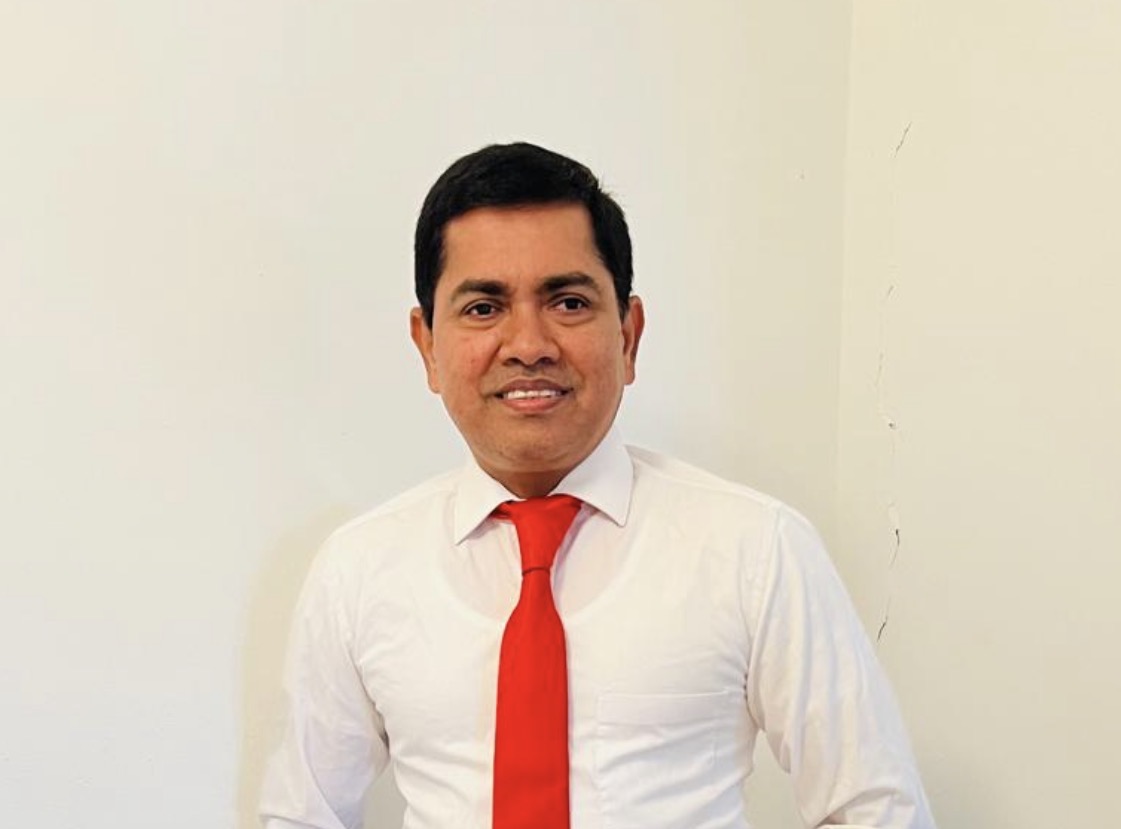
Dr. Mohamed Shareef Asees
Guest Columnist, Geneva Times
Dr. Mohamed Shareef Asees holds a PhD in Global Studies, a Master of Arts in International Relations, and a Bachelor of Arts in Political Science. He is a researcher and lecturer specializing in International Relations, Geopolitics, Peacebuilding, and Global Affairs. Based in Berlin, Germany, his work focuses on international security, conflict resolution, diplomacy, and contemporary geopolitical developments. He regularly contributes scholarly analysis and commentary on global political trends, international cooperation, and peacebuilding initiatives.
In international politics, wars are usually expected to follow a familiar pattern: tension, escalation, full-scale conflict, and eventually negotiations that lead to either peace or a frozen ceasefire. Yet the current situation involving Iran and the United States in 2026 does not fit neatly into this traditional model. Instead, it reflects something far more complex and increasingly common in today’s global order, a conflict that exists simultaneously between war and negotiation, without moving decisively toward either peace or total war
A conflict without a clear ending point
Over the past months, tensions between Iran and the United States have fluctuated between periods of military escalation and diplomatic engagement. There have been strikes, counterstrikes, and heightened military readiness in the region, particularly around strategic waterways such as the Strait of Hormuz. At the same time, diplomatic channels have remained open through intermediaries and indirect talks. This dual reality between war and negotiation has created an unusual situation. Neither side has fully committed to total war, but neither has stepped away from confrontation either.
This is not a classic battlefield, war with frontlines and territorial occupation. Instead, it is a layered conflict involving military pressure, economic constraints, political messaging, and continuous bargaining. It is precisely this mixture that makes the situation difficult to define and even harder to resolve.
The United States and the limits of military pressure
From the American side, the conflict has revealed an unexpected strategic challenge. Military pressure, sanctions, and limited strikes were initially expected to quickly shift the balance in favor of Washington’s objectives. However, the reality has proven more complicated.
Iran has not collapsed under pressure. Instead, it has responded with resilience, strategic adaptation, and continued resistance. This has forced a reconsideration of earlier assumptions about how quickly Iran could be compelled to change its position through coercive means.
As the conflict has dragged on, it has become increasingly clear that escalation alone does not produce a decisive outcome. Instead, it risks creating a prolonged cycle of response and counter-response that neither side can fully control.
In this context, there is growing perception that Trump is now searching for an exit strategy a way to reduce military involvement while still claiming a diplomatic or strategic success. The language of negotiations, ceasefires, and potential agreements reflects this shift.
Iran’s strategy of endurance and resistance
Iran, for its part, did not initiate this conflict in the conventional sense of declaring war. However, it has consistently positioned itself as acting in defense of sovereignty, security, and strategic interests. In doing so, it has relied on a doctrine of resilience rather than quick victory. This approach has several dimensions. Militarily, Iran has demonstrated its ability to absorb pressure and respond in ways that maintain deterrence. Politically, it has maintained internal cohesion despite external stress. Strategically, it has used its geographic and regional position particularly in relation to maritime routes as a source of leverage.
What stands out most is not just Iran’s capacity to respond, but its ability to sustain itself under prolonged pressure. In a conflict where endurance matters as much as immediate force, this resilience has become a defining factor. For Iran, survival under pressure is not simply a defensive posture. It is also a form of strategic communication: a signal that external pressure will not automatically produce political surrender or systemic change.
War and negotiation at the same time
One of the most striking features of the current Iran crisis is the simultaneity of war and negotiation. In many past conflicts, negotiations typically begin after military exhaustion or stalemate. In this case, however, diplomacy has not waited for the end of violence it is occurring alongside it. This creates a dual-track reality. On one track, military actions continue in limited but significant forms. On the other, diplomatic channels remain open, with discussions taking place indirectly and through intermediaries.
This duality is not accidental. It reflects a broader transformation in modern international relations, where states increasingly use both pressure and dialogue simultaneously. Military action is no longer simply a tool of war; it is also part of negotiation strategy. Likewise, diplomacy is not separate from conflict it is embedded within it. The result is a system where escalation and negotiation reinforce each other, rather than replace one another.
Miscalculations and shifting perceptions
The current phase of the conflict has also revealed something important about perception and expectation in international politics. There is a growing sense that the United States and particularly political leadership in Washington underestimated the complexity and resilience of Iran’s response. The expectation that pressure would lead to rapid concessions has not fully materialized. Instead, the conflict has become longer, more complicated, and more politically costly than initially anticipated.
As a result, the strategic conversation appears to be shifting. Instead of focusing solely on escalation, there is increasing attention on how to manage de-escalation, create a framework for exit, or secure a limited agreement that can be presented as progress. This does not necessarily mean a retreat, but it does indicate recognition that the original assumptions about the speed and direction of the conflict were overly optimistic.
Changing perceptions of Iran in the global order
Beyond the immediate military and diplomatic dynamics, something more subtle is also taking place: the global perception of Iran is gradually shifting. For decades, Iran has often been framed primarily through the lens of threat perception, sanctions, and regional instability. However, the current conflict has added a new dimension to that image. Iran is increasingly being seen not only as a subject of pressure, but also as a state capable of sustained resistance, strategic calculation, and regional influence.
This does not mean that international disagreements over Iran have disappeared. But it does suggest that the simplistic narrative of unilateral vulnerability or isolation is no longer sufficient to explain the current reality. In many ways, Iran’s role in the conflict is reshaping how it is viewed not just as a state under pressure, but as an active participant in shaping the terms of engagement.
Implications for the future international order
The broader significance of the Iran conflict goes beyond the Middle East. It reflects a wider transformation in the international system itself. We are increasingly witnessing conflicts that do not end decisively, but instead evolve into long-term structures of managed tension. In these systems, war does not fully resolve disputes, and diplomacy does not fully eliminate conflict. Instead, both exist together in a fragile balance.
This has important implications for global stability. Energy security, maritime trade routes, regional alliances, and global diplomatic frameworks are all affected by this kind of prolonged uncertainty. If this pattern continues, the world may be entering an era where conflicts are less about final outcomes and more about continuous management where the goal is not victory or peace in the traditional sense, but controlled instability.
Conclusion: A conflict without closure
The Iran–United States confrontation today represents more than a regional dispute. It reflects a structural shift in how modern conflicts operate. War and negotiation are no longer separate stages; they are parallel processes. Iran has demonstrated resilience under pressure, while the United States appears increasingly engaged in balancing escalation with the search for an exit strategy. This is why the conflict persists. It does not move toward closure, because the system itself no longer produces clear endings.
Iran today stands at the center of this transformation not only as a participant in conflict, but as part of a broader redefinition of how power, resistance, and negotiation interact in the contemporary international order. And it is precisely for this reason that the conflict between war and negotiation is not ending. It is continuing evolving, adapting, and reshaping the future of global geopolitics in the process.