

KYIV — Olha Stefanishyna has held three prominent jobs under President Volodymyr Zelenskyy over the past six years, most recently as Ukraine’s ambassador to the United States.
Ahead of renewed US diplomatic efforts to end Russia’s war on Ukraine, Stefanishyna resigned in early August after serving less than a year in Washington.
Her departure came just days before Ukraine’s main anti-graft agencies, the National Anti-Corruption Bureau (NABU) and the Specialized Anti-Corruption Prosecutor’s Office (SAPO), formally notified her that she was suspected of illegal enrichment and failure to declare assets.
With Zelenskyy yet to appoint a new ambassador to the United States, Stefanishyna, in an interview with RFE/RL’s Ukrainian Service, discussed her decision to resign and the dynamics between Kyiv and Washington amid Russia’s full-scale invasion, now in its fifth year.
‘Russia’s Narrative Has Not Changed’
RFE/RL: We are speaking shortly after [US President Donald Trump’s] representatives [Steve Witkoff and Jared Kushner] visited Ukraine…. [Witkoff] has been to Moscow many times; this time they were in Kyiv for the first time. I assume you also worked on this visit when you were ambassador, because it was postponed for several months. How do you assess this visit in the short-term perspective?
Olha Stefanishyna: […] The most important element is simply that they came. The event itself is the fact that they came and made it all the way to Kyiv….
[…]
We can see that the narrative coming from Russia has not changed at all since last year. Remember last year, [US Army Secretary] Dan Driscoll came here and brought us 28 points, saying: “The winter will be difficult. Ukraine will not survive this winter. It is better to negotiate now than in six months. In six months, Ukraine will be in terrible shape; its energy infrastructure will have been destroyed…[Russia] will capture the Donbas.” It’s the same old story.
A year ago, this looked so realistic to the Pentagon, the White House, the US president, and the negotiators that they were almost panicked about taking responsibility for what would happen if Ukraine fell…. But we survived the winter. We stabilized the situation on the front, and the war has been shifted onto the enemy’s territory.
What do we see now? The negotiators have returned from Moscow…. And essentially, the narrative is the same. And in the eyes of the [US] negotiators, I am sure this weakens Russia. Because today, we have cards that we did not have back when President Trump spoke with President Zelenskyy [at the White House in February 2025].
Putin calls Trump and asks him to call Zelenskyy to make sure he doesn’t attack Moscow and Red Square on May 9. You see, we already have our own levers of influence. Over the past year, we have shown that, despite limited resources, restrictions on weapons supplies, and enormous political pressure, including pressure from the United States, we not only survived the winter, but Ukrainians also stood their ground…. We managed to show an entirely new reality on the battlefield and we have brought the war onto the enemy’s territory through our long-range strikes.
Did Washington Ask Kyiv To Halt Attacks Against Russian Oil Terminals?
RFE/RL: In Washington, how often did you receive requests from government representatives asking Ukraine not to attack [Russia’s] oil terminals, Novorossiisk — anything that could drive up energy prices or be unfavorable for the US government?
Stefanishyna: Never regarding any strikes, except for strikes that targeted either vessels belonging to [US oil giants] Chevron and Exxon or infrastructure at the port of Novorossiisk. I have longstanding and good relations with Kazakhstan. I was in contact with the Kazakh ambassador. So, on the one hand, there is an understanding of the situation. On the other hand, this is a major revenue-generating sector for Kazakhstan and a direct matter of US economic interest.
Both the Kazakhs and Exxon and Chevron have made it clear they understand Ukraine’s position, but they also understand their mistake was creating a situation in which there was no alternative route. In other words, there is no quick alternative to shutting down this terminal and establishing some kind of alternative routes. But the Russians…knowing this as well, moved their military capabilities as close as possible to the commercial infrastructure.
In the end, I figured out how this could be resolved. There is now a mechanism for working with the companies that makes it possible to avoid incidents like those we saw. We can see that, despite the fact that long-range [Ukrainian strikes] reach different parts of the world and Russia, they do not reach Chevron and Exxon vessels.
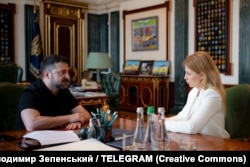
Ukrainian President Volodymyr Zelenskyy and Olha Stefanishyna meet in Kyiv in July 2025.
RFE/RL: Were you working on this solution while you were in Washington?
Stefanishyna: I was called directly to the White House, urgently. It’s quite a moment when you’re summoned to the White House at a high level and you don’t know why. I thought through a lot of different possibilities. I thought it could be about the war, peace, perhaps some kind of decision — maybe a license for Patriot [air-defense missiles], maybe the Lindsey Graham bill, or perhaps President Trump would come to Kyiv. I had all sorts of thoughts running through my head. Then I arrived and heard that this concerned the sovereign interests of the United States….
The first, official, message was that, while there is an understanding of Ukraine’s objectives in carrying out certain military operations, regardless of how those operations are assessed they result in events that directly harm the economic and sovereign interests of the United States. In other words, they said we should keep this in mind when we do something. And the second [message] was a call to develop a mechanism that would prevent this from happening.
Ukraine’s Corruption Scandals Through A US Lens
RFE/RL: […] Your [term as ambassador] coincided with a period when [Ukraine] was rocked by corruption scandals, most notably Mindichgate. A lot happened here in a relatively short period, from the fall of 2025 to the spring of 2026. First, [Zelenskyy’s former chief of staff] Andriy Yermak was formally suspected of a crime…. A number of ministers were also formally suspected of crimes…A lot of people were implicated. And all of this was happening while you were working in Washington…. What did you get asked about most often?
[…]
Stefanishyna: US politics is the politics of a mature society. We all understand and can see from the congresspeople and senators who come to Ukraine that…these are people who have been in politics for 30, 40, 50 years. So they’ve seen it all. These changes of ministers don’t particularly concern them.
I’ll say two things. First, the case involving Andriy Yermak was obviously a very big story in the United States because for many years Andriy was the person handling the US track…. In other words, he was actually the person who would pick up the phone and call Secretary [of State Marco] Rubio, and Rubio would speak with him. When events like these happen, of course, there were a lot of questions. And some of the communications that prosecutors decided to publish didn’t exactly help matters either, about Veronika Feng Shui….
RFE/RL: That’s about the president’s chief of staff appointing people after consulting fortune tellers and astrologers.
Stefanishyna: We discussed it all here in Ukraine like…it was a complete circus…. But in the United States, this information is viewed as part of the legal proceedings and as part of what Yermak is being accused of, because the information came from the prosecutor himself. So there were a lot of questions about it. They would ask, “Why is he being prosecuted?”…. They would ask, “Who is Veronica Feng Shui, and why is this so important?”
There’s a certain imbalance here. There’s nothing particularly outrageous about it. It’s not as though he was, I don’t know, hosting Russian agents or looting the entire state. So people were asking, “Why did Yermak resign? Why is NABU pursuing him, and what does Veronika Feng Shui have to do with it?”…
One conversation that really stuck with me was with the chairman of one of the Senate committees. He is a very respected senator who has been in the Senate for many years and has supported Ukraine for many years. He called me in. I had just arrived…and it was the first meeting of this kind. He asked me about all these events. I told him what had happened as it was being discussed publicly. And he told me, “The question is not what happened, but how you respond to it and how you come out of it. This is mature politics.”
To sum it up briefly, I can say Americans don’t simply look at particular events and say, “Oh, this is a disaster, this is terrible, terrible, terrible.” They also look at what happens afterward, what decisions are made, what is the response, does the person or leader involved become weaker or stronger? Do you come out of it stronger, or does it weaken you? That is the main thing US politicians are looking at in the current reality….
RFE/RL: Is Zelenskyy perceived in the United States as being part of this high-level corruption, Mindichgate, or the corruption cases in the energy sector? Do they see him as someone who knew about it, was involved, was in on it, and so on? Or do they see him as someone who knew nothing, but may simply have had a bad circle of people around him?
Stefanishyna: The view of [Zelenskyy] as a person has long been established in the United States, both under the previous administration and under this one. He is the person who held the country together and stayed in the country when everyone was advising him to leave and form a government in exile…. Everything you are talking about is viewed through the lens of how he applies the rules of political activity inside the country. It is not extrapolated outside.
But, of course, the events that became the subject of public discussion concerning the Defense Ministry or the defense minister set us back somewhat in terms of the relations we are building….
RFE/RL: Are you talking about [former Defense Minister] Mykhaylo Fedorov?
Stefanishyna: Yes, that story undermined some of the projects or discussions we had been having to some extent. There were lots of questions and confusion, but everything else is an issue that doesn’t significantly change the attitude toward the president. That view is already established.
[Zelenskyy] has President Trump’s personal phone number — he can text him, he can call him, and they understand each other. They are not always very happy to speak with each other, but practically the entire US government knows him as well, dozens of senators and congressmen.
Resignation Amid Corruption Probe
RFE/RL: […] Zelenskyy said he was happy with your work, and you were happy with your work, as well. But less than a year after your appointment, you announced you were resigning for personal reasons. What were those reasons?
Stefanishyna: I made this decision because the balance between certain personal circumstances in my private life and the ongoing investigative actions involving people close to me, including my parents and others in my circle, required my constant attention. I understand that my personal life and personal circumstances are being scrutinized. When this involves a large number of people around me, it becomes difficult for me to maintain that balance.
The job of Ukraine’s ambassador to the United States, or working on the US track in general, is something that completely consumes you. You cannot work at 50 percent, because if you are not giving 100 percent in America, it means you are accomplishing nothing. It was a matter of choosing. Either I deal with my personal affairs and organize my life here, or I am in the United States.
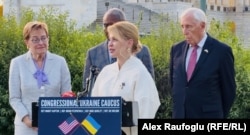
Stefanishyna speaks outside the US Congress after passage of the Ukraine Support Act on June 4.
RFE/RL: So, if I understand you correctly, the SAPO and NABU investigations that were launched against you forced you to resign?
Stefanishyna: It’s difficult to force me. I made the decision myself.
RFE/RL: Well, essentially, because of the SAPO and NABU investigations?
Stefanishyna: No, that was not the main reason. I’m a lawyer, and it’s not as though I had some kind of calendar [counting] the days until I’m charged.
RFE/RL: You say that this was not the main reason, but in fact…Zelenskyy signed the decree regarding you on August 3 and…on August 5 the news broke that you had been formally notified of suspicion, you were already in court, and the court was deciding on a preventive measure. It looks as though you got ahead of it and said, “Let me resign so that the charges are brought against a former ambassador rather than a sitting ambassador.” Did you know you were going to be formally notified of suspicion?
Stefanishyna: I knew directly, because I received a summons. I was being called in a few days in advance. If I submitted my resignation on Monday, then perhaps by Friday or Saturday I knew that this was going to happen….
RFE/RL: You received a summons to appear before NABU?
Stefanishyna: Yes, to be formally notified of suspicion.
RFE/RL: Did you inform the president about this and say, “I want to resign?”
Stefanishyna: The primary reason was still personal. I understood that I had to choose between continuing to serve the state, as I had done for the previous 10 years, sometimes at the expense of my family…and, on the other hand, being there for the people close to me who were going through one of the most difficult periods of their lives simply because they knew me…. At that moment, I felt that I had to stand by them and give them some of my time.
I made this decision because I also did not want to create a situation in which questions about my dismissal would be directed at the president, forcing him to comment on it. So I made the decision myself. I returned to Ukraine, having concluded my diplomatic career. His task now, of course, is to select a candidate for the new ambassador.
