



Banks continue expanding lending beyond traditional institutions, while overseas loans see higher ticket sizes despite domestic dominance.
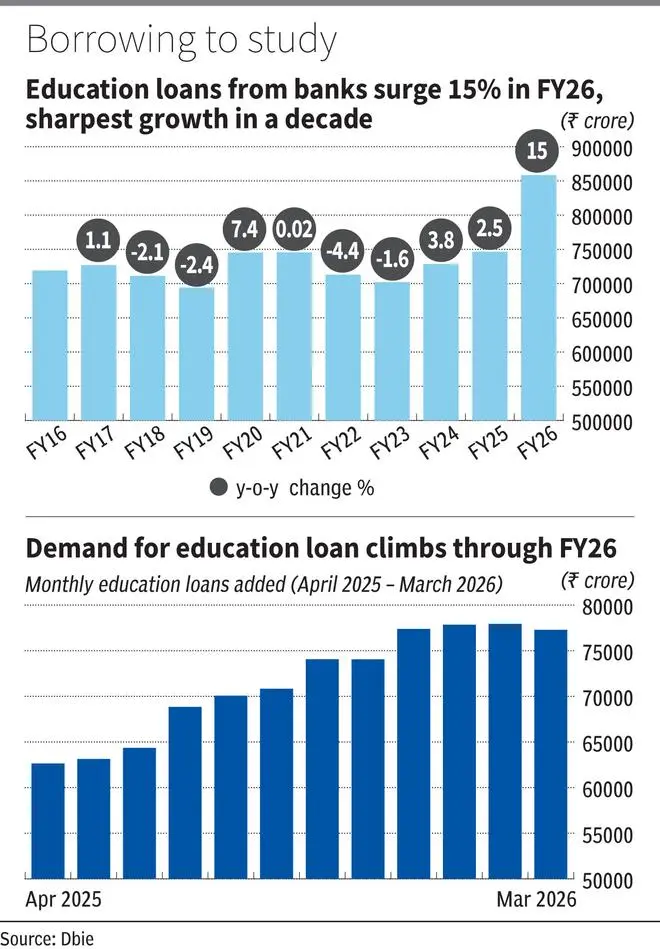
Rising tuition fees, growing overseas education aspirations, and wider lender participation pushed education loans from banks to their sharpest annual growth in a decade in FY26.
Outstanding education loans from banks rose nearly 15 per cent year-on-year to ₹8.58 lakh crore in FY26 from ₹7.46 lakh crore in FY25, according to data from Reserve Bank of India’s latest bulletin. The loan book had contracted in FY22 and FY23 before recovering in the last two fiscals.
Rising costs, rupee depreciation drive demand
Experts attributed the rise to increasing education costs, rupee depreciation, and a growing willingness among families to finance higher education through borrowings.
“There’s been a tendency for banks to reach out to more educational institutions where loans are being provided,” said Madan Sabnavis, Chief Economist, Bank of Baroda, adding that lenders are expanding beyond a limited set of institutions and professional courses as fees rise across the education sector.
Weak rupee boosts overseas education borrowing
The depreciating rupee has also significantly contributed to loan growth, particularly for overseas education.
“The same university, the same course, and the same student may now require a larger INR loan simply because the rupee is weaker,” said Sonal Kapoor, Global Chief Business Officer, Prodigy Finance.
Ramkumar Subramanian, Partner – Financial Services, Grant Thornton Bharat, said the weaker rupee has pushed families to rely more on external financing as savings increasingly fall short of covering education expenses abroad.
Overseas demand rises, US remains top destination
While domestic education loans continue to dominate by volume, overseas education loans account for larger ticket sizes. Experts noted that although the US remains the preferred destination for Indian students, countries such as Australia, New Zealand, and South Africa are also gaining traction.
Seasonal disbursals reflect admission cycles
Monthly data also reflected sustained demand through the year. Education loans added by lenders increased from ₹62,637 crore in April 2025 to ₹77,935 crore in February 2026 before moderating slightly to ₹77,289 crore in March.
The sharp rise in education loan additions during the second half of FY26 was largely driven by admissions cycles and fee payment schedules. Domestic course fees are generally paid around March-April ahead of the academic year, while international programme disbursals tend to pick up later in the year.
Banks dominate education loan market despite risks
Subramanian also mentioned that banks continue to dominate the education loan market with an 80 per cent share, while NBFCs account for the remaining 20 per cent, with some 5 per cent variation. He attributed this to the largely collateralised nature of education loans, unlike unsecured retail lending segments.
Sabnavis cautioned that repayment risks remain, particularly if students fail to secure employment after graduation, especially in overseas education loans due to larger borrowing sizes.
Published on May 26, 2026


