


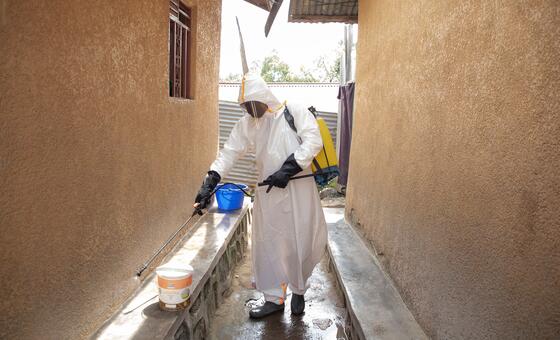
“Ebola feeds on delay, fear and hunger,” said Carl Skau, acting Executive Director of the World Food Programme (WFP). “Stopping this outbreak requires all hands on deck and communities at the centre.”
Declared in eastern DRC on 15 May, the Ebola outbreak is the fastest growing on record. Full-blown Ebola caused by the Bundibugyo virus is marked by severe bleeding and a fatality rate of around 40 per cent.
What you need to know
- This is the largest Ebola outbreak caused by the Bundibugyo virus to date, according to the latest update from the World Health Organization (WHO)
- 48 health zones across five provinces in eastern DRC are affected: Ituri, North Kivu, South Kivu, Tshopo and Haut-Uele
- Ituri, the outbreak’s epicentre, remains one of the country’s most severe hunger hotspots, with 1.9 million people facing crisis levels of food insecurity or worse
- More than 2.65 million people in the 48 Ebola-affected health zones face acute food insecurity, including more than 628,000 people in emergency conditions, according to the UN-backed global monitor Integrated Food Security Phase Classification (IPC)
‘Food is frontline Ebola containment’
The UN World Food Programme (WFP) issued a stark warning that food assistance and logistics are critical to containing the outbreak.
“Food assistance is frontline Ebola containment,” Mr. Skau said. “It helps families stay home, supports safe isolation, builds trust with communities and keeps health teams moving. We know what works. What we need now is the speed and resources to scale it before this outbreak outruns the response.”
Such efforts also help reduce movement of people in search of food, supports safe isolation, lowers the risk of harmful coping strategies and creates the social conditions for health actors to operate safely and effectively, the agency said.
What’s the UN doing?
The UN is actively helping authorities respond to the outbreak, including through its food agency, WHO and its children’s fund, UNICEF.
Here are highlights of some WFP efforts in DRC:
- Since the onset of the outbreak, the agency’s UN Humanitarian Air Service (UNHAS) has operated 495 flights, transported 3,395 humanitarian responders and delivered 56 metric tonnes of essential cargo to frontline locations, including newly affected provinces such as Haut-Uele and Tshopo
- WFP has delivered more than 160,000 hot meals to patients, contacts and frontline workers in 17 treatment and isolation centres
- WFP has also provided dry food rations to 23,000 people in North Kivu, South Kivu and Ituri, including 14,000 people under quarantine with monthly food assistance
- An additional 36,000 people in Ebola-affected zones have been reached with general food assistance
Challenges ahead
Speed and resources are the main challenges, and every delay gives Ebola more room to spread, while gaps in logistics, food assistance and community support risk weakening containment efforts, according to WFP.
At the same time, insecurity, access constraints, community unrest and limited operational capacity in newly affected areas continue to complicate surveillance, supply movements and response scale up.
To sustain all operations in DRC for the next six months, WFP requires $293.6 million, which includes funding emergency logistics and food assistance in Ituri and other affected areas.
Learn more about the UN Ebola response here.
Stay tuned
Stay tuned for the daily noon news briefing at UN Headquarters in New York, where WFP’s Mr. Skau and UN Senior Ebola Coordinator Julien Harneis will provide the latest updates on response efforts on the ground via videoconference from Bunia, DRC:

