

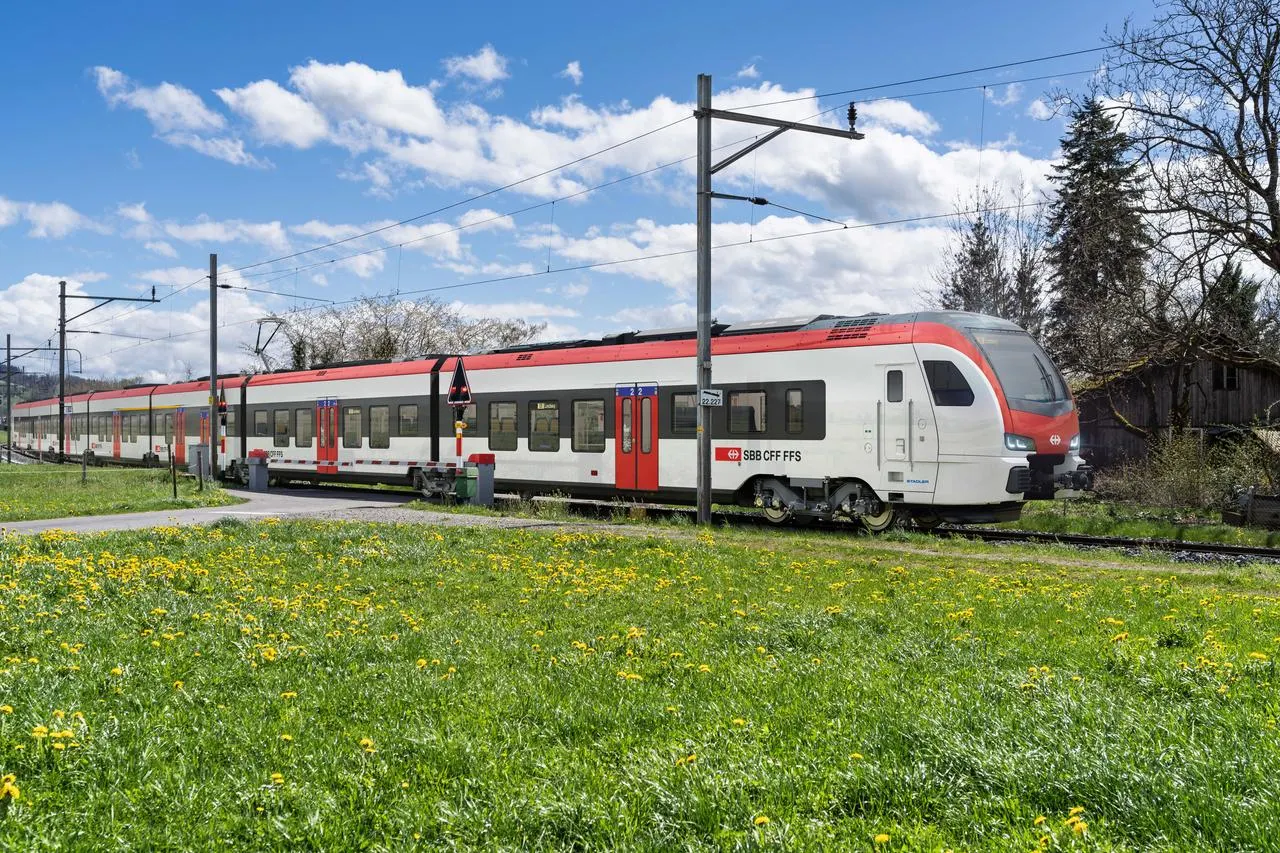
The collision between two trains in Spain on October 28th that killed 69 people and injured scores of others is blamed, pending further investigation, on signalling, technical issues, and/or human error. And that brings up a question of just how safe is high-speed train travel in Switzerland?
Switzerland’s national railway, SBB, refused to draw comparisons between the Spanish and Swiss rail systems.
Experts point out, however, that one of the major differences between the two is the speed monitoring system they use.
The derailed Madrid-to-Seville train used the so-called LZB system, which is not used in Switzerland.
Instead, the Swiss rail network is equipped with the newer, and more secure, European Train Control System (ETCS); under this system, the train is subject to real-time monitoring, and signals are transmitted directly to the driver’s cab.
What exactly does this mean?
Across its entire network, the ETCS “monitors trains and can trigger automatic braking in the event of danger,” said Raoul Fassbind, president of The Swiss Association of Train Drivers and Trainees (VSLF).
Concretely, on high-speed lines, signals are displayed directly inside the driver’s cab.
If the train control system fails, strict protocols apply: trains may only proceed at a maximum speed of 40 km/h and must be operated “on sight” – that is, train drivers must be able to stop before encountering any obstacle (like another train, for instance), at any given moment.
“Safety always takes priority,” the SBB spokesperson told Swiss media.
The VSLF also considers the train control system on the Swiss network to be “safe and stable.”
But gaps in the safety net do exist, the association says.
For instance, Fassbind pointed to ” complex procedures” involved when malfunctions do happen in the ETCS train control system.
For example, supposedly simple tasks like locating the appropriate checklist can pose problems during stressful but critical situations.
“This can lead to misunderstandings or errors in action,” he said, pointing out that “such scenarios are not practiced frequently enough during training.”
Even given Switzerland’s safe rail infrastructure, “absolute safety doesn’t exist,” Fassbind said.

