


Much has been said and written about Switzerland’s middle class – a socioeconomic group that falls into the median range of income (between the wealthy and poor) for the geographic area in which they live. This is what we know about them.
The Federal Statistical Office (FSO) has just published figures revealing some facts about Switzerland’s middle class, including their wages.
This is what we know:
Most people in Switzerland (nearly 60 percent) fall into the middle-income group.
This number is slightly lower than across the eurozone, where 64 percent of the population are considered middle class.
However, the reason for it may be that income criteria for middle class differs between Switzerland and the EU – typically, they are higher in Switzerland because wages are higher as well (read more about this below).
To be considered middle class in Switzerland, a single person must earn between 4,126 and 8,842 francs a month, while for a family with two children this amount falls between 8,666 and 18,569 francs.
In terms of annual income, these figures translate to between 49,513 and 106,104 francs for single individuals, and 103,992 to 222,828 francs for a family of four.
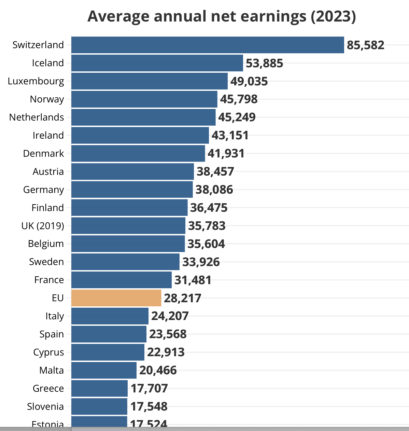
Crunching these numbers further indicates that the average annual income in Switzerland is 85,582 euros (81,735 francs).
This chart shows how this average income compares to elsewhere in Europe:
Eurostat
But let’s go back to Swiss middle class and how it compares, income-wise, with the eurozone.
According to the Organisation for Economic Co-operation and Development (OECD) Better Life Index, a household earning between 35,000 and 85,000 euros per year (33,433 to 81,210 francs) is typically considered middle class in the European Union.
Advertisement
Of course, these averages are higher in countries like Luxembourg and Norway, but they are offset by lower wages in poorer countries within the EU.
Swiss averages can’t be taken at face value however.
That’s because the cost of living is typically higher in Switzerland (though taxes are lower).
And that brings us to the subject of purchasing power party (PPP), which is basically a measure of the prices of goods and services in different countries versus average incomes.
Advertisement
How is Switzerland doing in terms of PPP?
An in-depth analysis by a digital employment platform Glassdoor provides some interesting and no doubt surprising insights into Switzerland’s PPP in comparison with other nations.
“Taking not only income and cost of living into account, but also the effects of differences in taxation, it is possible to derive an indication of after-tax, local purchasing-power-based, standard of living”, the study reported.
“On this basis, the highest overall standard of living is found in the cities of Switzerland, Denmark, and Germany. Although the cost of living can be relatively high in these countries, so are average wages and purchasing power”.
The study concluded that “in Switzerland, Denmark, and Germany the average city-based worker can afford to buy 60 percent or more goods and services with his or her salary than residents of New York”.
Also, if you look at the big picture – taking various factors into account – the cost-of-living situation is not as bad as many people believe.
“Various factors” in this context means the low inflation rate (in comparison with other countries), high employment, and a strong economy – all of which mean that Switzerland is outperforming other European nations on many fronts.
So if you analyse things from a different angle, Switzerland’s cost of living doesn’t look so bad.
READ ALSO: Why Switzerland’s cost of living isn’t as high as you think


