


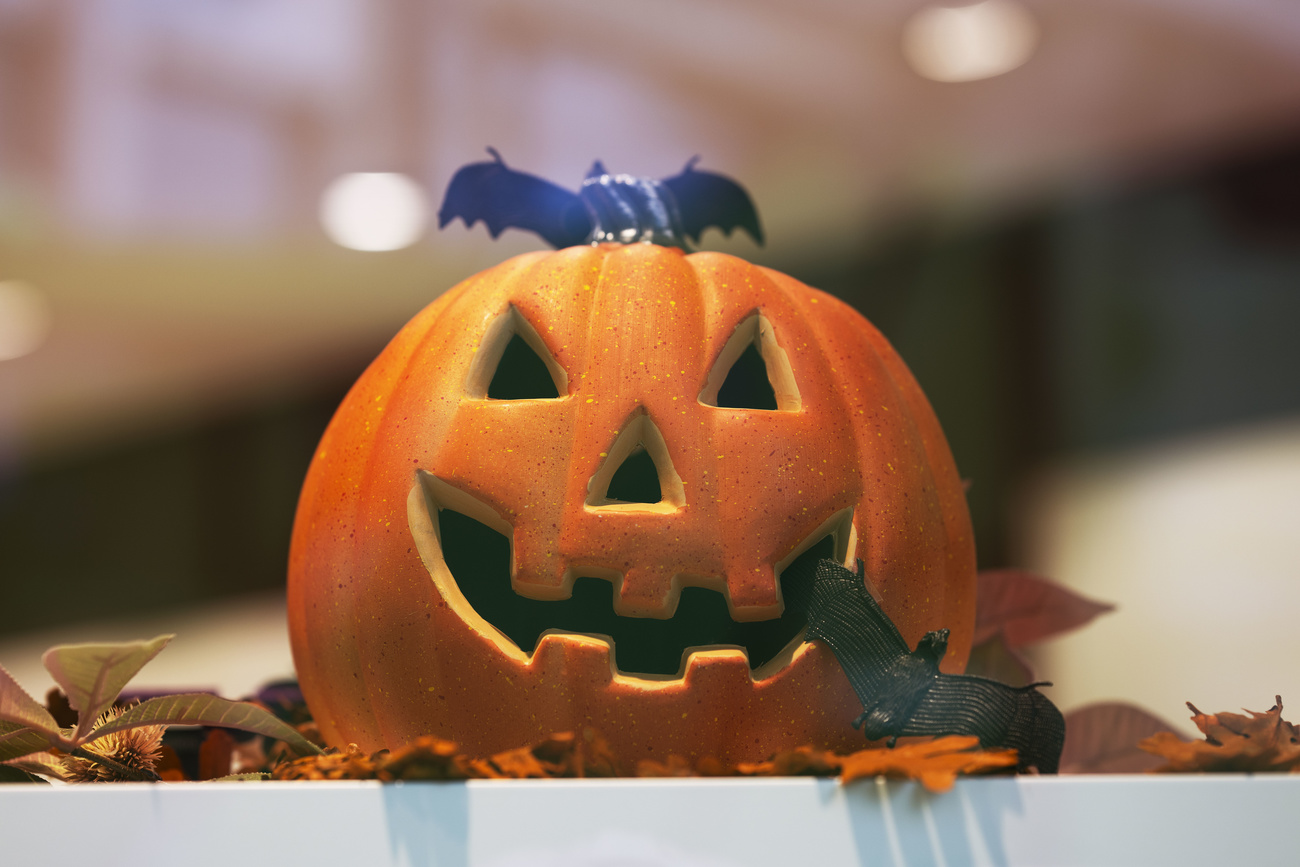
A happy pumpkin in Zurich.
© Keystone / Christian Beutler
The Swiss calendar is packed with bizarre and often alarming traditions. Is there room for Halloween? Absolutely, say delighted children and pumpkin-sellers. Some neighbours and cultural purists are less sure.
“Süsses oder Saures!” “Des bonbons ou un sort!” Thirty years ago, most Swiss wouldn’t have had a clue what was going on if they had opened their front door to find a couple of eight-year-olds, high on sugar and dressed as witches or skeletons, shrieking “trick or treat!”.
Since the mid-1990s, Halloween has embedded itself, albeit weakly, in Swiss cultural life. “Like Oktoberfests, which now also intoxicate town and country in Switzerland,” wrote the St. Galler TagblattExternal link, referring to German beer festivals.
“Cultural pessimists see domestic customs threatened,” it continued. “And evangelical Christians in particular reject Halloween because it’s about occultism and Satanism – regardless of the fact that the event has long since ceased to have any serious religious traits and is largely commercialised. Folklorists rather than theologians are responsible for Halloween, and marketing experts and event organisers for its spread in our country.”
The evolution of Halloween is murky, but in a simplified nutshell, it is thought to have originated with pagan Celtic traditions, such as the ancient Gaelic festival of Samhain, when people would light bonfires and wear costumes to ward off ghosts.
In the eighth century, Pope Gregory III designated November 1 as a day to honour all saints. Soon, All Saints’ Day incorporated some of the traditions of Samhain. The evening before was known as All Hallows’ Eve, and later Halloween.
Mass Irish and Scottish emigration in the 19th century resulted in Halloween taking off in the United States, eventually being celebrated by people of all social, racial and religious backgrounds. By the late 20th and early 21st century, through US cultural influence, Halloween had spread to many regions around the world, including to mainland Europe.
The tradition crept into French-speaking Switzerland from France, and then into German-speaking Switzerland, according to folklorist Konrad Kuhn, who confirmed that Halloween wasn’t an issue in Switzerland before the mid-1990s.
It took a few years for the larger retailers and the media to get interested, but what really gave Halloween a boost in Switzerland was farmers’ discovery, at the same time, of the pumpkin as a new source of income, Kuhn wrote in Kürbis, Kommerz und KultExternal link: Halloween und Kürbisfest zwischen Gegenwartsbrauch und Marketing (Pumpkin, commerce and cult: Halloween and the pumpkin festival between contemporary custom and marketing), published in “Folklore Suisse” in 2010.
A pioneering role was played by the publicity-savvy Jucker brothers in canton Zurich, whose farm soon became known throughout Switzerland for pumping out pumpkins and holding events such as competitions for the biggest pumpkin pyramid, the biggest pumpkin soup, the heaviest pumpkin and so on. The media lapped this up, and countless farmers followed their example and flooded Switzerland with pumpkins, which until then had been eaten sparingly but which now filled home kitchens and restaurants.
In 1991, 230 tonnes of pumpkins were sold in Switzerland. By 2000, it was around 10,000 tonnes, according to this SWI swissinfo.ch article from 2001.
“The Juckers took advantage of the traditional November gap in the event sector, so that in addition to the major retailers, amusement parks, catering establishments and costume shops also showed interest and achieved high sales,” Kuhn said.

Old school: ready to hit the town in Daillens, southwestern Switzerland
Keystone / Laurent Gillieron
‘Prowling youths’
However, it appears that Halloween then took a slight hit. Halloween sales at the country’s two biggest supermarkets, Migros and Coop, plummeted in 2007.
At the same time, media coverage of Halloween changed, Kuhn said. “While earlier there had been favourable reports and Halloween had even made it onto daytime television, now the focus was mainly on the damage to property committed during the night by prowling youths”.
In 2021, Lausanne newspaper Le MatinExternal link said the police were well aware that little monsters for one evening can really be just that: little monsters.
“In recent years, more and more people have had the unpleasant surprise of finding eggs thrown at the front of their house or windows,” it said. “While the threat of ‘trick or treat’ is supposed to be no more than a threat, some children really do take revenge on those who don’t give them anything or open the door for them.”
The police pointed out that participation in Halloween “is not compulsory” and that refusal shouldn’t lead to reprisals, “however harmless they may seem”.
Zombie parties
Today, October 31 means Swiss department stores offering “Halloween deals”, restaurants still throwing pumpkin into everything, and cinemas showing classic horror films.
“Playing with spooky things is catching on in ever wider circles,” reckoned the St. Galler TagblattExternal link on Tuesday. “Many people have fun with it, organising Halloween parties where they walk through the living room dressed up as zombies with a glass of blood-coloured liquid and dip tortilla chips into guacamole ‘vomited up’ from a pumpkin.”
While Halloween in Switzerland is still far from the massive national celebration it is in the United States, those Swiss who celebrate it really go for it, with adults seemingly trying to outdo each other with impressively gory make-up.
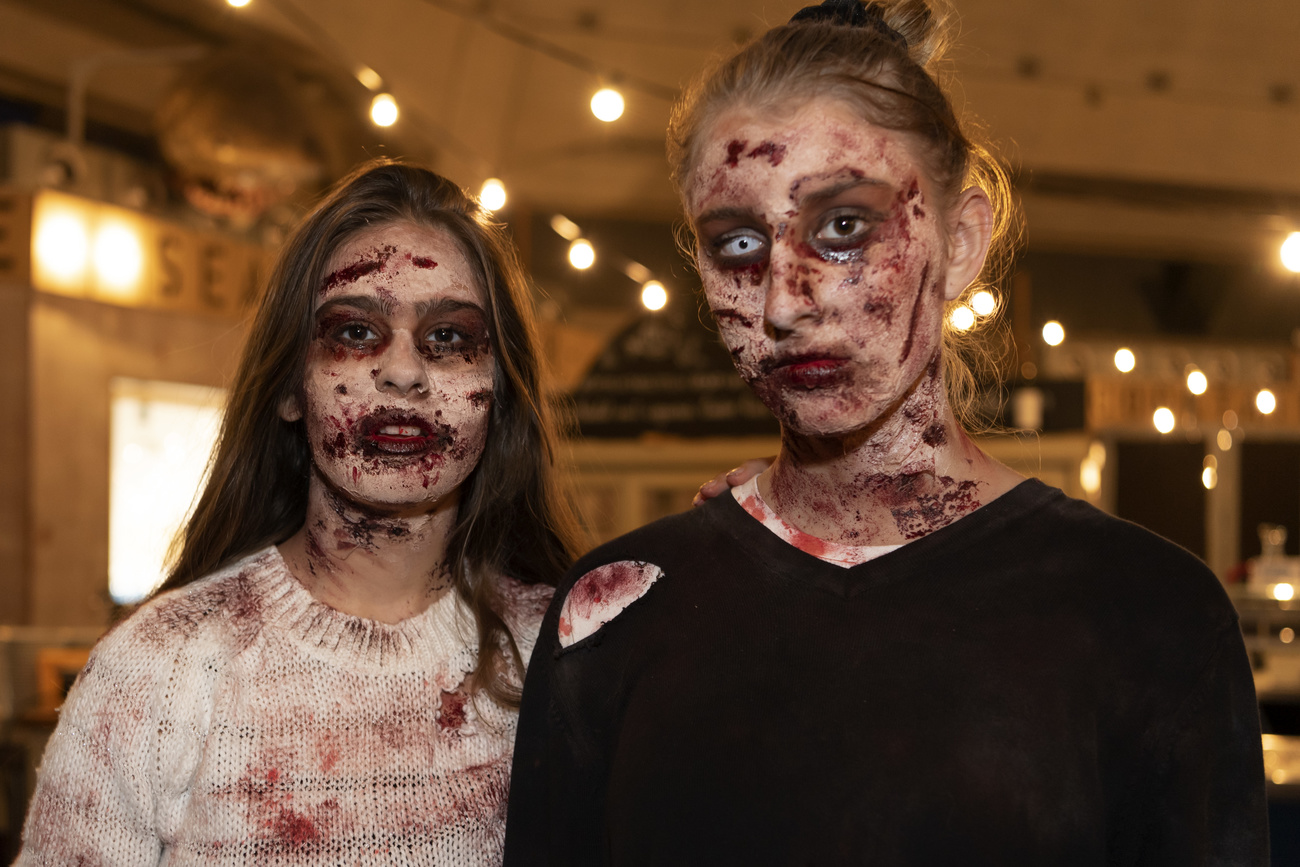
Two of the undead who took part in a Halloween zombie walk through Basel in 2019
Keystone / Georgios Kefalas
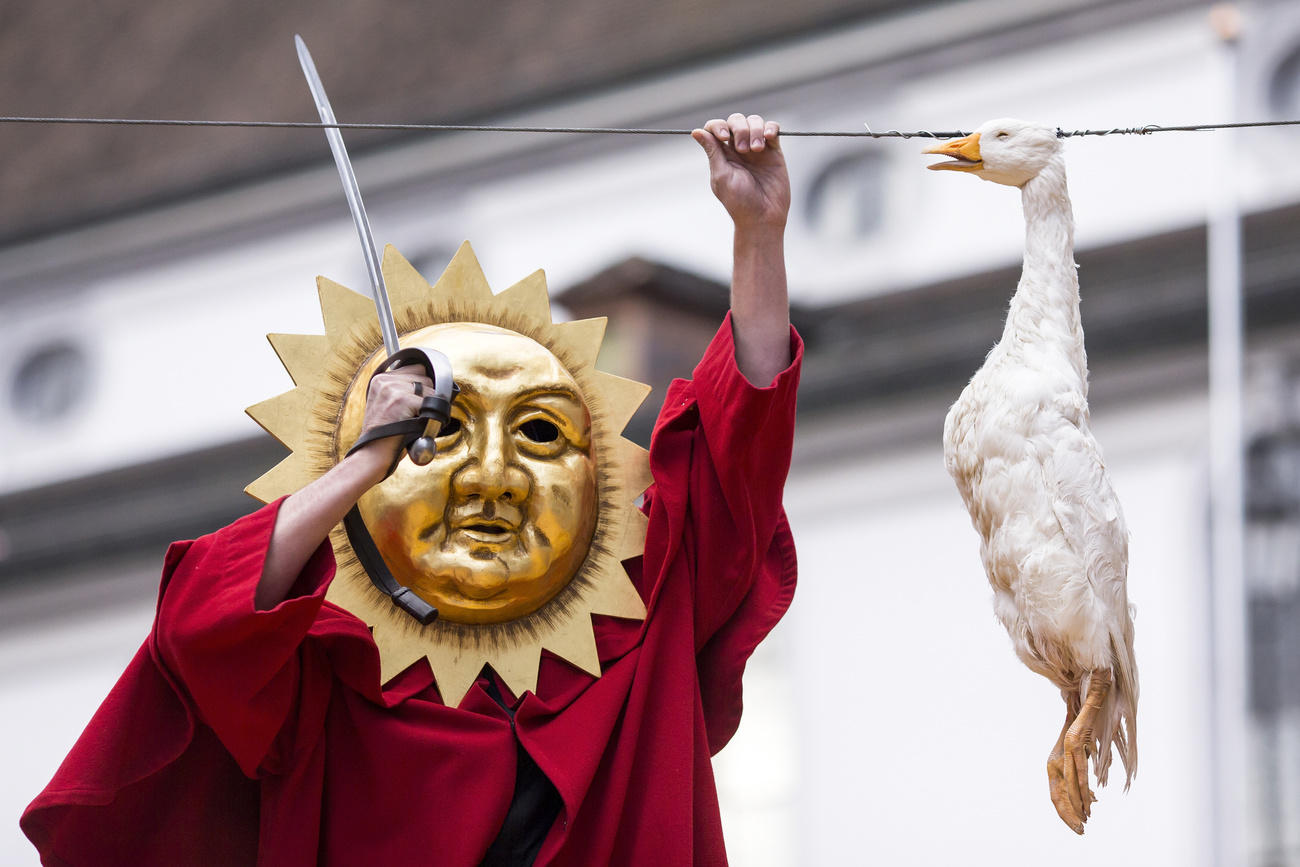
Costumes in the US are generally more humorous or satirical, but the Swiss have a chance to do satire during the carnival season. It should also be pointed out that the Swiss are no strangers to eyebrow-raising customs, such as decapitating a dead goose or holding down young girls and putting blackface on them:
More
More
They do what? Five frankly bizarre Swiss traditions
And as Kuhn noted, elements of Halloween can be found in other customs that are widespread in Switzerland, such as the carved turnip with a candle as in the Räbeliechtli procession, asking for something at the front door as in carol singing, or the elements of commemorating the dead on All Saints’ Day.
As for whether Halloween is gaining or losing popularity in Switzerland, it’s hard to say. Some neighbourhoods put on well-organised parties for adults and are teeming with skeletons and witches. Social media enables parents to create maps of which houses are tricking or treating. Other streets are dead.
But Kuhn was confident that the tradition would continue in some form. “The need for a yearly cycle shaped by highlights continues, so it can be assumed that Halloween […] will be innovatively integrated into the existing customs landscape”.
The pumpkin, he added, also seems to have found its place beyond Halloween parties by being carved as a family and then put on display: “a family custom during the dark season”.
This article was originally published on October 31, 2023.
More
More


