


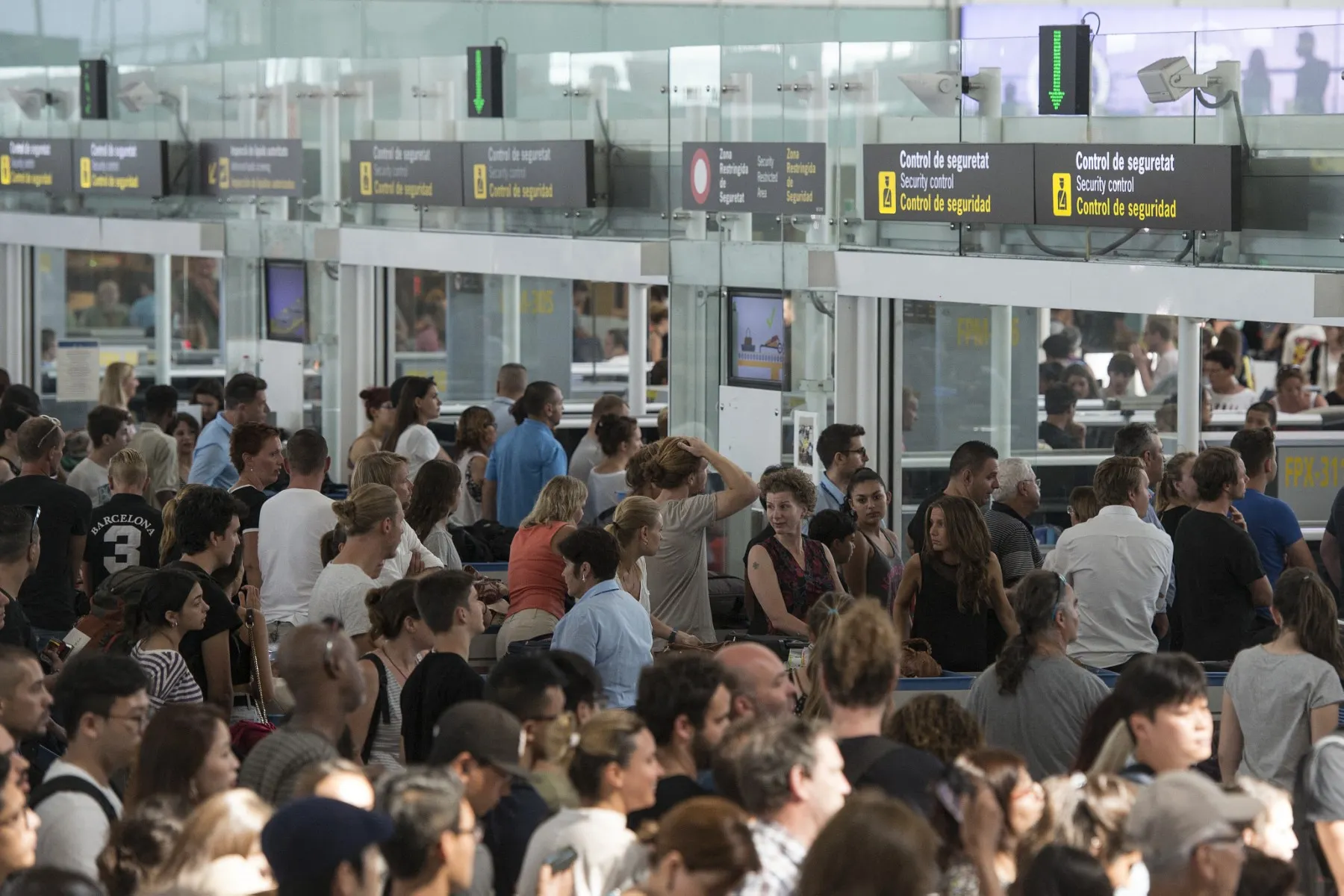
Hoteliers and tourism bosses are calling for more police and fully functioning passport control machines at Spanish airports to fix the problem of long waits for Brits and other non-EU tourists since the rollout of the EU’s new Entry Exit System.
The Spanish Confederation of Hotels and Tourist Accommodation (CEHAT) has urged Spain’s Interior Ministry to immediately bolster police numbers at Spanish airports and ensure the full operation of new EES control systems.
According to the group, the long queues and waiting times at passport control have become “a structural problem that seriously damages tourists’ experiences as well as Spain’s image as a top-level tourist destination in a highly competitive environment.”
Advertisement
CEHAT points out that this problem, denounced on numerous occasions by hotel associations in different parts of the country, is particularly troublesome at airports with a high influx of international passengers, such as Málaga, Tenerife South or Lanzarote, among other prominent tourist destinations.
READ MORE: Which airports in Spain are having problems with the EES launch?
At these airports, the massive flow of non-EU travellers, particularly from the UK since Brexit, have caused hour-long queues at border controls, and the introduction of e-gates since EES came into force in October 2025 has done little to speed up the transfer of passengers.
Many passengers have reported that not many of the e-gates are not in use or working, and that there aren’t enough police officers at the passport control booths either, with plenty of confusion among passengers about which queue they should be in and how and if to give their fingerprints.
CEHAT insists that this is not an isolated or temporary incident and criticises the fact that the biometric and technological control systems continue to operate below full capacity.
The confederation points out that this lack of technological efficiency is compounded by an insufficient number of police officers to handle the huge volume of passengers, leading to huge queues in the international transit areas of airports.
The president of CEHAT, Jorge Marichal, considers it “unreasonable” that tourists should have to endure waits of an hour or longer to be able to access Spain.
“Spain cannot afford for the first contact of millions of visitors with our country to be an endless queue at passport control,” Marichal argued.
“This is also part of the ‘Spain brand’ and we must protect it.”
CEHAT points out that these queues are especially problematic for vulnerable groups, such as families with children, the elderly, or travellers with special needs, for whom standing for long periods represents an additional hardship.
As a result, the confederation has made a formal appeal to Spain’s Ministry of the Interior to implement urgent and structural measures to alleviate these issues at passport control.
Advertisement
What is EES?
The new passport checks started being implemented in many European countries on October 12th and will be rolled out across much of the bloc for the next six months until April 10th 2026.
To be exact, this affects the 29 European countries that form part of the Schengen Area – all those in the European Union except Cyprus and Ireland, as well as Norway, Switzerland, Iceland, and Liechtenstein.
It essentially means more checks for those from third countries – such as having photographs and fingerprints taken – and will record entries and exits from the Schengen Area for third-country nationals.
It gathers and stores:
Details from your travel document (e.g. full name, nationality, date of birth, passport number).
The date, time, and location of your entry and exit.
Your facial image and fingerprints (“biometric data”).
Any record of refused entry, where applicable.
Once the process is complete, passport stamps will be eliminated.
Crucially, if you’re a non-EU citizen but are a resident in Spain, you will not have to register for EES, but you still have to queue in a third-country national queue if flying in from outside of the Schengen Area.


