


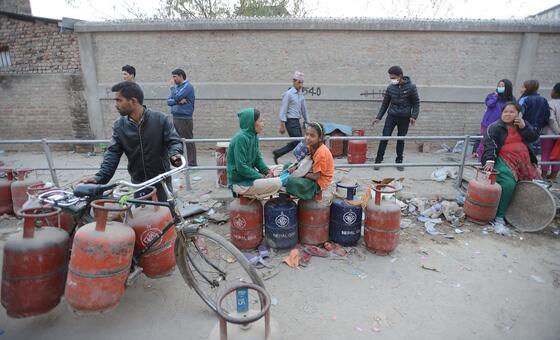
Southeast Asia and South Asia were first to be impacted by the most severe energy crisis in a generation, said Dario Liguti from the UN Economic Commission for Europe (ECE), but he warned that “it is an unfolding energy crisis,” with motorists in Europe already bracing themselves every time they fill up the tank.
Given how national economies the world over remain so dependent on fossil fuels and regional or geopolitical shocks, ECE has been bringing countries together in Geneva and elsewhere to discuss ways to wean themselves off fossil fuels, or at least use them more wisely.
One wasted resource that could be used far more widely is natural gas – methane – which is commonly burned off, or “flared” at oil wells, fossil fuel processing plants or refineries, as a safety measure.
Instead of burning off the gas – as is often the case at refineries the world over – it could be stored and used when needed, lowering our dependence on primary sources of energy, UNECE maintains.
The agency is already leading efforts to reduce emissions of methane which is more than 80 times more potent than CO₂ over a 20-year period and a clear driver of global warming.
Data from the Strait of Hormuz Dashboard.
Clean energy transition crucial
In line with sustainability goals which the world’s nations agreed to in 2015, the UN supports a transition to renewable energy production, away from fossil fuels.
The current crisis “is a clear signal that we need to advance with the energy transition in particular through the electrification of transport or heating,” Mr. Liguti stressed.
“We need to accelerate renewable energy deployment because these are decentralised energy sources and much cleaner, not only from an environmental perspective, but from an energy security perspective too.”
Hunger worsens in Lebanon
In Lebanon, where ongoing clashes between Hezbollah fighters and Israel continue to cause panic and fear, the economic impact has strained livelihoods, rising costs and supply disruptions are worsening food insecurity.
Nearly a quarter of the population is facing acute hunger, according to UN-backed food security experts.
A new alert from the IPC (the Integrated Food Security Phase Classification) on Wednesday warned that the situation is deteriorating rapidly. Around 1.2 million people could face high levels of acute food insecurity between now and August – a sharp increase from the 874,000 affected in late 2025 and early 2026.
“Behind every number are families struggling to meet their food needs consistently,” the World Food Programme (WFP) said, as it continues to scale up assistance with partners.
Public services stretched
The humanitarian situation is further compounded by displacement and fragile public services. In one school-turned-shelter in Jdeideh, in northern Beirut city, 377 people – around 90 families – are living in cramped conditions, highlighting the pressures on basic infrastructure.
Health services are also under strain. The UN World Health Organization (WHO) has been working with partners to strengthen hospitals, including support for blood banks to ensure life-saving transfusions during emergencies.
Despite these efforts, aid agencies warn that needs continue to outpace resources.
The crisis in the Strait of Hormuz, they say, is not just a regional disruption but a global shock, but one that is amplifying existing vulnerabilities and pushing already fragile humanitarian systems closer to the brink.


