


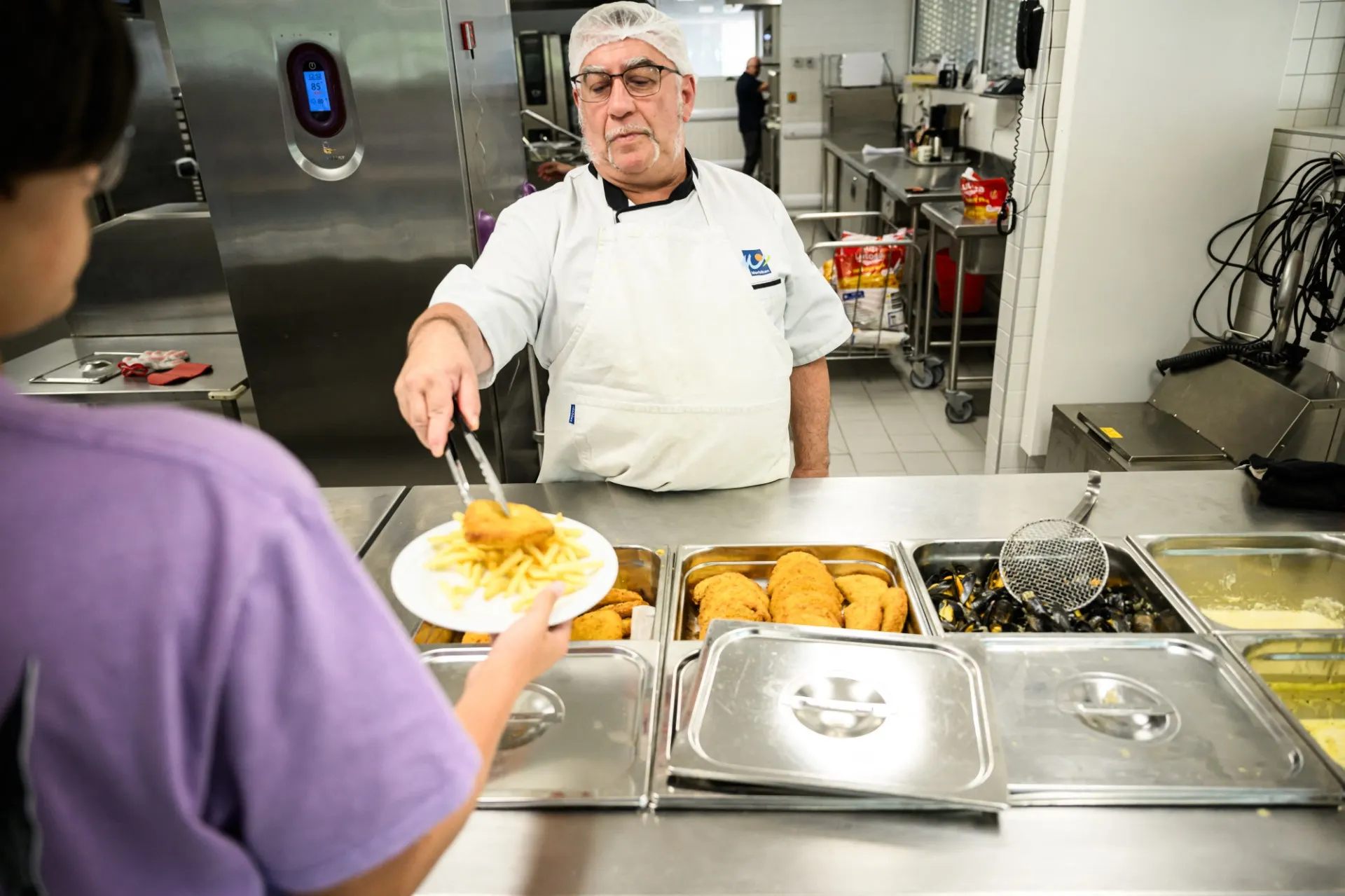
Several posts circling online claim that Spain will soon introduce halal menus in its school canteens. Is there any truth to this?
Posts circulating on Spanish social media networks recently claim that the Spanish government has banned pork in the country’s school canteens.
“Pedro Sánchez’s government has banned pork in Spanish school canteens so as not to offend Muslims,” reads one post shared more than 8,000 times on X since October.
Various other posts and messages add supposed context, such as “all meat used must have ‘halal certification’ and comply with Islamic dietary laws”.
Put simply, this is not true and another example of misinformation surrounding migration and social integration in Spain.
According to verification from both state broadcaster RTVE and fact-checking website Maldita, Spain’s Ministry of Education has awarded three contracts for halal and pork-free meals to six (though some outlets report this as twelve) schools in Ceuta and Melilla specifically.
That is to say: some schools in Spain’s two North African autonomous cities will have halal and pork-free meals. Other regions do not fall under the control of the Ministry of Education so will not be affected.
According to the Ministry of Education, in all these schools the proportion of Muslim pupils exceeds 76 percent and reaches 100 percent in three schools.
Any pupil therefore may request halal or pork: “The company awarded the school meals contract is obliged, under the terms of the tender, to serve it”, the Ministry says.
Furthermore, efforts to tie the specific contracts to Prime Minister Pedro Sánchez — as well as the idea that this is a country-wide policy — are also false.
In Spain, the management of school canteens is a responsibility of the regional governments, rather than the national government.
According to Article 149 of the Spanish Constitution, Madrid establishes the general principles of education, but the regions manage public education within their area: schools, teaching staff, canteens, and school transport, among others.
Therefore, the organisation and management of school canteens is the responsibility of the regional authority.
The autonomous cities of Ceuta and Melilla are the only ones that remain under the educational jurisdiction of the Ministry of Education.
School menus in Spain must be adapted to accommodate allergies, intolerances or religious beliefs, for example, pork-free menus.
As to where the fake news has come from, it seems a reference to halal meat in a royal draft royal decree on healthy eating in healthcare and social care centres in June 2025 could be the source. That, combined with news of school menu changes in Ceuta and Melilla, has fed the idea that the Sánchez government is attempting to introduce halal menus across Spanish schools.
In the notes on nutritional requirements, the decree notes that “ethical, cultural or religious diversity must be respected. Flexibility in menus, allowing for 100 percent plant-based (vegan) options, gluten-free, halal, lactose-free or adapted to other specific needs”.
So no, it’s not true schools in Spain have banned pork and introduced halal menus. It’s only in specific schools in two specific autonomous cities in Africa, and even if the national government wanted to introduce halal menus in schools across mainland Spain and its archipelagos, it doesn’t have the constitutional powers to do so.
READ ALSO: The myths surrounding Spain’s mass regularisation of migrants


