


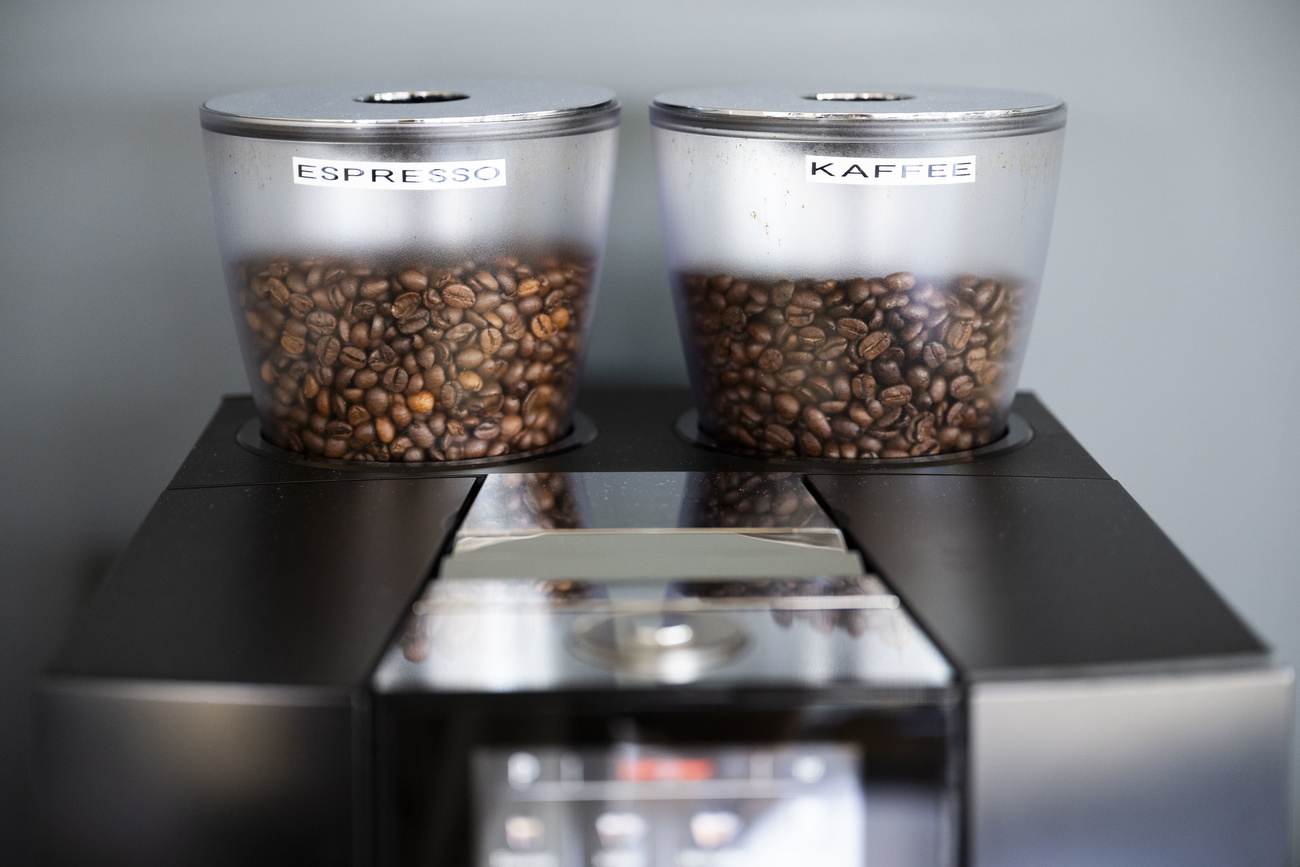
Coffee roasters are now obliged to have larger inventories to avoid running out of beans.
Keystone
War is a top concern for Swiss coffee traders and alternative routes a top priority. But adapting supply chains in an era of constant disruption is no easy task.

Next time you sip a cup of coffee you can thank the Swiss Coffee Trade Association (SCTA). SCTA members – such as Nestlé, Starbucks, Sucafina, Olam, COFCO and LDC – represent over half of the coffee volume traded globally. Switzerland is a globally important coffee trading hub but threats to shipping routes and rising oil prices are pressuring supply chains. Participants polled at this year’s SCTA annual forum on October 1 listed “war” as their main cause for concern and “flexibility and alternative routes” as their top priority.
Shipping woes
Coffee beans are grown and harvested in South America, Asia and Africa. The beans called “green coffee” must then be transported across oceans to Europe and North America where most coffee roasters are based. According to the International Coffee Organization (ICO), of the 183.6 million 60kg bags of coffee harvested in 2025, 77% was exported via 246 different routes. The most popular routes by volume are exports out of Brazil, Colombia and Vietnam to Europe or the United States. The closure of the Strait of Hormuz since February has not had a major impact on coffee trade but has forced carriers to reroute vessels and add fuel surcharges which have had a knock-on effect on coffee traders. The shortest shipping route between Asia and Europe have effectively been closed. Shipments of coffee beans from Vietnam must take the longer route via the Cape of Good Hope.
“We operate as a network. If one route is affected it has a knock-on effect on our entire shipping fleet,” a senior executive at a European shipping company told coffee traders at the SCTA forum. The executive wished to remain anonymous because the comments were made as part of a panel discussion meant for coffee traders.
The European shipping firm manages 700 vessels that transport 25,000 containers from Asia to Europe. According to the executive, rerouting coffee through the Cape of Good Hope increased transit time for their shipments by 20 days from Asia to Europe.
The new norm
It remains to be seen if such route diversions become the norm. Maritime research firm Drewery estimates that Suez Canal transits will return to 80% of their pre-diversion levels by February 2027. However, cost savings from shorter shipping time compared to the Cape of Good Hope will not be as significant as before because from now on insurers are likely to charge a war-risk premium which the shipping companies will pass on to coffee traders as surcharges.
“Coffee traders must get used to fast and bold decision-making with incomplete information because this ‘never normal’ situation will continue and exception management will be critical,” the shipping company executive said.
More

More
How Switzerland became a land of coffee
The Hormuz crisis thus served as a kind of litmus test for the resilience of coffee traders’ supply chains.
“Companies doing well now are the ones that were well-prepared. The companies that waited longer to adapt to longer shipping times did not do so well,” says Dany Barkha, global head of logistics at Geneva-based coffee trader Sucafina.
The company chose to act fast and commit to the longer transit time rather than wait to see how the situation would evolve.
“Putting the coffee on water with delayed transit time is better than waiting for the unknown. And the unknown is still not known till date after months of conflict,” says Barkha.
According to Barkha, resilience will not be an option but a compulsory core skill in supply chain management. He says in the future, coffee traders should invest in diversification of routes, smart inventory planning and strengthening relationships with shipping companies. Sucafina invested in a combination of all three to ensure a resilient supply chain.
“Diversification of routes gave us flexibility. Smart inventory planning bought us time and the carrier relationship gave us solutions when we hit severe disruptions,” says Barkha.
Rethinking supply chain planning
“In most cases, coffee supply chain is ‘just-in-time’. Roasters know they can buy spot coffee and survive a couple of weeks during a crisis,” says José Luis Pérez, head of commodities at Commodity Supplies AG. The canton Schwyz-based ocean freight broker has around 200 coffee customers.
According to Pérez, this “just-in-time” strategy is no longer as attractive as before because unexpected conflicts and changing government policies occur more often. The more time the coffee shipment is at sea, the more money a roaster loses as they have to make up for any shortfall by sourcing beans from warehouses more expensively. To avoid running out of beans, coffee roasters are now obliged to have larger inventories even if it means tying up more working capital and increases in financing and insurance costs.
“Five to 10 years ago the focus was on efficient supply chains, now it is resilient supply chains and in the future it will be adaptable supply chains,” Pérez concludes.
More

More
Better latte than never: Swiss coffee industry joins forces to improve conditions of coffee growers
Being adaptable means letting go of the old ways that no longer serve their purpose. Some of the supply chain planning in the coffee industry is no longer fit for purpose after the Hormuz crisis, according to Aleks Sidorecs, global head of supply chain at Swiss coffee trading firm Volcafe.
Instead of focusing on reports from the last month, he says the industry will have to keep track of leading shipping indicators that signal where disruptions are likely to happen, such as pre-shipment sample approval status, shipping instructions status and booking placed and accepted.
“These indicators give coffee industry players advance signals of potential disruptions and help them plan accordingly,” says Sidorecs.
The price of a cup of coffee
Reduced supply and increased demand have pushed green coffee prices to record highs over the last two years. ICO reported the first surplus in five years for 2025/2026 but consumers are still paying more because beans bought expensively are still circulating in supply chains. For example, price increases accounted for 4.7% of Nestlé’s coffee sales growth in the first half of the year. The Swiss multinational with brands like Nespresso and Nescafe expects lower green coffee prices in the second half of the year but cautioned investors that this will be “offset by some higher transportation and energy costs arising from the Middle East conflict”.
Weather conditions in top coffee producing countries like Brazil or Vietnam play a much bigger role in determining coffee prices than logistics costs. However, shipping bottlenecks can compound existing price pressure, especially when supply is already tight. Burkha reiterates that the cost of coffee isn’t only shaped at its origin and when logistics becomes more expensive, coffee becomes more expensive to move, store, and deliver.
“Not every increase reaches the consumer directly, but the pressure builds across the value chain. And that is why efficient logistics matters more than ever,” he says.
More
More
Your favourite coffee was probably made by a Swiss machine
Edited by Virginie Mangin/ds


