

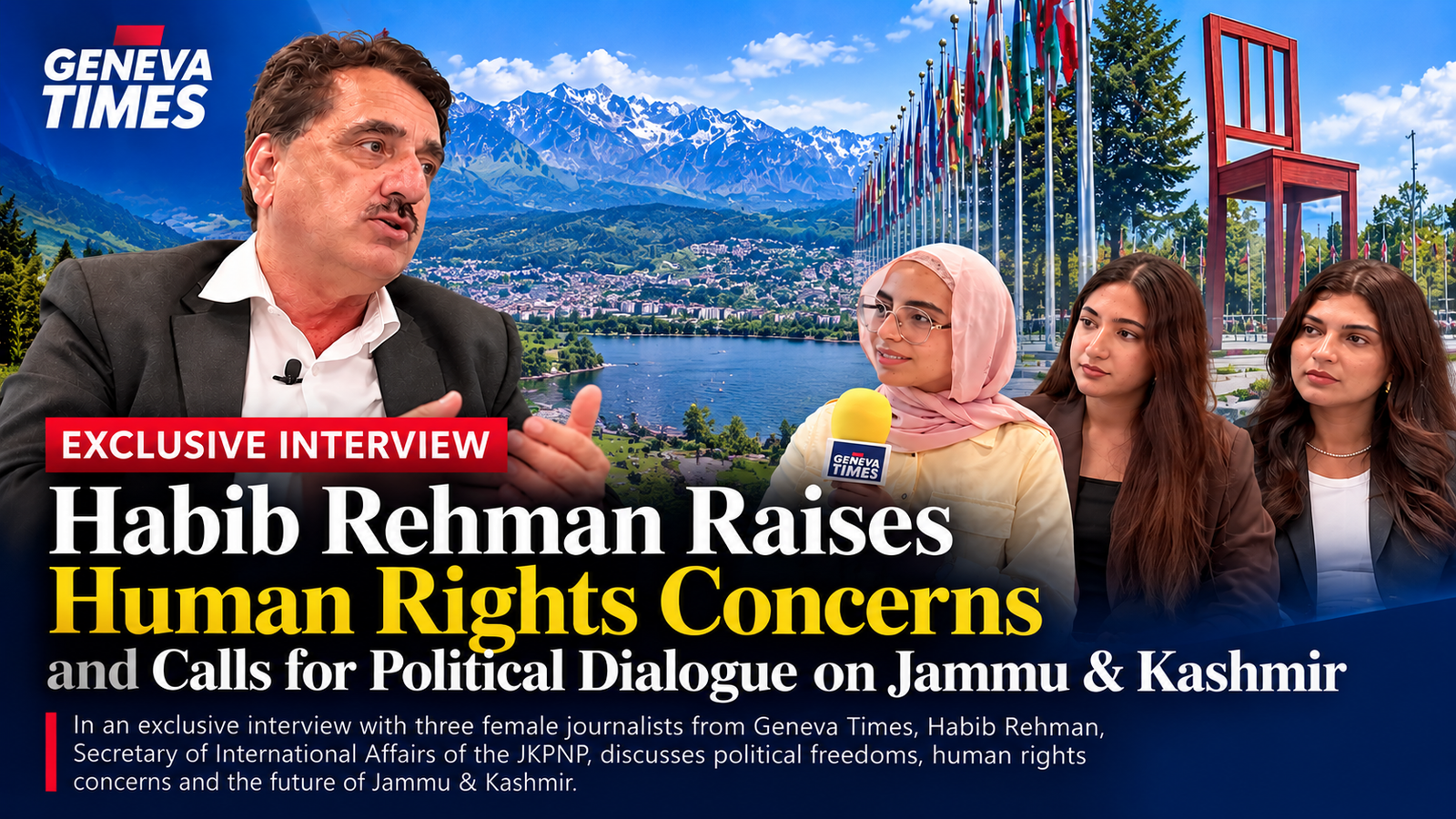
GENEVA — In an exclusive interview with Geneva Times, Habib Rehman, Secretary of International Affairs of the Jammu Kashmir Peoples National Party (JKPNP), discussed political freedoms, human rights concerns and his vision for the future of Jammu and Kashmir, while calling for greater international attention to developments in Pakistan-administered Jammu and Kashmir.
The interview, conducted in Geneva by three female journalists from Geneva Times, examined reported restrictions on political activity, the treatment of protesters, accountability for alleged human rights violations, democratic participation and the role Rehman believes the United Nations and international community should play.
Rehman is a writer, political activist and human rights defender from Pakistan-administered Jammu and Kashmir. His political work focuses on democracy, political rights and human rights across the wider Jammu and Kashmir region.
“The shrinking space for peaceful political expression”
Asked to assess the current situation, Rehman described developments in Pakistan-administered Jammu and Kashmir as “deeply concerning,” arguing that demands concerning economic justice, political rights and accountability had developed into a wider human rights crisis.
“What concerns me most is the apparent normalization of the use of force against civilians and the shrinking space for peaceful political expression,” he told Geneva Times.
Some of the broader developments raised during the interview have been independently documented. On 5 June 2026, authorities designated the Jammu Kashmir Joint Awami Action Committee (JKJAAC) as a proscribed organisation under the region’s Anti-Terrorism Act. Amnesty International subsequently reported an internet shutdown, arrests and deadly use of force during the crackdown, while calling the proscription disproportionate and unlawful.
The regional authorities, however, have presented a sharply different account. Their notification accused the JKJAAC of activities prejudicial to peace and security and of creating disorder, while officials have maintained that security measures were necessary to protect public order and citizens.
Questions over force, arrests and communications
The Geneva Times journalists pressed Rehman to identify concrete developments that he believed deserved international scrutiny rather than relying solely on broader political allegations.
He pointed to the proscription of the JKJAAC, arrests, restrictions on communications and reported use of lethal force against demonstrators.
In late July, Amnesty International separately called for a “prompt, independent, and transparent investigation” following reports that security forces had used lethal force against protesters in Rawalakot. The organisation also warned that restrictions on internet and mobile services impeded independent verification of events on the ground.
Rehman argued that communications restrictions were particularly significant because they made independent reporting and verification more difficult.
His interview also underscored the importance of distinguishing allegations, independently documented incidents and competing accounts from political actors — an especially important consideration in a region where information itself remains heavily contested.
What should the authorities do?
Asked what responsibility he believed Pakistan and the authorities in Pakistan-administered Jammu and Kashmir carried, Rehman outlined several measures he wanted to see implemented.
He called for independent and transparent investigations into deaths and allegations of excessive force; due process for detainees and the release of people held solely for peaceful political expression or assembly; fewer restrictions on internet access, journalism and peaceful political activity; credible information about people killed, injured, detained or reported missing; and political dialogue involving civil society, political parties, women, young people and other affected communities.
“The objective should not be revenge or further confrontation,” Rehman said. “The objective should be accountability, justice and restoration of public trust.”
The authorities have disputed allegations surrounding the protest movement and attributed responsibility for violence and deaths to the proscribed JKJAAC leadership. In June, senior AJK officials said there would be no blanket amnesty for its leaders and that legal proceedings would continue.
A political vision — and a question about dissent
The interview moved beyond allegations against the authorities to challenge Rehman on his own political vision.
Geneva Times asked how a future political arrangement advocated by him would protect people who disagreed with his position — an important test of democratic principles beyond opposition politics.
Rehman responded that his vision was based on allowing the people of Jammu and Kashmir to determine their political future through peaceful and democratic means.
“Democracy is not simply about achieving the political outcome that I or my party believe in,” he said. “Democracy also means protecting the rights of people who disagree with us.”
He cited freedom of expression, political association, religion and belief, press freedom, peaceful assembly, equal citizenship and political participation as principles that should apply irrespective of political position.
“If we demand democratic rights for ourselves, we must be prepared to defend those same rights for our political opponents,” he said.
From Kashmir to Geneva
The final part of the interview focused on why Rehman had brought his concerns to Geneva and what, specifically, he expected from international institutions.
Rather than limiting his appeal to expressions of concern, Rehman called for continued international monitoring, independent scrutiny of alleged violations and greater support for political dialogue.
He said international attention should not be confined to periods when violence escalates, arguing that human rights conditions in Jammu and Kashmir require sustained scrutiny.
His concluding message was directed not only at governments and international institutions but also at people across the different parts of Jammu and Kashmir.
“We may have different political visions, but we share a fundamental interest in human dignity, peace and the right to live without fear,” he said.
“Our demand is not for silence from those who disagree with us. Our demand is for a political environment where every voice — including a dissenting voice — can be heard peacefully.”
Watch the Geneva Times Interview
In the full interview, Geneva Times journalists question Habib Rehman on the human rights situation, restrictions on political freedoms, accountability, the responsibilities of authorities, his own political vision and what action he wants from the United Nations and international community.
Watch the full exclusive interview below.
Editor’s note: Statements attributed to Habib Rehman represent his views as expressed during the interview. Where independently available, Geneva Times has distinguished those statements from documented reporting and the positions of relevant authorities.

