


That’s according to the final Gaza Rapid Damage and Needs Assessment (RDNA), jointly conducted with the UN-partnered World Bank.
The assessment says $26.3 billion will be needed in the first 18 months to restore essential services, rebuild critical infrastructure and support economic recovery.
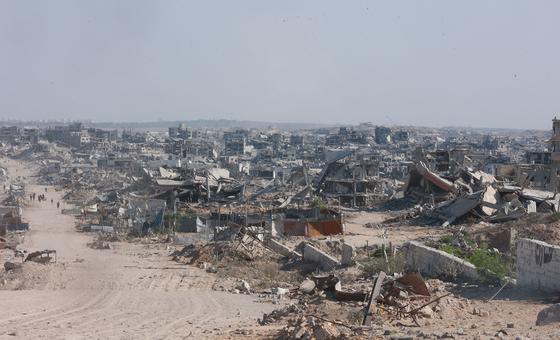
Since full-scale war erupted in Gaza following the Hamas-led attacks on southern Israel in October 2023, the physical damage in the Strip is estimated at $35.2 billion, with a further $22.7 billion in economic and social losses.
Entire sectors have been devastated, including housing, health, education, commerce, and agriculture.
Over 371,888 housing units have been destroyed or damaged, more than 50 per cent of hospitals are non-functional, and nearly all schools have been destroyed or damaged. The economy has contracted by 84 per cent.
Devastating human toll
The impact on the lives of Gazans is just as devastating: more than 60 per cent of the population having lost their homes and 1.9 million people displaced, often multiple times. Women, children, persons with disabilities, and those with pre-existing vulnerabilities bear the greatest burden.
Over two years of conflict has resulted in more than 71,000 Palestinian fatalities and over 171,000 injured, according to local authorities, with many still missing under the rubble.
Framework for reconstruction
The report provides the foundation for early recovery planning and reconstruction, stressing it must must run in parallel with humanitarian action to ensure an effective transition from emergency relief toward reconstruction at scale in both the Gaza Strip and West Bank.
The assessment is framed in line with Security Council adopted resolution 2803 (2025) of the US-backed Comprehensive Plan to End the Gaza Conflict, which welcomed establishment of the Board of Peace led by President Trump as a transitional administration to set the framework for redevelopment and authorised the mechanism to set up a temporary International Stabilisation Force (ISF).
The EU and UN emphasise that recovery and reconstruction should be Palestinian-led and should support the transition of governance to the Palestinian Authority, while advancing a durable political settlement based on the two-State solution.
Planning and implementation should be inclusive, transparent, and accountable, with particular attention to the needs of women, children, elderly, and persons with disabilities.
Conditions needed
The assessment recognises that a set of enabling conditions are essential for recovery, reconstruction, and implementation of the broader political framework:
- A sustained ceasefire and adequate security
- Unimpeded humanitarian access and immediate restoration of essential services
- Free movement of people, goods, and reconstruction materials, within and between Gaza and the West Bank, and a functional, transparent financial system
- Clear, accountable governance, including defined mandates and establishment of conditions for the transitional administrative bodies in coordination with the Palestinian Authority (PA)
- A credible pathway for the PA’s future governance across the entire Occupied Palestinian territory, including Gaza, the West Bank and East Jerusalem, is essential
- Debris clearance, explosive ordnance management, and resolution of housing, land, and property rights are prerequisites for reconstruction.
- The international community must mobilise resources in a targeted, sequenced, coordinated manner
- All obstacles to the deployment of expertise and equipment must be removed rapidly


