


Members of an Adivasi tribe photographed in India, 1969.
Eberhard Fischer
By tracing the career of the ethnographer and art historian Eberhard Fischer, a key figure at Zurich’s Rietberg Museum, the Indian filmmaker Amit Dutta sheds light on the tensions between ethnographic research, colonial legacy and the search for a fair perspective on India’s traditions.
When Eberhard Fischer takes the floor, visibly moved, after a special screening of Eberhard As Seen By Amit in early April at the Cinéma du Réel festival in Paris, he introduces its author, Amit Dutta, as an “independent Indian filmmaker” based in northern India, in the Himalayan mountains. He describes his long-time friend as a kind of modern hermit, something of a poet, and too prone to motion sickness to accompany his films to festivals. With a smile, Fischer notes that although he has often travelled to India, Dutta has never visited him in Switzerland.
In his hand he holds a few pages – copies of emails Dutta sent to him to present the film. “I make films to explore and capture a life that appeals to me. A life of education, diligence, self-control and intense focus,” Dutta writes in the emails. “That is what I saw when I worked with Eberhard Fischer on Nainsukh in 2010,” a film inspired by the life and work of the 18th-century Indian miniature painter.
The historian and the filmmaker
Born in Germany, Fischer has lived most of his life in Switzerland. He is deeply familiar with Indian art, to which he has devoted numerous books and exhibitions as director of Zurich’s Rietberg Museum, a post he held for 27 years.

The ethnographer and art historian Eberhard Fischer.
Courtesy of Amit Dutta
Before becoming an institutional figure, however, Fischer was a field researcher. From the 1960s onwards, he travelled across Africa and Asia, especially in India, focusing on ritual and traditional practices, with a particular interest in craftsmanship, such as pottery-making and weaving techniques. Together with his wife, Barbara Fischer, he regularly filmed these practices using a small camera. In recognition of his work, Fischer was awarded the prestigious Padma Shri by the Indian government in 2012.
He met Dutta through Nainsukh, a hybrid, quasi-essayistic film blending the painter’s life, his works and a vision of the spiritual and material world that surrounded him.
Originally conceived as a short film, the project took on a life of its own. The meeting between historian and filmmaker on the path traced by the painter’s life proved so fruitful that it led to a feature-length film – one that Dutta made deeply personal, fully integrating it into his own body of work.
Fischer’s role was to provide Dutta with a solid theoretical and historical foundation, as well as access, via the Rietberg Museum, to the painter’s works and research on Pahari painting. He became the film’s producer and even took part in the editing process.
An overview of Eberhard Fischer’s photographic documentation:

In 1969, Eberhard Fischer photographed a four-day funeral ritual in collaboration with the Indian artist and anthropologist Haku Shah.
Eberhard Fischer

The ritual took place in 1969 in Ranveri, a village in the southern part of the Indian state of Gujarat.
Eberhard Fischer

At the deceased’s home, on the final day of the ritual.
Eberhard Fischer

The entire photographic archive is held at the Rietberg Museum in Zurich.
Eberhard Fischer
Memory, words, singularity
Eberhard As Seen By Amit, the latest stage in this collaboration, is a composite film documenting a life of work. It draws on footage from Fischer’s many ethnographic films, alongside images shot by Dutta in India and more recent sequences filmed by Fischer himself at his residence in Switzerland.

The Indian filmmaker Amit Dutta.
Courtesy of Amit Dutta
The project originated with the filmmaker, but discussions were long and difficult. For years, the art historian refused to be the central subject of a film. It was only after the death of a colleague that both men realised how cinema can preserve memory, voice and a person’s individuality. Faced with this realisation, the project finally began in 2024.
Fischer recounts the story of their collaboration. After handing over copies of his entire archive, he recorded an interview lasting more than eight hours, in which he revisited in detail each of his many books, the ideas they develop and the works they discuss.
Once this material was in Dutta’s hands, Fischer stepped back, responding only to the filmmaker’s specific requests, such as asking him to film himself in everyday situations: working at his desk on a typewriter, tending his garden, or resting at Muzot Castle in the canton of Valais, where the poet Rainer Maria Rilke spent the final years of his life.
The result is a quiet, almost pastoral life unfolding with the seasons. Fischer says he tried to film it by imitating, as best he could, Dutta’s “style” and way of constructing scenes, as he had observed during the shooting of NainsukhExternal link.
Portrait of a friend
Reached by email, Dutta says he prefers to speak of “affinity” rather than imitation. “If there is any resemblance, it likely comes from simple, observable features such as a preference for long takes and walking shots, a way of composing images that allows time and space to unfold without interruption.”
That closeness reflects a deep friendship. The film feels first and foremost like a portrait of a friend, imbued with humour, tenderness and at times melancholy. But is it also the portrait of a filmmaker?
“One may consider him a filmmaker in his own right”, says Dutta. “His work shows discipline, attention and a sustained engagement with the act of looking.” Fischer has filmed all his life from an ethnographic perspective, and these images have mattered greatly to him. He says he accepted a lower salary to preserve his independence, allowing him to travel whenever he wished to meet India’s traditional artisans.

Pratibha Devisingh Patil, then President of India, presented Eberhard Fischer with the Padma Shri Award in New Delhi in 2012. It is India’s fourth-highest civilian honour.
Courtesy of Eberhard Fischer
One seen by the other
Dutta describes the films of Eberhard and Barbara as “born from a strictly documentary motivation. The emphasis is placed on precision, on recording the subject with fidelity and consideration. My own approach is more subjective as I try to allow subconscious impulses to guide the process.”
What stands out in Fischer – and what Dutta so admires – is his seriousness, his deep commitment to precise and nuanced knowledge of art that has too often been reduced in the West to “primitive arts,” lumping together artists from different places and periods. Fischer’s precision, both as an art historian and ethnographer, is a gesture of respect, and one that resonates with a central challenge facing cultural institutions today: the legacy of colonialism.
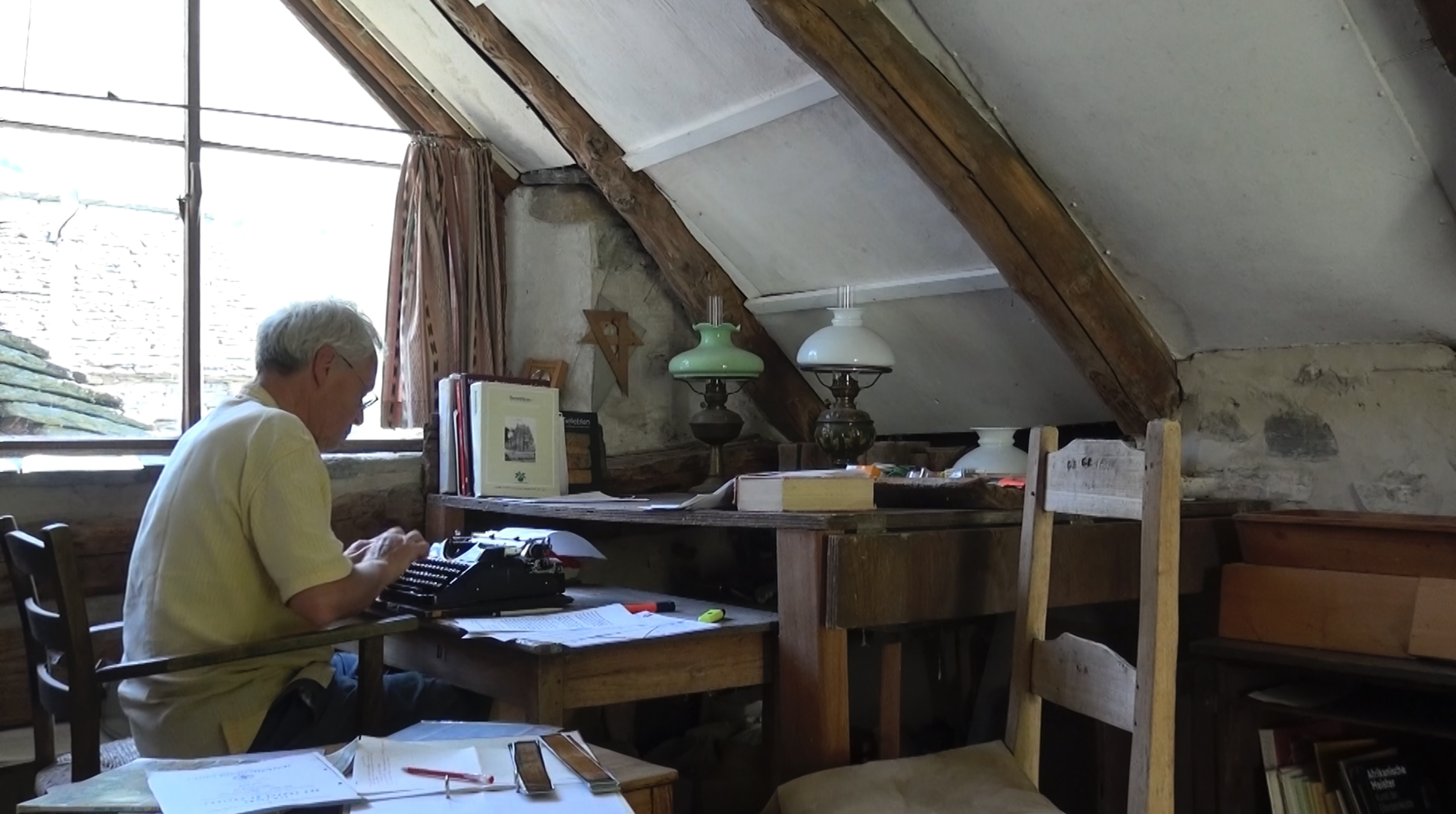
An still taken from the film “Eberhard as Seen by Amit”.
Amit Dutta
“His work reflects a sustained commitment to understanding, preserving and presenting these traditions with seriousness, goodwill and a strong ethical sense. That was one of the reasons why I collaborated with him over so many years.”
The passage from work to friendship, the affinity between two personalities, the process of mutual learning: this is what this simple film, with its direct title, conveys. No honorifics, no surnames, but just first names, one seen through the eyes of the other.
As the Nainsukh project took shape, Dutta wrote a kind of credo, cited by Fischer during the screening, which he described as the foundation of their collaboration and friendship. It ends with these words: “Through his eyes, I began to see my own heritage with a clarity and depth I never knew.”
Edited by Virginie Mangin/Eduardo Simantob. Adapted from French by Catherine Hickley/gw


