

Vlada Kharebova has been trying to renounce her Russian citizenship since 2022, without success so far.
Kharebova lives in Latvia and is seeking citizenship for herself and her two children there. But the Baltic nation generally does not allow dual citizenship in such cases: The law indicates dual Latvian-Russian citizenship is not permitted.
She has run into problems with the Russian consulate in Riga, which she said provides a list of required documents but little guidance on how to obtain them.
“When you call or write to the consulate, they say: ‘We don’t deal with this. Sorry, we can’t help,'” Kharebova told Current Time. Russia has also increased the fees for this process, now making it “a significantly high amount” for her to pay on her salary as a teacher.
Her daughter encountered an obstacle when the consulate refused to accept her application because she had not brought a copy of her college diploma from Russia. Kharebova said the requirement was not listed in the available instructions.
For Russians who live abroad who want to give up their Russian citizenship, be it for legal, bureaucratic, or moral reasons or a combination of factors, the process can take years. And it just got considerably more expensive, for those inside and outside Russia.
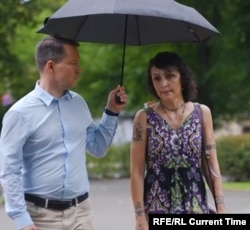
Vlada Kharebova speaks to Current Time correspondent Artyom Filatov. (Screengrab)
A new law that took effect on July 22 raised the state duty for renouncing citizenship from 4,200 rubles ($50) to 50,000 rubles ($592), while a separate government resolution raised the consular fee for applications submitted abroad from $130 to $1,200.
The increase piles another problem onto a process that applicants abroad say can be difficult to navigate.
Finnish resident Veronika Mikkonen said some documents required for the procedure are valid for only three months.
That can create a race against time, particularly when applicants struggle to secure an appointment at a Russian diplomatic mission — something that can also take months.
Mikkonen eventually succeeded in renouncing her citizenship but said preparing the documents cost her nearly 1,000 euros ($1,160) even though the consular fee at the time was 130 euros ($152).
Mikkonen suggested her decision was motivated by the Kremlin’s repression at home and the full-scale invasion of Ukraine, launched by President Vladimir Putin in February 2022.
“I just didn’t want to carry in my pocket the passport of a dictatorial country and a country that started a war,” she told Current Time.
Moscow Stopped Publishing Stats
The Russian Foreign Ministry has not published nationwide figures on citizenship renunciations since 2023. Its publicly reported figures show 4,356 people renounced Russian citizenship in 2019, 3,877 in 2020, 4,055 in 2021, and 4,306 in 2022, the first year of the full-scale war.
The ministry said the 2022 figure did not represent a significant change in the trend. In the first nine months of 2023, about 4,400 people renounced their citizenship, according to the head of the Foreign Ministry’s Consular Department.
Hundreds of thousands of Russians fled abroad after Putin announced a large-scale military mobilization in September 2022.
The absence of updated state statistics makes it difficult to determine whether the number of people seeking to give up their Russian citizenship has increased as the invasion continues with little sign of an end in sight.
But data from individual countries suggests that demand is significant.
Estonia registered 107 people having renounced Russian citizenship in 2024. By August 25, 2025, the figure for that year had already reached 126, according to the country’s Interior Ministry.
Estonia also reported persistent delays: The Russian Embassy in Tallinn stopped accepting new renunciation applications from late 2023 until February 2024 following the entry into force of a new Russian citizenship law.
After processing resumed, long lines remained because Russia had closed its consulates in the cities of Tartu and Narva and reduced staffing at the embassy in Tallinn.
Russian consulates in several other cities in Europe and elsewhere have been closed amid high tensions between Moscow and the West over the invasion of Ukraine and other issues.
Foreigners seeking Estonian citizenship through naturalization generally have to give up their existing citizenship. The delays at the Russian Embassy have therefore created a problem for people who need proof they are no longer Russian citizens before they can complete the naturalization process.
‘I Have Nothing To Do With Russia’
Russian law also places conditions on renunciation. Applicants must have another citizenship or a guarantee of its receipt, and renunciation can be denied if the applicant has outstanding taxes, fees, and fines or certain unresolved legal obligations.
For some applicants, the question is not whether they want to leave Russia but whether they can afford, navigate, and complete the process.
Madrid resident Aleksandr Smirnov, who obtained Spanish citizenship, told Current Time that he has tried without success to renounce his Russian citizenship.

Aleksandr Smirnov
After the fee increase, he said, he was unsure whether it would be worth continuing the process.
“I haven’t been to Russia for 10 years, I have nothing to do with Russia, I have no property or bank accounts there. I don’t need this citizenship,” he told Current Time.
“I would like to renounce it so that I have just one citizenship, of the country where I live. That’s logical. But my feeling is that their goal is to put obstacles in the way.”
Human rights activist Lev Ponomaryov agrees, saying he believes the Russian authorities are interested in making renunciation a procedure that is difficult to access.
“They don’t want there to be a large flow of people renouncing [their citizenship], so that it becomes a kind of information bomb that more and more people are giving up Russian citizenship,” he said.
